Offshore rigs: The missing piece in the Middle East risk narrative
Key highlights:
- Regional conflicts have led to increased insurance premiums and coverage issues for vessels supporting offshore drilling operations.
- High utilization of jackup rigs in the Middle East makes the region particularly vulnerable to disruptions in logistics and supply chains.
- Offshore activity in Israel and the Eastern Mediterranean faces delays and cost increases due to security concerns and regional escalation.
- The offshore market's recovery is now at risk, with execution, logistics and timing uncertainties becoming central concerns.
- Future offshore projects may be delayed or revalued depending on the persistence of regional tensions and maritime disruptions.
By Sofia Forestieri, Esgian
Since Feb. 28, 2026, escalating military tensions involving Iran, Israel and the US have injected fresh volatility into global energy markets. Oil prices have surged, key energy facilities have been attacked, and shipping through the Strait of Hormuz, which handles roughly 20% of global oil consumption and about 20% of global LNG trade, has slowed sharply as insurers, shipowners and operators reassess risk. Brent crude has responded accordingly.
On Feb. 27, Brent settled around $72.5/bbl. As of March 3, Brent is trading near $81/bbl, a gain of more than $8/bbl, or roughly 11%, in just two trading sessions as geopolitical risk has been rapidly repriced.
While much of the market focus has centered on oil prices and LNG disruptions, offshore drilling activity across the Middle East and Eastern Mediterranean is emerging as a key but under‑examined, exposure point.
The Middle East remains the largest jackup rig market globally. According to Esgian, there are currently 177 drilling jackups in the region (~36% of the global supply), of which 138 are actively drilling. This high utilization reflects more than just legacy activity. Offshore demand had been recovering across multiple countries, supported not only by Saudi Aramco’s latest multi‑rig jackup tender, but also by ongoing and upcoming rig requirements in Kuwait, the UAE, Saudi Arabia beyond Aramco, and Oman.
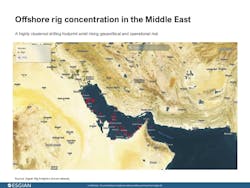
This concentration of activity also shapes how exposed offshore operations are to disruption. Offshore rigs are not standalone assets. Their ability to drill safely and continuously depends on a functioning logistics chain that includes platform supply vessels (PSVs), anchor‑handling tug supply vessels (AHTS), crew boats and helicopter services.
Since Feb. 28, this logistics ecosystem has come under increasing strain. War‑risk insurers have repriced or temporarily withdrawn coverage for vessels operating in the Arabian Gulf, with reported premium increases in the 25%-50% range, depending on vessel profile and exposure. In some cases, vessels have struggled to obtain coverage altogether.
The resulting pressure points include missed or delayed rig resupply windows, reduced flexibility in crew rotations, increased reliance on minimum‑manning and contingency planning. Importantly, these risks exist even where offshore rigs have not been physically damaged.
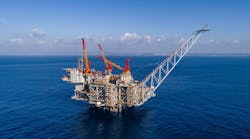
Beyond the Arabian Gulf, offshore activity in Israel and neighboring countries in the Eastern Mediterranean introduces another layer of uncertainty, and now beyond the jackup market. There are seven rigs across Israel, Egypt and Libya. The Santorini drillship is scheduled to commence a contract offshore Israel in mid‑April 2026, while several additional rig requirements in the region are expected to happen from mid-2026 onward. Continued regional escalation or prolonged security concerns could delay contract startups, push future rig requirements into 2027, and increase operational, insurance and mobilization costs.
The Middle East conflict is no longer only a story about crude prices, shipping lanes or isolated infrastructure strikes. It is increasingly an offshore operations and execution story, unfolding in a region that was already moving into a modest but broad‑based offshore recovery.
With 177 jackups currently positioned in the Middle East and 138 actively drilling, offshore activity is highly concentrated and operating with limited slack. At the same time, multiple rig requirements across Saudi Arabia, Kuwait, the UAE, Oman and Eastern Mediterranean were beginning to take shape, suggesting that offshore demand was set to increase beyond a single national oil company or tender cycle.
So far, offshore markets have absorbed the shock without a visible repricing of rig values or dayrates. But the balance of risks has shifted. Execution risk, logistics reliability and timing uncertainty are now central variables, particularly if regional tensions persist or maritime disruption becomes prolonged.
In that context, offshore outcomes may diverge. Some projects could be delayed, while others, especially rigs already operating in‑region, could see their strategic value increased by constrained mobility and tightening availability. Whether the current disruption proves temporary or structural, offshore drilling in the Middle East now sits squarely on the geopolitical fault line, just as activity had begun to recover.
Related content:
About the Author

Sofia Forestieri
Sofia Forestieri is a senior analyst at Esgian, specializing in offshore rig market analysis and energy economics. She has over seven years in the energy sector where she has in that time covered a diverse range of areas energy transition topics, economics modeling, rig market analysis and rig valuation, and energy sustainability issues. Forestieri previously held positions as an upstream Latin American analyst with Rystad Energy and senior field engineer-wireline with Schlumberger. She is also a member of Offshore's 2026 Editorial Advisory Board.
She can be reached at [email protected].