SolarDuck gets government grant for remote offshore, subsea power development
Why this news matters:
-
Targets a persistent offshore challenge: The concept addresses how to reliably power remote subsea infrastructure without long tieback cables or diesel generators—potentially reducing cost, complexity and emissions for subsea tiebacks, CCS and monitoring systems.
-
Signals a new offshore energy integration model: A floating, redeployable solar hub with storage could enable distributed offshore power systems, supporting both oil and gas and emerging applications like CCS and electrified subsea operations.
-
Moves offshore solar closer to deployment: The grant-funded MARIN testing program (hydrodynamics, wave response, structural loading) is a critical step toward validating offshore solar platforms under real conditions—helping de-risk future commercial projects.
This sidebar section was created with the help of generative AI tools and edited by our content team for clarity and accuracy.
Floating solar technology developer SolarDuck and the Maritime Research Institute Netherlands (MARIN) have secured a EUR3.2-million (US$3.64-million) grant for their Steady Seas research project from RVO, the Netherlands Enterprise Agency.
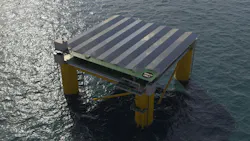
Their goal is to advance the foundational design of SolarDuck’s Offshore Floating Power & Utility Hub (OFPH) to provide power, communications and other utilities to remote offshore and subsea facilities.
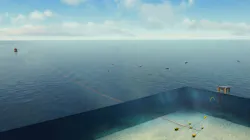
All can be expensive and complex to install, vulnerable to damage and carbon-intensive, according to SolarDuck.
The OFPH provides a redeployable offshore platform that generates renewable power where needed. It is also designed for continuous operations via its integrated energy storage and auxiliary systems.
This can potentially reduce the life-cycle costs of subsea tieback and CCS projects, the company added.
Steady Seas builds on the operational experience of SolarDuck’s DEI+ Merganser project in the Dutch North Sea. SolarDuck will lead the OFPH design and system integration, while MARIN performs hydrodynamic analysis, simulations and basin testing to confirm the platform’s behavior, reliability and wave response under "realistic" offshore conditions.
The next step would be demonstration projects with offshore industry partners in real, operational offshore conditions to power and control remote assets.
The joint program will also factor in experience with previous offshore solar pilots to strengthen the OFPH design for wide-ranging offshore applications.
“The technical challenges of powering assets far offshore are significant, from mooring and motion behavior to integration with subsea infrastructure," SolarDuck CTO Don Hoogendoorn said in a June 25 LinkedIn post by the company. “This program gives us the means to engineer and validate robust answers before the solution is deployed at sea.”
MARIN's William Otto added, “MARIN will investigate the impact of the topology on behavior and hydrodynamic coefficients, and it will assess the impact of extreme wave conditions on structural loading, including wave buildup beneath the platform. This kind of rigorous, test-driven validation is essential to bring offshore solar technology confidently toward commercial deployment.”
Source: Maritime Research Institute Netherlands - MARIN YouTube; Published: Aug. 26, 2025
Related content:
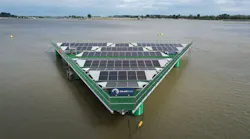 SolarDuck floating solar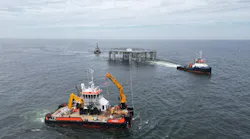
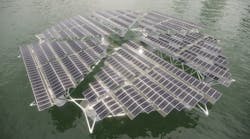 closeup of floating solar power plant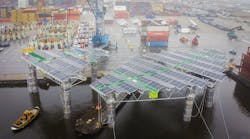
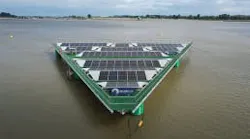 solarduck
About the Author
 Jeremy Beckman
Jeremy Beckman
Staff Writer / Editor, Europe
Jeremy Beckman has been Editor Europe, Offshore since 1992. Prior to joining Offshore he was a freelance journalist for eight years, working for a variety of electronics, computing and scientific journals in the UK. He regularly writes news columns on trends and events both in the NW Europe offshore region and globally. He also writes features on developments and technology in exploration and production.
Related
