Instrumentation for Baltica 2 monopiles fitted, tested ahead of tow to offshore site
Key highlights:
-
Early installation is the key differentiator: Structural monitoring systems are installed and fully verified at the fabrication yard stage, requiring them to remain operational through towing, handling and high-energy piling with no opportunity for offshore rework.
-
Harsh Baltic conditions elevate QA requirements: Cold temperatures and icing risk necessitate controlled curing environments and enhanced validation methods (e.g., dolly testing) to ensure long-term sensor reliability.
-
Integrated monitoring supports full life-cycle insight: The project combines pile driving, structural health and corrosion monitoring within one system, delivering continuous data from installation through operations to validate design assumptions and inform future offshore wind developments.
By Jeremy Beckman, Editor-Europe
Baltica 2, Poland’s second offshore wind farm development, has entered the offshore construction phase.
The project, a joint venture between Ørsted and Polish energy company PGE Polska Grupa Energetyczna, is located across a 190-sq-km area in the Baltic Sea, 40 km from the coast at its nearest point. It will feature 107 Siemens Gamesa 14-MW wind turbines generating up to 1.5 GW, which will be transmitted via four offshore substations to an onshore substation.
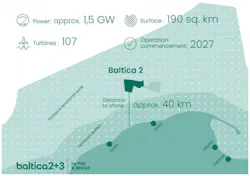
Van Oord has started installing the 111 monopiles for the foundations for the wind turbines and the four offshore substations, with Cadeler and Fred. Olsen Windcarrier managing installation of the turbines. The facilities should be fully commissioned by the end of next year.
Ørsted contracted Acteon’s UTEC Geo-Services business line to design, engineer, procure, install and commission the measurement and data acquisition systems for structural monitoring of the monopile foundations. UTEC has worked previously for Ørsted on multiple wind projects offshore Taiwan, the UK and Germany over the past six years, performing corrosion and anode monitoring of monopile and substation jacket substructures and other data provision services.
The Baltica 2 contract’s initial measuring scope covered load, corrosion, inclination and pile driving for the monopiles, and it was later expanded to include additional data analysis during pile driving.
“While all of these elements have been delivered by Acteon before, the overall solution is unique to this project,” Brian Taylor, global head of sales with UTEC Geo-services, told Offshore.
Regional and environmental factors are influencing how the monitoring technology will be deployed, added Carlos R. Huerta, installation and commissioning manager of structural monitoring. “But the single clearest differentiator between this campaign and numerous others the company has delivered for North Sea projects lies in the installation sequence the monitoring system must fit into," he said.
Early-stage instrumentation drives installation strategy
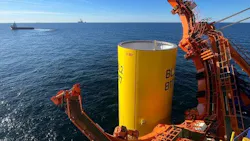
Huerta continued, “On Baltica 2, instrumentation is being installed earlier in the project life-cycle because the monopiles are fabricated, instrumented, sealed and prepared in the yard before they are floated and towed to site. Once that preparation and sealing process is complete, there is no practical opportunity to install or modify instrumentation later in the sequence.
“As a result, the monitoring system has to be fully installed, tested and verified at an earlier stage than is typical on many North Sea campaigns. From that point onward, the installed system will need to remain fully operational through everything that follows, including sealing, transportation in water, multiple handling stages, offshore lifting and ultimately high-energy piling.”
Another defining feature of this project is that the monopiles will be partially submerged, floated and towed long distances to the wind farm site with the monitoring equipment already in place, said John Hill, general manager of structural monitoring at UTEC.
“That means the installed system must withstand towing loads, mechanical handling and then the significant acceleration forces generated during hammer piling, without any opportunity for rework once offshore installation begins," Hill added. “Because the system is installed before towing and offshore works begin, Baltica 2 places a strong emphasis on getting the installation right first time and ensuring robustness from the outset. By comparison, on many North Sea projects Acteon has worked on the instrumentation may be installed later in the construction sequence or may pass through fewer pre-installation handling steps. This reduces the number of stages the installed system must pass through before it begins its long-term monitoring role.
While the delivery sequence differs, he mentioned that Acteon is applying the same core structural health monitoring technology on Baltica 2 as it does in the North Sea, so the monitoring approach and data remain consistent over the 25- to 30-year asset life.
Baltic conditions introduce curing and QA challenges
“In the Baltic, cold temperatures and the potential for icing can affect installation conditions during the onshore yard phase," Huerta explained.
Acteon’s sensors are installed using a non-intrusive adhesive-based method, and that adhesive must cure under controlled conditions to deliver a reliable long-term bond.
"In winter Baltic conditions, ambient temperatures alone are not sufficient to achieve this, so additional controls are required during installation," he continued. "This is why monopiles are being enclosed and heated internally during the yard phase, allowing sensors to be installed and commissioned under suitable conditions before the monopiles are sealed and prepared for towing."
Because instrumentation is installed before the monopiles are floated and towed, verification becomes critical at this stage, Huerta added. Once the monopiles leave the yard, the sensors will be carried through transportation, handling and piling with no opportunity for rework. Therefore, Acteon is applying dolly testing alongside sensor installation, installing test samples under the same environmental conditions and pull-testing them over time to confirm adhesive strength development before the monopiles are moved offshore.
"While this quality assurance [QA] process is used across Acteon’s projects globally, on Baltica 2 it is being carried out under colder ambient conditions and ahead of extended towing and handling, which increases its importance in the overall delivery sequence," Huerta said. “But overall, this campaign is following the same established data management framework used on Acteon’s North Sea projects and is aligned with Ørsted’s specifications, ensuring continuity in how data is delivered and interpreted.”
Front-loading installation assurance and validation
“Although Baltica 2 is still in the delivery phase,” said Sandip Ukani, global technology systems and IT director at UTEC Monitoring, “the project is already illustrating the practical value of front-loading installation assurance when monitoring equipment must be installed early and then carried through a complex logistics chain without further access. Controlled installation environments and quantified dolly testing are providing measurable evidence, before the monopiles leave the yard, that the monitoring system has achieved the required integrity to withstand towing, handling and piling."
Ukani continued, “The campaign also stands out for the breadth and integration of its monitoring scope, combining pile drive monitoring, long-term structural health monitoring, and corrosion and anode efficiency measurement within a single coordinated program. By integrating these elements, the monitoring system supports validation of structural behavior not only during operation but throughout installation and early life. As the project progresses, the data will support confirmation of behavior against design assumptions and inform future design, construction and life-cycle performance decisions across offshore wind projects.”
Delivery of the Baltica 2 workscope draws on UTEC’s full capabilities, Taylor added, from design and engineering through to build and manufacture, logistics, delivery across numerous yards and offshore locations, and digital connectivity. “In support, we are also engaging Acteon’s engineering consultancy, 2H, to provide some data analysis as part of an extended pile drive monitoring scope,” Ukani said.
As for the local offshore environment, currents and seabed conditions, “this campaign does not rely on pre-existing knowledge supplied by the client, other than the design information required for us to develop and install our monitoring solution," he added.
The system is designed around the pile and wind turbine, rather than any soil or other geological information. UTEC has been contracted to provide the measurement systems, ensuring that the data is captured and safely transmitted to Ørsted’s data team. However, Acteon has had previous experience in working in locations with similar conditions, he added.
“This particular scope,” Ukani explained, “comprises designing, specifying, procuring, integrating and commissioning the monitoring system based on Ørsted’s requirements. We manage all elements of the supply chain and deliver a turnkey solution. Load and acceleration will be measured as part of the pile installation process, which is governed by the Ørsted schedule. The sensors will continue to provide data for the life of the wind farm.”
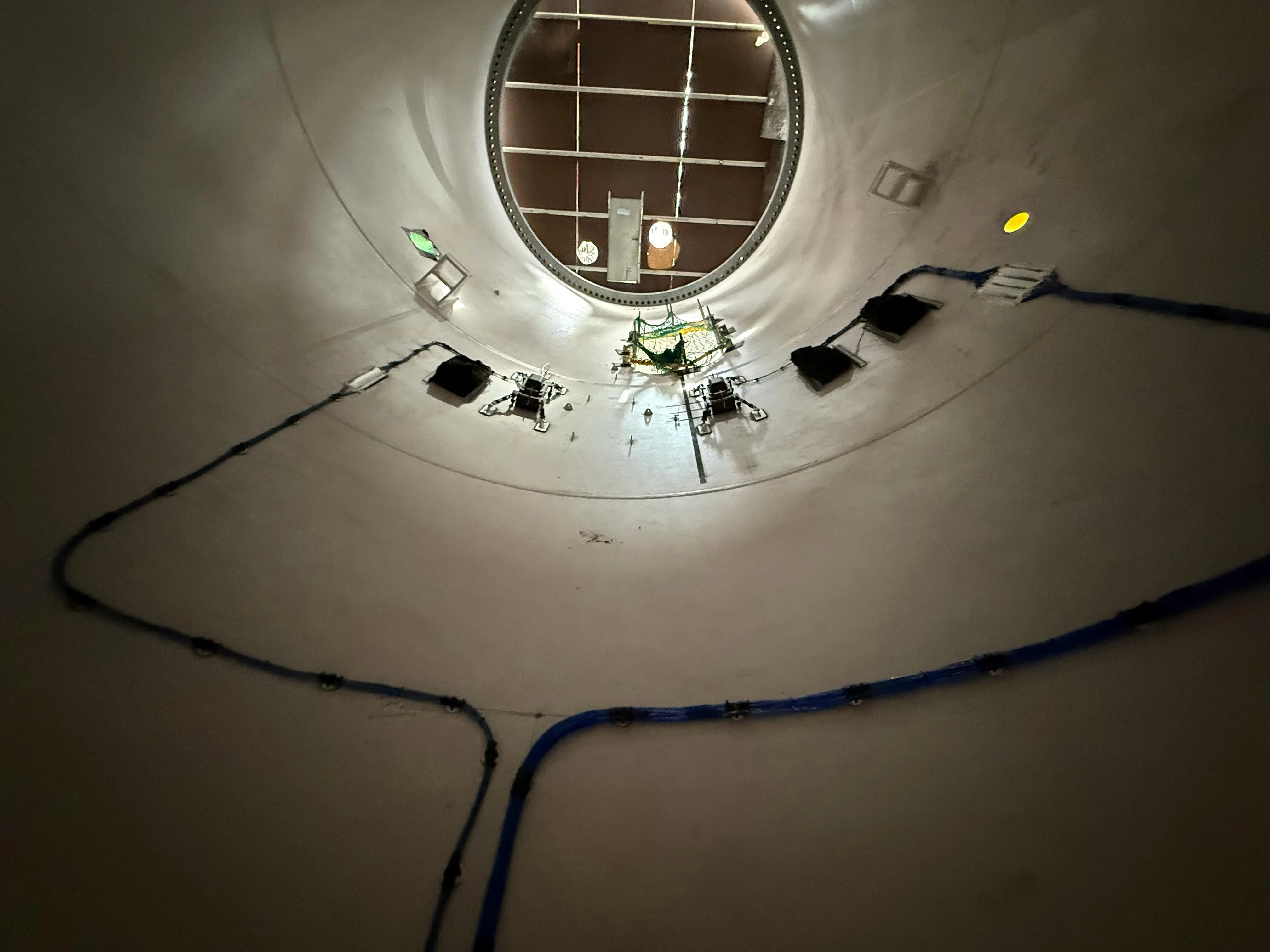
Monitoring/analysis also extends to settlement, corrosion and anode efficiency, with the data integrated in real time through Acteon’s NX2 digital platform to provide Ørsted with information on structural integrity.
“The NX2 digital platform comprises multiple hardware and software elements,” Hill explained. “This scope includes hardware for measuring structural loads, as well as ongoing corrosion and anode efficiency. Data will be collected in three stages.
“The first stage involves monopile corrosion and anode efficiency monitoring, drawing on the NX2’s ultra-low-power data management and transfer capabilities. Following the installation of the Suspended Internal Platform piece, monitoring will continue for corrosion and anode efficiency. Finally, once the turbine is installed, the system will also monitor loads and inclinations. It will be connected to the local electricity supply, with network links back to the client’s data center, providing the client with a full scope of monitoring data for the life of the field.”
About the Author
 Jeremy Beckman
Jeremy Beckman
Staff Writer / Editor, Europe
Jeremy Beckman has been Editor Europe, Offshore since 1992. Prior to joining Offshore he was a freelance journalist for eight years, working for a variety of electronics, computing and scientific journals in the UK. He regularly writes news columns on trends and events both in the NW Europe offshore region and globally. He also writes features on developments and technology in exploration and production.
Related
