Shell adds production in deepwater Gulf as Phase 3 Silvertip comes online

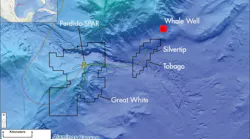
Shell Offshore Inc. has announced the start of production at Phase 3 of the Silvertip project in the Alaminos Canyon area, which is now delivering production from two new wells to the Perdido spar.
The Silvertip field, specifically the Silvertip Frio reservoir targeted by Phase 3, is located in Alaminos Canyon block 815, in roughly 9,000-plus feet of water. It has employed a subsea tieback into existing infrastructure that feeds the Perdido spar, which itself sits in nearby Alaminos Canyon block 857, about 200 miles south of Galveston, Texas, in approximately 8,000 feet of water).
This tieback fits Shell’s strategy of maximizing existing deepwater hubs with efficient subsea tiebacks rather than building new host facilities.
The two new wells are expected to collectively produce up to 6,000 barrels of oil equivalent per day (boe/d) at peak rates.
“By adding new production through existing Perdido infrastructure, we can safely deliver more value and optimize the life of a world-class asset,” said Colette Hirstius, Shell’s Executive Vice President for GoA and Shell USA President. “This is further proof of how we are making the most out of our assets in the GoA, helping to provide secure energy from one of the most competitive deep-water basins in the world.”
The current estimated recoverable resource volumes of Phase 3 Silvertip are 17 million boe. The estimate of resource volumes is currently classified as 2P under the Society of Petroleum Engineers’ Resource Classification System.
Perdido has been in production since 2010 and is one of the deepest spar facilities in the world.
Tieback strategy
Recent US Gulf of Mexico subsea tiebacks have become a dominant development model. Operators are favoring them to add production faster and at lower cost by connecting new wells to existing hubs instead of building new platforms.
Other Gulf operators are advancing similar tieback plans. Murphy has sanctioned or is advancing smaller tiebacks (e.g., String Music, Banjo, Cello) to Delta House. LLOG has additional packages such as Buckskin South. Shell continues to market capacity on its ~13 host facilities for third-party or its own tiebacks.
Industry commentary has highlighted the advantages: shorter cycle times, lower capex, reduced emissions from using existing infrastructure, and the ability to monetize smaller or more distant discoveries. Many 2024–2026 startups in the basin have followed this pattern.
Tiebacks typically deliver lower-cost barrels with faster payback than greenfield hubs. Chevron’s Ballymore and bp’s Argos/Atlantis expansions were cited as strong examples of schedule and cost performance.
Common distances are a few miles out to 20-plus miles; the industry is pushing longer step-outs (toward 50–100 km) with better flow assurance, subsea boosting, and HIPPS systems.
The growth of the tieback strategy is also enabling older platforms to remain in service. Mature facilities such as Perdido, Olympus/Mars, Blind Faith, Atlantis, and Who Dat are being extended well into the 2030s. New hubs, such as bp’s Tiber-Guadalupe, targeting 2030, are also being designed with future tieback capacity in mind.
Multiple additional tiebacks are expected through 2026–2028. The model supports both major operators maximizing existing assets and independents (Beacon, LLOG, etc.) bringing discoveries online with lower risk. Shell’s Silvertip Phase 3 announcement fits squarely into this ongoing pattern of infrastructure-led, capital-efficient growth in the deepwater Gulf.
About the Author
 Bruce Beaubouef
Senior Lead Reporter / Managing Editor
Bruce Beaubouef is Managing Editor for Offshore magazine. In that capacity, he plans and oversees content for the magazine; writes features on technologies and trends for the magazine; writes news updates for the website; creates and moderates topical webinars; and creates videos that focus on offshore oil and gas and renewable energies. Beaubouef has been in the oil and gas trade media for 25 years, starting out as Editor of Hart’s Pipeline Digest in 1998. From there, he went on to serve as Associate Editor for Pipe Line and Gas Industry for Gulf Publishing for four years before rejoining Hart Publications as Editor of PipeLine and Gas Technology in 2003. He joined Offshore magazine as Managing Editor in 2010, at that time owned by PennWell Corp. Beaubouef earned his Ph.D. at the University of Houston in 1997, and his dissertation was published in book form by Texas A&M University Press in September 2007 as The Strategic Petroleum Reserve: U.S. Energy Security and Oil Politics, 1975-2005.
Related