OTC 2026: Panel delivers insights on subsea tiebacks
Industry experts gathered at the Offshore Technology Conference (OTC) on Monday, May 4, for a compelling panel discussion on subsea tiebacks, one of the offshore sector’s most effective strategies for increasing output while minimizing capital expenditure, operational risks, and environmental impact.
Moderated by Art Schroeder, President of Energy Valley Inc., the session – “Subsea Tiebacks, Increased Production, Lower Costs & Risks, Greater Optionality” – drew on real-world operator, contractor, and analyst perspectives to highlight why tiebacks have become the preferred development concept in today’s capital-constrained environment. Subsea tiebacks not only significantly reduce capex – often by hundreds of millions of dollars compared to a standalone development — but they also reduce the time to first oil, and reduce project and construction-related emissions — while extending the economic life of aging hosts by spreading fixed costs over additional barrels. Additional production can keep facilities running longer, improve utilization rates, and unlock reserves that would otherwise remain stranded.
A recurring theme was the carbon advantage. By maximizing existing hosts, tiebacks avoid the steel tonnage, fabrication emissions, and installation impacts of new platforms. Keeping facilities full longer amortizes their embedded carbon over more production, supporting industry goals for lower-intensity barrels. Schroeder, drawing on his extensive background in subsea innovation (including work on extended tieback technologies), noted that this approach aligns capital discipline with sustainability objectives.
Market context and economics
Einar Michel, Senior Analyst and Offshore Vessel Product Manager at Rystad Energy, provided a data-driven overview of market trends. He noted that in the US Gulf of Mexico, a significant portion of recent field developments relied on tiebacks to existing floating production units. This strategy has helped offset natural decline without requiring massive newbuild investments amid flat demand forecasts, political uncertainty, and rising costs.
Michel highlighted how tiebacks deliver shorter cycle times and better economics, with many projects achieving breakevens well below $40 per barrel. “All offshore regions will have an increasing number of tiebacks…but particularly in Europe, which will see a 20% increase out to 2030,” Michel said. The Middle East and Asia will also see increases. “Subsea tiebacks are easier to sanction in our current uncertain price environment.” He added that “Subsea tieback awards will keep growing out to 2030, and this will also drive subsea tree demand,” although North America is expected to see a slight decline in 2029–2030.
Operator perspectives
Katie Pelliccio, General Manager of Facilities Engineering at Chevron Angola (with deep experience in Chevron’s US Gulf projects), underscored the value of the tieback strategy. Chevron’s Ballymore project, which achieved first oil in April 2025, exemplified this: three wells tied back just three miles to the existing Blind Faith facility, delivering up to 75,000 gross barrels of oil per day without a new platform. The project came in on time and on budget, contributing to Chevron’s goal of 300,000 net boe/d from the Gulf. Pelliccio stressed that tiebacks lower development costs, accelerate timelines, and reduce the overall project and production footprint. Pelliccio noted that Chevron is also emphasizing “disciplined capital expenditures and cost management.” She described subsea tiebacks as “a strategic growth engine. They make offshore E&P more competitive. They bring first oil faster.” Pelliccio underscored the importance of a “hubs approach,” which emphasizes subsea tiebacks to existing platforms and processing facilities. Chevron plans to pursue this strategy in the US Gulf, West Africa, Eastern Mediterranean, and Australia.
Maggie Sheridan, Manager of Operations Engineering at Murphy Oil Corp., shared insights from the company’s Kings Quay hub and associated Khaleesi, Mormont, and Samurai tiebacks. First oil in 2022 demonstrated how a purpose-built floating production system could serve as a host for multiple fields, with ongoing tieback activity and expansions planned for years. Sheridan discussed operational lessons on maintaining system integrity, managing production handling across partners, and continuous improvements in subsea infrastructure. Sheridan noted her company’s move toward subsea tiebacks. “They are faster, and bring lower-cost barrels.” In the “Gulf of America,” she said, “volumes are decreasing, while time to market is increasing.” Subsea tiebacks can help alleviate those trends. “There is available capacity at these deepwater facilities,” she added.
Don Craig, Subsea Technology Manager at BP America, and Sandeep Patini, Subsea Team Lead at Shell, brought supermajor viewpoints. BP has successfully executed multiple tiebacks in the Gulf, including recent expansions at Argos and Atlantis, adding meaningful production with minimal new infrastructure. Craig highlighted technical advances that have enabled safer, longer-distance connections. Craig noted that six of BP’s ten global offshore projects were subsea tiebacks. “Subsea tiebacks are not just an option anymore. They are a primary lever for delivering offshore production.” Patini noted that Shell currently has 13 host facilities in the US Gulf of Mexico and that his company remains open to subsea tiebacks to these facilities. The key rationale, he said, is “lower investment, faster cycle time, and lower emissions. Subsea tiebacks are one of the most attractive investments in deepwater.”
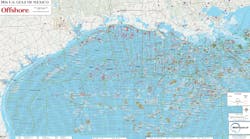 Gulf of Mexico map 2026
Contractor perspective
Michael Ellis, Country Technology Manager – Gulf of Mexico Region at Subsea7, provided the installation and EPCI perspective. Subsea7 has delivered numerous tieback contracts in the Gulf, as well as recent flowline and umbilical installations. Ellis addressed the push toward ever-longer tiebacks—now routinely exceeding 20-50 km and targeting 100 km with enabling technologies. Key challenges include flow assurance for viscous fluids, high-pressure management, hydrate formation, and maintaining integrity over distance. Innovations in subsea boosting, compression, drag-reducing agents (DRA), and advanced materials are extending reach while controlling costs. Ellis said the cumulative positives for subsea tiebacks are gaining momentum. “You can move quickly to first oil. You can enable smaller and marginal fields to move to production. You can bundle small fields together and move them to production. Tiebacks are a low-risk, field-proven solution.”
He did issue a note of concern for the industry: declining global R&D funding. “We’ve got to find a way to invest in new technologies, apart from the project cycle,” to keep offshore resources competitive.
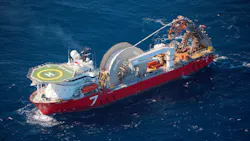
 DeepOcean pipeline inspection
Looking ahead
Panelists agreed that tiebacks offer greater operational flexibility—phased developments, easier repurposing of assets, and the ability to tie in marginal fields. As distances grow and fluid complexities increase, continued investment in subsea processing, power transmission, and digital monitoring will be essential.
Offshore is an official media partner of OTC 2026.
 OTC 2026 Opening Ceremony
About the Author
 Bruce Beaubouef
Bruce Beaubouef
Senior Lead Reporter / Managing Editor
Bruce Beaubouef is Managing Editor for Offshore magazine. In that capacity, he plans and oversees content for the magazine; writes features on technologies and trends for the magazine; writes news updates for the website; creates and moderates topical webinars; and creates videos that focus on offshore oil and gas and renewable energies. Beaubouef has been in the oil and gas trade media for 25 years, starting out as Editor of Hart’s Pipeline Digest in 1998. From there, he went on to serve as Associate Editor for Pipe Line and Gas Industry for Gulf Publishing for four years before rejoining Hart Publications as Editor of PipeLine and Gas Technology in 2003. He joined Offshore magazine as Managing Editor in 2010, at that time owned by PennWell Corp. Beaubouef earned his Ph.D. at the University of Houston in 1997, and his dissertation was published in book form by Texas A&M University Press in September 2007 as The Strategic Petroleum Reserve: U.S. Energy Security and Oil Politics, 1975-2005.