ADIPEC 2026: Middle East offshore operators face a prolonged equipment squeeze
Key highlights:
-
Offshore equipment shortages are becoming a long-term operational risk in the Middle East, with shipping disruptions, rising costs and constrained cargo carrying unit availability affecting drilling and development campaigns.
-
Improved equipment visibility, fleet tracking and earlier project planning will be critical to supporting ADNOC, QatarEnergy and other offshore expansion programs as regional activity accelerates.
By Chris Kleinhans, OEG Middle East
Daily transits through the Strait of Hormuz have fallen by more than 90% since the Middle East conflict began in February, regularly dropping into single figures, according to Kpler ship-tracking data reported by Reuters. Offshore work in the UAE and Saudi Arabia is still moving forward, but getting equipment to it has become a set of problems that feed each other, almost all rooted in the supply chain.
With the Bab el-Mandeb also disrupted, some ports have opened and closed at such short notice that a vessel bound for Sohar can end up in the Gulf of Aqaba, while airspace closures and security concerns have disrupted international crew rotations.
Costs have followed, with offshore paint now about 20 times its previous price and shipping a single flat rack up from about US$900 in January to roughly US$15,000.
With many rates fixed in five-year contracts agreed in 2023, suppliers have so far absorbed much of this increase to keep committed mobilizations on track, but that is a compromise that can only go on for so long.
oil and gas operations offshore EgyptAs the six-day Suez Canal blockage of 2021 showed, disruption outlasts its cause. So, operators should expect six to 12 months of knock-on impacts, felt most in peak campaigns that, unlike mobilizations, are rarely planned at tender stage.
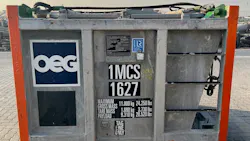
Cargo carrying units look ubiquitous, yet campaigns across the region often overlap, and a shortfall of a few hundred cuttings skips can hold up a drilling program as surely as a missing drillbit.
Equipment shortages become a long-term offshore challenge
Building more is slower than it looks, because even a type-approved factory needs around two months to produce 500 certified units, and with most built in China and specialist equipment in Europe, every new build faces the same uncertain routes. Our answer has been to adapt proven designs to the materials and fabricators available within the region, in line with each Gulf state’s in-country value rules.
Demobilization needs equal attention. In July, one major customer returned 1,000 units during summer working restrictions. Knowing that half OEG's regional fleet sits in two equipment types meant returns could be staged alongside dispatches, while cool rooms, air-conditioned forklifts and a 15-minutes-on, 15-minutes-off rota kept crews safe through about 1,700 movements without an HSE incident.
Improving visibility and planning across offshore supply chains
Visibility is the next gap to close, particularly at shared cleaning yards where identical units from several contractors arrive together and lose their link to the right client. A dedicated coordinator matching unit numbers to customers has solved much of that, and GPS tracking (now on 600 units for one oilfield services customer) will add each unit’s status to its location.
Standard units give crews certainty wherever they were built, but regional practice can expose gaps.
In Qatar, steel pallets were being used for offshore lifts until a bespoke DNV-certified pallet basket replaced them. After 400 were delivered, the operator adopted the design as its standard for offshore lifts.
Looking ahead, the market has also changed shape: the old cycle of drilling followed by production, around which offshore fleets were built, is giving way to projects that respond quickly to shifting priorities, leaving some designs short just as a global shortage of several cargo carrying unit types develops.
With significant disruption expected at peak campaign times, the earlier suppliers can see a customer’s horizon, the better they can make sure operationally critical equipment is there when needed.
aging offshore assets
offshore oil and gas platformWith ADNOC’s offshore expansion and Qatar’s North Field program pointing to an execution peak later this decade, suppliers need as much as 36 months’ visibility from national oil companies, oilfield service majors and EPC contractors.
Combined with longer, infrastructure-style agreements, which remain rare in the Middle East, that visibility lets suppliers invest ahead of demand and deliver the right technical solutions at competitive rates.
The disruption facing the Gulf’s offshore sector will not disappear when shipping routes reopen, but neither will the growth behind it. Those who treat equipment availability as a strategic decision rather than a last-minute logistics task will be best placed to deliver the region’s next wave of offshore work on schedule.
ADIPEC 2026:
Offshore is an official media partner of ADIPEC.
The event is taking place this week, Nov. 2-5, in Abu Dhabi. For more information about this article's topic, visit OEG at the show in Hall 8 at booth 8454.
Missed the event last year?
We've got you covered: ADIPEC 2025 Special Report
About the Author
Chris KleinhansChris Kleinhans
As regional director for OEG Middle East, Chris Kleinhans oversees its evolution in the region, introducing new services and products that drive regional growth aligned with the group strategy. He brings a wealth of knowledge of the Middle East market, including 15 years of equipment rental expertise across multiple segments, six concentrating on Qatar and the Eastern province of the Kingdom of Saudi Arabia. His experience in the provision of niche and specialized mechanical and non-mechanical equipment spans key sectors including oil and gas, construction and infrastructure. Prior to OEG, he held a key role within Ferguson Seacabs, from October 2016 until the company was acquired by OEG in 2020.