ONS 2026: Aging offshore assets heighten concerns over spare-parts availability
Key highlights:
-
Aging offshore assets are driving greater interest in on-demand manufacturing as operators seek alternatives to long lead times, discontinued components and growing spare-parts obsolescence challenges.
-
Industry acceptance is increasing as qualification frameworks and standards mature, enabling operators to source certified replacement parts while supporting asset life extension and supply chain resilience.
As offshore operators continue to extend the lives of producing assets, securing replacement components for aging equipment is becoming an increasingly complex challenge. From mature North Sea platforms to long-life floating production facilities, many assets remain in service years beyond their original design life, often relying on equipment whose original manufacturers no longer produce replacement parts.

"Obsolescence has become an increasing operational risk due to aging assets and infrastructure," Appleton told Offshore. "Many of these assets are running past their original design life, and the OEMs who built the original components have often discontinued the parts, changed ownership or exited the business."
Historically, operators have addressed the issue by maintaining large inventories of spare parts or accepting lengthy lead times when components need replacement. Neither approach is ideal in an industry where equipment reliability and production uptime can directly affect project economics.
"Operators are looking for more reliable, faster ways to secure legacy parts, while OEMs are seeing on-demand manufacturing as a way to continue supporting equipment they can no longer produce economically through traditional channels," Appleton said.
 offshore oil and gas platform
Targeting hard-to-source components
The growing interest in on-demand manufacturing is centered primarily on low-volume components that are difficult to obtain through conventional supply chains. These parts may be critical to operations but no longer justify large-scale production runs.
"Adoption is concentrated mainly on low-volume, high-criticality, long lead time components that sit outside an OEM's active production line," Appleton explained. "This includes housings, impellers, valves and pump components, for example, where the original supply chain for the part has been discontinued."
Instead of stocking physical inventory, operators and OEMs can maintain digital records of qualified components and manufacture them when required through additive manufacturing or conventional production methods.
Qualification remains critical
For offshore operators, however, speed alone is not enough. Any replacement component must meet the same quality, traceability and performance requirements expected of conventionally manufactured parts.
Appleton said operators should expect "full material traceability in line with EN10204 3.1 or 3.2 certification, as well as mechanical and dimensional verification against the OEM specification." He added that industry standards such as API requirements continue to apply regardless of the manufacturing method used.
Classification societies have also played an important role in advancing adoption.
"DNV's additive manufacturing standard, DNV-ST-B203, has given operators, class surveyors and manufacturers a shared reference point for qualifying both the additive manufacturing process and the part," Appleton said. "This has helped build credibility within the industry."
Reducing lead times and downtime
One of the strongest arguments for on-demand manufacturing is its potential to shorten procurement cycles and minimize operational disruptions.
"The clearest benefit of on-demand manufacturing is the shortened lead time," Appleton said. "A digital inventory approach means the design and qualification work happens once, up front."
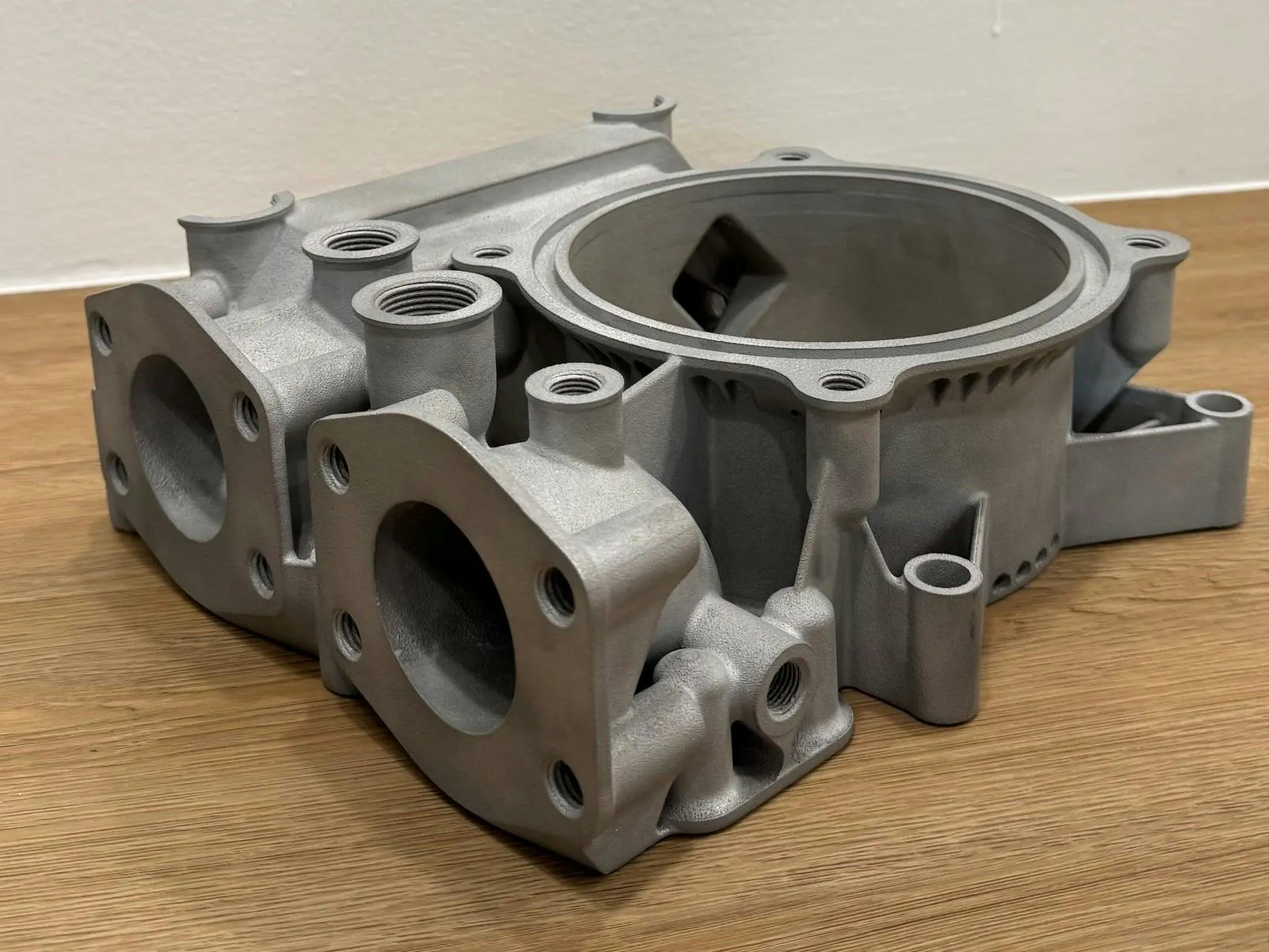
As an example, he described a steering gear hydraulic valve block with an integrated heat exchanger that was redesigned using additive manufacturing. The original assembly weighed about 45 kg and consisted of multiple components connected by tubing and fittings.
Using laser powder bed fusion and stainless steel 316L, the design was consolidated into a single component weighing 6.3 kg, representing an 85% reduction in weight. The part was produced with a lead time of three weeks while also improving reliability and simplifying installation.
Looking beyond today's aging assets
Appleton expects on-demand manufacturing to become increasingly integrated into offshore supply chain strategies over the next decade, particularly as operators seek more resilient approaches to maintaining aging infrastructure.
"Over the next five to 10 years, I expect on-demand manufacturing to become a standard procurement process for the offshore supply chain," he said. "On-demand manufacturing is not replacing OEM supply but sitting alongside it as the answer for manufacturing legacy parts that OEMs can no longer economically support."
Among offshore asset types, Appleton sees particular opportunity within floating production facilities because of their long operating lives.
"Floating production assets are seeing some of the strongest early benefits," he said. "With an increasingly aging asset base, the demand for legacy parts will continue to grow."
As offshore operators continue balancing asset life extension, cost management and operational reliability, on-demand manufacturing could become an increasingly important tool for keeping critical equipment running long after traditional supply chains have moved on.
Pelagus COO Henry Appleton will be visiting the ONS 2026 event next week in Stavanger, Norway. He can be contacted at [email protected].
Offshore is an official media partner of ONS 2026.
Additional ONS 2026 features:
About the Author
 Ariana Hurtado
Ariana Hurtado
Editor-in-Chief
With more than a decade of copy editing, project management and journalism experience, Ariana Hurtado is a seasoned managing editor born and raised in the energy capital of the world—Houston, Texas. She currently serves as editor-in-chief of Offshore, overseeing the editorial team, its content and the brand's growth from a digital perspective.
Utilizing her editorial expertise, she manages digital media for the Offshore team. She also helps create and oversee new special industry reports and revolutionizes existing supplements, while also contributing content to Offshore's magazine, newsletters and website as a copy editor and writer.
Prior to her current role, she served as Offshore's editor and director of special reports from April 2022 to December 2024. Before joining Offshore, she served as senior managing editor of publications with Hart Energy. Prior to her nearly nine years with Hart, she worked on the copy desk as a news editor at the Houston Chronicle.
She graduated magna cum laude with a bachelor's degree in journalism from the University of Houston.