bp, Shell reportedly seeking US licenses for Caribbean gas fields
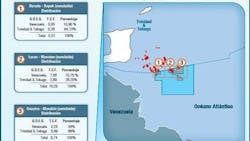
Shell and bp are seeking US licenses to extract natural gas from fields that lay in cross-border areas offshore Trinidad and Tobago and Venezuela, according to a recent Reuters report.
The report cited comments made by Roodal Moonilal, the energy minister for Trinidad and Tobago. Moonilal spoke with reporters on the sidelines of the recent Indian Energy Week conference, according to Reuters.
Trinidad is Latin America’s largest liquefied natural gas exporter and one of the world’s largest exporters of ammonia, methanol, and petrochemical products – which need natural gas for the refining process. The Caribbean Island has been aiming to develop offshore fields in Venezuela and on the maritime border to counter its declining gas reserves and secure supply.
Its gas projects have progressed slowly in recent years amid frequent US policy changes towards Venezuela.
Last year, under President Nicolas Maduro, Venezuela suspended energy development cooperation with Trinidad and Tobago, including a number of joint natural gas development projects.
But following its capture of Maduro, the US is reportedly accelerating developments in the country’s oil and gas sector. US licenses are needed for companies to develop the projects due to American sanctions on Venezuela’s energy industry.
Shell is reportedly seeking a license to develop the offshore Loran-Manatee discovery, Moonilal told reporters. The field, located some 100 km offshore in the Atlantic Ocean, spans the maritime boundary between Venezuela and Trinidad and Tobago. It is estimated to hold some 10 trillion cubic feet of natural gas, with 7.3 Tcf on Venezuela’s side and the remaining 2.7 Tcf in Trinidad’s offshore territory.
The Loran-Manatee field is located in 91 meters (299 feet) of water, and the development will reportedly involve a normally unattended installation platform, with gas transported to the Beachfield gas processing facility.
Meanwhile, bp is reportedly seeking a license to develop the offshore Cocuina-Manakin field, Moonilal added. The Cocuina-Manakin field is a cross-border natural gas play located approximately 68 miles (110 km) off the southeast coast of Trinidad, straddling the maritime boundary between Venezuela and Trinidad and Tobago.
The Cocuina portion of the field is on the Venezuelan side and Manakin portion of the field is on the Trinidadian side. The field’s Venezuelan portion belongs to the idled gas offshore project Plataforma Deltana which has 1 trillion cubic feet of proven gas reserves.
bp and its partner National Gas Company of Trinidad and Tobago (NGC) received a license from Venezuela last year to develop the Cocuina gas discovery. bp also holds a working interest in and operatorship of the Manakin field, which sits on the Trinidad side of the maritime border.
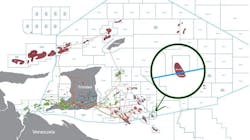
In addition to these potential offshore projects, there is also the Dragon gas field offshore Venezuela, close to the maritime border. Last October, American regulators authorized Shell and Trinidad and Tobago to develop the Dragon gas field, a project aimed at supplying Trinidad with Venezuelan gas.
Moonilal said he hopes to see production start on the Dragon gas field in the fourth quarter of 2027, and expects that it will produce 350 million cubic feet of gas per day. The Dragon field is said to hold one of the largest deposits of natural gas in Venezuela.
With its projects back on track, Trinidad hopes to lead and co-operate with other Caribbean nations such as Suriname, Guyana, and Grenada to develop natural gas, Moonilal said.
“There is emerging now a new Caribbean energy landscape, of which Trinidad and Tobago can position itself as a leader,” Moonilal was quoted as saying in the Reuters report.
Meanwhile, Venezuela’s acting president, Delcy Eloína Rodríguez Gómez, has signed into law a bill making significant changes to the country’s oil sector after pressure from the US to open it up to foreign private investment.
The new hydrocarbons law promises to give private companies control over oil production and sales, ease taxes and allow for independent arbitration of disputes, while largely maintaining state control over oil production.
As reported by The Guardian, analysts remain cautious about the law’s practical application, arguing that the text lacks clarity and that the changes, while welcomed by the industry, are insufficient to deliver the overhauls sought by the US as it attempts to revive Venezuela’s battered oil industry.
 Venezuela oil output
About the Author
 Bruce Beaubouef
Bruce Beaubouef
Senior Lead Reporter / Managing Editor
Bruce Beaubouef is Managing Editor for Offshore magazine. In that capacity, he plans and oversees content for the magazine; writes features on technologies and trends for the magazine; writes news updates for the website; creates and moderates topical webinars; and creates videos that focus on offshore oil and gas and renewable energies. Beaubouef has been in the oil and gas trade media for 25 years, starting out as Editor of Hart’s Pipeline Digest in 1998. From there, he went on to serve as Associate Editor for Pipe Line and Gas Industry for Gulf Publishing for four years before rejoining Hart Publications as Editor of PipeLine and Gas Technology in 2003. He joined Offshore magazine as Managing Editor in 2010, at that time owned by PennWell Corp. Beaubouef earned his Ph.D. at the University of Houston in 1997, and his dissertation was published in book form by Texas A&M University Press in September 2007 as The Strategic Petroleum Reserve: U.S. Energy Security and Oil Politics, 1975-2005.