OFFSHORE EUROPE
Jeremy Beckman • London
TAQA buys into Brent
Abu Dhabi National Energy Co. is stepping up its pursuit of production and transportation interests off northwest Europe.
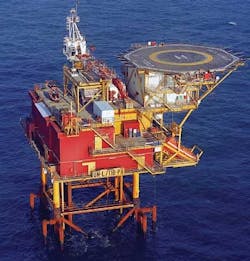
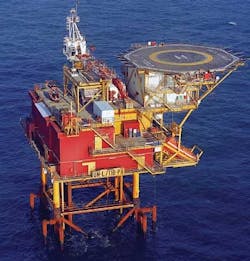
The L11b-A production platform in the Dutch North Sea.
In the northern North Sea, the UK division TAQA Bratani has taken on management of the Brent System pipeline and process facilities, which previous operator Shell UK installed in the 1970s. The 150-km (93-mi) pipeline transports 100,000 b/d of oil from 20 fields in the region between the offshore process center – TAQA’s Cormorant Alpha platform – and the Sullom Voe terminal on Shetland, where TAQA is a 24% shareholder.
Elsewhere, the company’s Netherlands branch agreed to buy DSM Energy for $404 million and a 15% percentage in assets held by the L11b group, including operatorship of the L11b-A production platform.
DSM’s Dutch sector assets will provide TAQA with a further 5,000 boe/d of production, and a share of the Noordgastransport offshore trunkline. Following modifications, the L11b-A platform will host production from the two-well L8-D field development, operated by Cirrus Energy, which is due onstream later this year.
Serica sets sights on Muckish
Ireland’s government has awarded Serica Energy a frontier exploration license in the Rockall basin off the country’s west coast. FEL 1/09 comprises six blocks in the northeast part of the basin, and covers an area of 993 sq km (383 sq mi). The entire basin extends over 100,000 sq km (38,610 sq mi), and only three exploratory wells have been drilled to date, one of which led to Enterprise Oil’s Dooish discovery in 2002.
Serica plans to re-process 400 sq km (154 sq mi) of existing 3D seismic on its acreage, the immediate aim being to sharpen definition of Muckish, a 30-sq km (11.6-sq mi) prospect in a water depth of 1,450 m (4,757 ft). It then will acquire several 2D long-offset seismic lines over the structure. Analysis to date suggests a prospective gas/condensate resource in Permo-Triassic sandstones with reserves of 675 bcf equivalent, although Muckish could contain dry gas or oil. The company’s previous probe off western Ireland in the Slyne basin found oil in the Bandon structure, also assumed prior to drilling to be gas prospect.
Serica’s in-house team, which includes ex-Enterprise staff involved with Dooish, puts the probability of technical success for Muckish at 20%. The company estimates the cost of a well in this water depth at $50-60 million, and would seek a farm-in partner to share the burden.
Another consortium in the Dunquin license in the Porcupine basin, led by ExxonMobil, has elected to commit to a second phase which includes exploratory drilling. Eni recently farmed into the license, FEL 3/04, ceding in exchange 40% of its adjacent license FEL 1/99 to the Dunquin partners.
Record hot tap at Ormen Lange
StatoilHydro has completed two remotely conducted hot taps on a pipeline on the Ormen Lange field in the Norwegian Sea. The water depth of 860 m (2,821 ft) is thought to be the deepest on record for a pressurized pipeline tie-in operation. In this case, the purpose was to connect a new subsea template on the southern part of the field to infrastructure on the sea floor.
Both hot taps were monitored and controlled from the ROV launch vessel, with 100 sensors, 23 cameras, and 18 subsea computers on the seabed relaying data via heavy-duty cables.
Last month, Grenland Group was due to deliver a 250-metric ton (25-ton) protection structure for a manifold for Norne M, another StatoilHydro subsea development in the Norwegian Sea. Production from wells tied into the new M-template will be routed to the field’s FPSO.
Rosebank floater screening study
Sevan has produced oil from its second FPSO in the UK sector, on the Premier-operated Shelley field in block 22/2. Shelley was part of a package of interests Premier took on following its acquisition of the now-defunct Oilexco North Sea. Development involves two horizontal subsea producer wells with downhole electric submersible pumps, connected to theSevan Voyageur via a flowline and control umbilical.
In June, Eni and its partners in the Goliat field in the Barents Sea opted for a winterized version of Sevan’s cylindrical shaped platform concept. Chevron has since contracted Sevan for a study for another potential application in an equally harsh environment, on its Rosebank project west of Shetland. The work scope includes hull sizing and configuration; topsides engineering; mooring motion and stability analysis; and cost/schedule estimations.
Lundin seeks Luno extension
Consultants Gaffney, Cline and Associates (GCA) have assigned 95 MMboe proven and probable reserves to Lundin Petroleum’s Luno field in the Norwegian North Sea. Results were based on two discovery wells and initials findings from an ocean bottom cable survey acquired last year. GCA assumes a 26% recovery factor for a waterflood development, with total in-place reserves assessed currently at 365 MMboe.
Lundin recently spudded an extension well on Luno, where it targets a further 241 MMboe gross, and the company aims to drill four further exploratory wells in the Greater Luno area over the next 18 months. Conceptual work is under way for a standalone development – Lundin hopes to improve on GCA’s recovery estimate as studies progress.
Elsewhere in the North Sea, StatoilHydro has completed an appraisal well on the 2005 Peon discovery, 60 km (37 mi) northwest of its Gjøa project. The well proved gas could be produced from what is thought to be a record shallow depth reservoir on the Norwegian shelf, a mere 209 m (685 ft) beneath the seabed. Water depth was 372 m (1,220 ft). StatoilHydro sees this as a probable marker for a new phase of exploration aimed at developing shallower gas offshore Norway.
Breagh transferred to RWE Dea
RWE Dea is taking operatorship of Breagh, thought to be one of the largest undeveloped gas fields in the UK southern North Sea. Breagh was discovered by Mobil in 1997 in block 42/13a, 65 km (40 mi) from the coast of northeast England. A new group led by Sterling Resources drilled three successful appraisal wells on the structure, the last being completed in January.
Sterling is retaining a 30% interest, with RWE Dea holding the remainder. The other five group members were unwilling to commit funds to a development this size. RWE Dea has the will and resources to expand in this region, operating an existing hub on the Cavendish gas field to the south and the Clipper South tight Rotliegend gas development. The company has in principle accepted Sterling’s development scheme for Breagh, and the two parties aim to submit a plan to the UK government by year-end.