Shallow-water well control lowering arrangement eases capping stack deployments
By Jeremy Beckman, Editor, Europe
At the recent SpillAsia 2026 conference in Singapore, Oil Spill Response Ltd. (OSRL) released its new shallow-water deployment system for managing complex well control scenarios. This co-development with Intermoor and Oceaneering is designed for running capping stacks in water depths from 75 to 600 m, with multiple new safety features including improved control during the final landing sequence.
OSRL claims to be the world’s largest industry-funded organization for oil spill preparedness and response, working with its 176 member companies, regulators, and others to maintain and strengthen a global spill response capability.
Offshore discussed the background to the new development and other initiatives with the association’s response director, Andy Myers.
Offshore: When did development work start on the new shallow-water deployment system? Is its location in Tananger, Norway, driven by local North Sea needs, or is it intended for use globally?

Myers: The underlying Split Lowering System (SLS) concept was developed by Intermoor in 2018 and patented in 2022. OSRL's focused development, simulation and integration work accelerated during 2024-2026.
The capability was not developed solely for the North Sea but with rapid global mobilization in mind for the shallow-water response scenario where vertical access above the incident well may not be possible. The system is stored in Norway, but is designed as a globally deployable shallow-water solution for 75 m to 600 m water depth, subject to incident-specific engineering, suitable vessels, ROVs, logistics and local approvals.
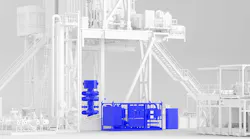
The SLS and the Snub Line Winch System (SLWS), developed by Oceaneering, are both intended for use with OSRL's four original Trendsetter-manufactured capping stacks. The four stack frames were match-drilled to accept the stack-mounted winch assemblies, also designed by Oceaneering. Trendsetter remains relevant as the capping-stack OEM and supports stack-specific engineering and modifications. The regional UK and Guyana stacks are compatible in design principle with the new equipment system, as are all OSRL capping systems globally; however, detailed interface engineering is ongoing.
Offshore: The new development is said to address surface conditions that might make direct vertical access unsafe or impractical. What are these conditions, and can you explain in more detail how the new lowering capability would operate?
Myers: Safe direct vertical access above an incident well can be more challenging in shallow water. Examples include a hydrocarbon or gas plume reaching the surface, surface boil, high volatile organic compound concentrations, benzene exposure, lower-explosive-limit restrictions, fire or explosion risk, reduced visibility, unstable sea conditions and an exclusion zone that prevents the installation vessel from safely remaining above the incident well.
The actual safe working area is incident-specific and is established by the incident owner using real-time gas monitoring, metocean data and operational risk assessment.
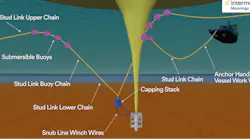
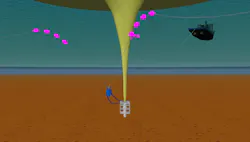
The SLS creates an offset deployment path, so the principal vessels do not have to remain directly above the incident well. Three anchor-handling vessels control separate work-wire and buoyancy-supported lowering paths, while a construction vessel supports stack preparation and overboarding. The capping stack is suspended, moved horizontally from the safe offset area, and lowered toward a position adjacent to the BOP or wellhead. Two work-class ROVs support subsea connections, monitoring and disconnection activities.
The system's published operating envelope is 75 m to 600 m water depth, reflecting its shallow-water design basis. However, the system could also have applications outside this envelope, particularly in helping to manage capping stack stability as the stack enters the plume.
Offshore: How does Oceaneering's Snub Line Winch System improve final alignment and landing?
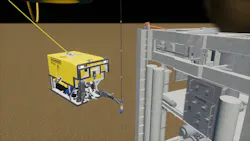
Myers: The SLWS mounts four hydraulic subsea winches directly onto the capping stack. Once the stack is positioned near the incident well, ROVs attach the winch wires to selected points on the BOP structure. The winches can then be operated individually or together to pull the stack laterally, correct heading and offset, manage the final approach, and seat the connector on the lower BOP mandrel. The ROV pilot operates the winches either individually or ganged together, with control delivered via an ROV-mounted valve pack interfaced to the capping stack through a control umbilical and bespoke interface.
Offshore: The new arrangement is said to support installation without a seabed interface of components—can you clarify?
Myers: It means the primary SLS architecture does not depend on the use of equipment pre-installed on the seabed. The stack remains suspended from vessel-controlled work wires and buoyancy strings as it is transported and lowered. The SLWS then uses temporary wire connections to the BOP structure for the final pull-in and landing. This eliminates seabed preparation and avoids making the main installation method dependent on seabed-mounted positioning hardware. Removing the potential complexities of a geotechnical interface simplifies shallow-water well response at the incident well site and supports rapid response times globally. It does not mean that no equipment ever contacts the seabed or BOP during the wider response.
Offshore: Does the new development replace or complement existing systems such as OSPRAG for capping UK subsea wells, which is located at OSRL’s base in Shetland in the UK’s far north?
Myers: The SLS/SLWS combination complements OSRL's wider capping portfolio by providing a non-vertical shallow-water deployment method for the four global SWIS capping stacks. It does not replace the UK regional OSPRAG capping device, which remains a separate regional capability with its own access and deployment arrangements.
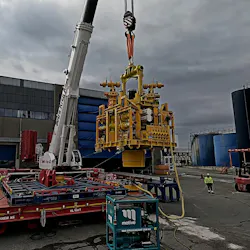
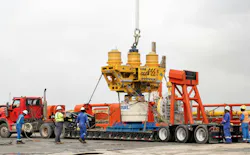
SLS components, which are stored at the Tananger subsea base, near Stavanger, are rapidly transportable by road, sea or air. At the outset, the design of the system considered onward logistics and streamlining any transportation requirements as far as possible. The rigging is packaged into transportable half-height units allocated across the marine spread, while the SLWS storage solution reuses one full-height and one half-height container. Trendsetter and Oceaneering technicians support installation and testing of the winches at the relevant OSRL base.
Offshore: Will additional shallow-water systems be placed at some point in other shallow-midwater regions, such as MENA, the Caspian, India, West Africa or Southeast Asia?
Myers: OSRL is assessing global and regional response needs. The current strategy is a globally transportable system stored in Norway, supported by global logistics planning and incident location sourced marine assets. A second SLWS package is scheduled for delivery in January 2027 to build redundancy into the system. Any future staging decision would depend on member demand, aligned with the needs of our members.
Offshore: How many capping stack systems does OSRL now offer globally, and how often have they been deployed, even as a precaution?
Myers: OSRL's current portfolio comprises six capping stack systems: four global capping stack systems located in Norway, Brazil, Singapore and South Africa; the Americas Equatorial Margin Guyana-based capping stack; and the UK regional capping device.
Access is provided through OSRL membership and the relevant supplementary or regional subscription agreement. Host governments may participate in preparedness, oversight or regulatory arrangements, but oil and gas operators are the subscribers for the service.
Strictly speaking, not all OSRL systems have been activated, prepared or mobilized for real incidents, though they are all routinely exercised. In early 2025, the Brazil and Norway stacks were prepared at our storage facilities during a live response, with the Norway stack being mobilized infield to a remote well location. There have also been other examples of equipment from our comprehensive subsea service equipment stock being mobilized to support response activities outside of capping missions.
Offshore: Recently, OSRL transferred its deepwater-capable Guyana capping stack to a new base. What was the reason for this, and what is this system’s geographical coverage?
Myers: The 7 1/16-inch, 15,000-psi gate valve-based system is designed for water depths up to 12,500 ft (3,800 m), and for liquid flow rates of up to 330,000 bbl/d. It was relocated from Guyana Shore Base Inc. (GYSBI), east of the Demerara River, to the permanent Emergency Response Building at Vreed-en-Hoop Shorebase Inc. (VEHSI) in Georgetown. The move was completed in early June 2026 using land transport, lifted loadout and sea transport.
The new location provides improved quayside access, a dredged harbor basin, a streamlined route from storage to quayside, and co-location with other emergency-response resources.
The Guyana capping stack is currently for use in Guyana and the wider region within the Equatorial Margin. We will continue to engage and review the coverage area with our membership to ensure that their response coverage needs are met.
It is a locally based OSRL operation with international technical support available when required. The Guyana team includes a Guyana response manager, base administrator and Guyana-based responders who support maintenance, preservation, drills, mobilization readiness and stakeholder engagement at VEHSI. For a major mobilization or deployment, OSRL would augment the local team with global subsea specialists, OEM technicians, logistics providers, marine contractors and other Global Subsea Response Network resources suited to the incident.
Offshore: Have other improvements been introduced recently to the deepwater capping stacks, or are further changes planned?
Myers: Recent work includes completion of match-drilling on all four global capping stacks for SLWS installation; development of a second SLWS package scheduled for January 2027; improved storage and transport arrangements; ongoing SLS/SLWS procedures, simulation and training; updated maintenance planning; and continued work on logistics and loadability studies.
The Norway stack also completed its five-year BOP recertification and returned to response-ready status.
Wider future studies include possible single-leg interim containment through a capping stack and a strategic review of future asset requirements.
Alongside these equipment improvements, OSRL continues to strengthen the Global Subsea Response Network, extending the specialist support available to subsea members for preparedness, source control planning and emergency response worldwide. The network has expanded through new partners and framework agreements, giving members access to collective expertise for both planning and response. This complements the capping stacks by strengthening the arrangements needed to mobilize equipment and coordinate specialist support during an incident.
About the Author
 Jeremy Beckman
Staff Writer / Editor, Europe
Jeremy Beckman has been Editor Europe, Offshore since 1992. Prior to joining Offshore he was a freelance journalist for eight years, working for a variety of electronics, computing and scientific journals in the UK. He regularly writes news columns on trends and events both in the NW Europe offshore region and globally. He also writes features on developments and technology in exploration and production.