Managing benzene exposure during offshore well abandonment
Key highlights:
-
Continuous monitoring during a 37-well North Sea P&A campaign enabled crews to identify and manage fluctuating benzene and H2S exposure risks without recorded gas-related downtime.
-
Gas concentrations varied significantly between wells, reinforcing the need for real-time measurement at the point of release rather than relying solely on historical well records.
-
The case study found that early deployment of detection equipment, respiratory protection and trained gas-management specialists allowed operations to continue safely even when elevated gas levels were encountered.
By Craig Morrison, Dräger
Benzene is a volatile organic compound and a known human carcinogen frequently encountered in the oil and gas industry. It is present in crude oil, natural gas condensates and fuels, as well as being a by-product of various petrochemical processes. Workers may be exposed to benzene during drilling, production, refining, pipeline maintenance, tank cleaning and especially during the removal of old infrastructure where residues remain.
Decommissioning work carries heightened risks, since dismantling old pipelines, tanks and production units often releases trapped hydrocarbons and benzene-containing residues. In many cases, historical infrastructure may lack proper documentation, increasing uncertainty about contamination hotspots. This underscores the need for stringent risk assessments, atmospheric monitoring, use of personal protective equipment (PPE) and safe waste disposal practices.
Aging infrastructure is bringing this issue to the fore as operators work through their inventory of assets nearing end of life. Wells that have been shut in or suspended for years hold annular fluids in which benzene and other gases have had long periods to accumulate. Abandonment work disturbs those settled fluids, for example, cutting casings and circulating annuli can release vapors that have not moved since the well was last worked on.
With records of each well's history often incomplete, gas levels are difficult to predict from paperwork alone, meaning continuous monitoring at the point of work has become central to safe abandonment campaigns.
 Offshore oil and gas operations and the digital workflow
Operational realities during P&A
The campaign centered on the well abandonment phase of a North Sea decommissioning project, with 37 wells on a single platform to be plugged and abandoned (P&A) over a planned eight to nine months.
With the asset no longer producing, every day of delay carried the full running costs of the platform and the decommissioning scope, leaving little tolerance for stoppages. That pressure was felt during early operations, when uncertainty around detection equipment, measurement methods and management of the gas hazard had caused continual downtime and delays to the schedule.
Exposure risk was concentrated in cutting casings and circulating annular fluid. Both activities disturb fluids that may have sat in the annuli for years, and both bring returns to the surface at the well, in the active pits and at the holding and wing tanks, where crews are working.
Monitoring was carried out at key points in each operation and maintained continuously until the circulation of fluid volumes had been completed.
Conditions differed markedly from well to well, and benzene was not the only hazard—hydrogen sulphide (H2S) was also encountered at high levels on a couple of wells.
Monitoring data and exposure findings
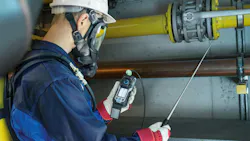
Dräger was engaged to manage the gas hazard for this scope, with its engineers on sire throughout operations. The monitoring approach combined photo-ionisation detection, for accurate measurement of benzene at low concentrations, with multi-gas detectors for real-time monitoring. Area detectors were positioned at the well and above the holding tank, and crew wore personal monitors. The equipment deployed at any points was matched to the operation under way and the values being recorded.
The readings recorded during the campaign illustrate how much conditions varied. While running tools into the hole, benzene levels measured directly at the well opening ranged from 1.97 ppm before the tool entered to a peak of 12.1 ppm during running in, although these were point readings at the opening itself, with insufficient volumes to create an atmosphere; levels at the top edge of the well were 0.24 ppm. Readings across the wider work areas during circulation were typically well below 1 ppm, from peaks of 1.12 ppm at the well top and 0.85 ppm in the active pits to just 0.02 ppm at the shakers. During circulation of one well’s C annulus, readings of 0.35 ppm to 0.43 ppm in the active pits rose to 2.38 ppm directly at the inlet where returning fluid entered, and had fallen to 0.13 ppm in the pit room an hour after returns stopped.

Decision-making during gas events
The sharpest readings of the campaign came not from benzene but from H2S. When fluid returned from one well’s B annulus during attempted circulation and manipulation of the well, area detectors at the well and above the holding rank recorded peaks of 35 ppm and 13 ppm, respectively, with each spike lasting about two minutes.
The response followed a simple rule: Any time a detector picked up gas, personnel were moved back until levels returned with safe limits. No personal monitors alarmed during this shift.
Beyond that immediate step, controls were scaled to what the readings showed. Gas was detected on numerous occasions across the campaign, in most instances at levels and volumes low enough for respirators to be suitable. Where readings warranted more, the onsite engineers applied further controls, including access restrictions and forced ventilation using air movers in confined and higher-risk areas.
On one well, H2S levels were high enough that access was restricted and crews moved to self-contained breathing apparatus and airline equipment, allowing operations to continue under controlled conditions rather than stopping.
To adequately prepare, all personnel underwent face-fit testing and training, supported by toolbox talks and short, informal safety meetings at the workplace. The onsite engineers managed equipment operation and safety reporting, and because detection and respiratory equipment was already on site as part of the scope, controls could be introduced as soon as they were needed.
There was no recorded downtime attributable to gas measurement across the campaign and no safety incidents, and the operator described the approach as safer and easier than previous methods.
Transferable lessons for other operators
One of the main takeaways from this project is to expect the unexpected. Many of the wells now being abandoned are older than the personnel working on them, and records of their history vary in detail.
On this campaign, wells on the same asset produced different gas readings and different hazards, so assumptions carried over from one well to the next were no substitute for measurement at the point of work.
Another lesson is to monitor at the point of release, not just the general work area. The highest readings were concentrated where tools and fluid met the atmosphere, at the well opening and at the inlet to the pits during returns, with levels falling away sharply a short distance from the source. Positioning detection at these points gives the earliest warning and the clearest basis for decisions about access.
It is always useful to plan for more than benzene. Although benzene was the hazard the campaign was scoped around, H2S produced the highest readings recorded. Monitoring and respiratory protection plans for abandonment work should cover the full range of gases a well may hold.
Finally, have controls on site before they are needed and dedicated people to manage them. The downtime seen in earlier operations stemmed from uncertainty over equipment, measurement and hazard management. With equipment available on site and specialists dedicated solely to gas management, the response to each reading could be immediate, which allowed operations to continue safely without stopping.
On an asset that is no longer producing, where every delay carries the platform’s full running costs, that capability can deliver significant reductions in both cost and downtime.
Conclusion
As the North Sea’s aging well stock moves through decommissioning, gas exposure during P&A will remain a live risk, and one that well records alone cannot quantify. This campaign shows that benzene and other toxic gases can be managed without halting operations, provided monitoring is continuous and positions at the points of release, and is backed by clear decision rules, equipment ready to use and crews trained to act on what the readings show.
About the Author
 Craig Morrison
Craig Morrison is the DMO service operations manager at Dräger’s Aberdeen office, leading offshore and onshore engineering teams, as well as the team responsible for managing and maintaining the rental fleet.
With more than 11 years at Dräger and over 17 years in the oil, gas and safety equipment industry, he brings hands-on experience across the service operation. He began his career as a service engineer, progressed to senior engineer, and moved into his current management role.
Morrison's experience spans marine and offshore servicing, project support and gas management scopes, giving him a practical understanding of both field delivery and the operational demands behind reliable service and equipment readiness.
Related
