Offshore borehole mining extends drilling technology to critical minerals
By Dr. Gregory Abramov, Borehole Mining International Inc.
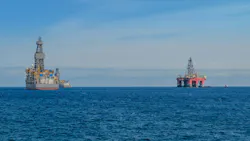
For more than half a century, offshore drilling technology has enabled the recovery of hydrocarbon resources beneath the ocean floor, transforming the global energy industry and extending resource development far beyond the shoreline.
Meanwhile, beneath the same seabed, lies another vast and largely untapped resource base: mineral deposits containing many of the critical materials required for modern technologies and energy systems. Many of these deposits can potentially be accessed using the same offshore drilling infrastructure.
This article explores how borehole mining technology may provide a practical pathway for recovering subseafloor mineral resources.
Modern offshore mining and its limitations
In the last 40 to 50 years, scientists and engineers have been trying to develop an array of underwater technologies enabling the development of the mineral wealth from underwater, including:
- Dredging in shallow waters (up to 50 m) from mining vessels; and
- submersible deepwater (up to 6 km) unmanned seabed mining systems that pick, scoop, collect or vacuum up seabed nodules or cut and grind the ocean crust.
These systems’ capacity often reaches 5,000 to 6,000 tons of material per hour or more. Though, all of them present two major limitations:
- They are not aquatic life-friendly; and
- They develop deposits on the ocean floor only, resulting in all mineral resources located below it remaining inaccessible.
Meanwhile, according to studies conducted by USGS and BOEM, substantial mineral accumulations occur below the seabed, within the 200-nautical-miles-wide US Exclusive Economic Zone. These include heavy mineral sands containing titanium and zirconium minerals, phosphate-rich sediments with rare earth elements as byproducts, metalliferous sediments and offshore placer deposits. To begin production from these deposits, an environmentally responsible, rapid, cost-effective and field-proven remotely operated extraction method is required.
Borehole mining technology
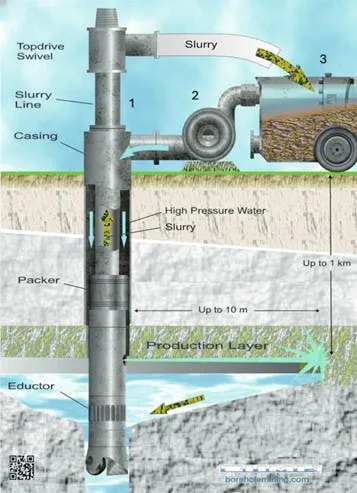
Borehole mining is a remotely operated hydraulic excavation process conducted through a drilled and cased wellbore. A borehole mining tool typically consists of two concentric flow paths that form the tool’s dual-wall API-standard extension string (Figure 1). Typically, high-pressure water is delivered to the downhole mining assembly through the annulus while the produced slurry containing excavated materials is returned to the surface through the inner column.
At the bottom of the dual string, a bottom head containing a hydromonitor and an eductor is attached. The hydromonitor converts pressurized water into a powerful water jet capable of disaggregating the target formation. The resulting slurry is transported to the surface through an eductor-assisted lifting system. At depths beyond 200-250 m, an airlift is used to assist slurry pumping.
The system is based on water circulation, is compatible with existing standard drilling infrastructure, requires no surface excavation and uses no chemicals, satisfying modern environmental standards.
All borehole mining advantages are based on the direct access to the target interval(s) and include rapidness, low footprint, emission, environmental impact, capital and operational costs, and the ability to work underwater. Borehole mining is deployable from land, offshore, ice sheets and operates 24/7. Recently, it demonstrated reliable performance at temperatures approaching -30 C.
The extendable and scalable borehole mining tool is suspended from a conventional top-drive drilling rig and is rotated and advanced vertically, allowing controlled excavation of the production interval(s).
Depending on formation characteristics, excavated cavities—or stopes—can reach diameters exceeding 14 m. Main borehole mining parameters are based on ore properties, tool size and mining depth, among others (Table 1).
Table 1. Main borehole mining parameters
|
Parameter / Units |
SI |
USCS |
|
Mining depth |
40 m - 1 km |
130 - 3,280 ft |
|
Production interval thickness |
1 m to 400 m |
3 - 1,300 ft |
|
Tool diameter (API standard) |
140 - 273 mm |
5.5 - 10.75” |
|
Dry tool weight Emergency pullback capacity |
3-5 t up to 50-60 t |
|
|
Torque / Rotation |
1,500 kgm (11,000 Lb*ft) @ 0.5 - 3 RPM |
|
|
Water pressure and flowrate |
70 - 150 bars 150 - 200 m3/hour |
1,000 - 2,200 PSI 5,300 - 7,000 ft3/h |
|
Pump motor/engine power |
700 - 800 kW |
950 - 1,100 horsepower |
|
Solids content (by volume) |
1/6 - 1/1 (17% - 50%) |
|
|
Tool production |
35 - 90 m3/hour |
1,200 - 3,000 ft3/h |
|
Cutting diameter |
13 - 17 m |
40 - 52 ft |
|
Manpower required |
5 - 8 |
|
Unlike seafloor mining systems that physically interact with the seabed over large areas, borehole mining accesses resources through a limited number of drilled wellbores. Excavation occurs below the seabed surface, minimizing disturbance to benthic habitats and sufficiently reducing sediment plume generation.
Borehole mining has already demonstrated operation at depths relevant to offshore mineral extraction. In a San Juan Basin coalbed methane stimulation project, a borehole mining system modified for a gas well operated by Phillips Petroleum successfully excavated coal seams from depths approaching 1,000 m. Sonar surveys confirmed creation of underground cavities, and post-treatment gas production doubled relative to pre-treatment performance. The project demonstrated the ability of borehole mining systems to operate through conventional oilfield infrastructure at great depths.
Offshore borehole mining technology
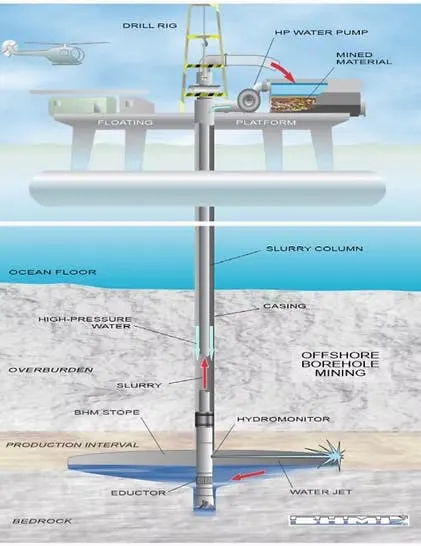
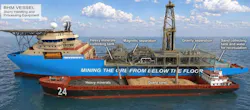
Figure 2 illustrates an offshore borehole mining concept from a mining vessel and the sequential borehole mining steps, which include:
- Mooring the vessel atop of the designated position;
- Drilling and casing into the production interval;
- Continue drilling through the ore body into its lower boundary;
- Installation of a borehole mining tool;
- Pumping down of high-pressure water, tool rotation and vertical advancement;
- Creating slurry and transporting it to the vessel;
- Onboard ore separation and recirculation of the clarified water;
- Transportation of the ore to an onland processing facility;
- Borehole mining tool removal;
- Casing string partial removal and wellbore plugging;
- Complete removal of the casing string for the subsequent wellbore reuse;
- If required, a borehole mining stope backfill conducted prior to Step 10; and
- Mining vessel is relocated to the next subsequent mining site.
The final borehole mining steps (9-13) take place upon completion of the well.
A typical marine borehole mining operation would utilize equipment familiar to offshore drilling operators:
- Top-drive drilling rig;
- Casing and tubulars;
- Mud pumps and fluid circulation systems;
- Well-control equipment;
- Deck handling equipment; and
- Material separation systems.
The primary addition is the borehole mining tool itself—a downhole assembly designed to hydraulically excavate formation material and transport it to the surface as slurry.
It is important to highlight that offshore borehole mining should be viewed not as a new mining technology, but as an extension of proven offshore drilling technology into the critical minerals sector.
Vessel type
As they are functionally largely similar to the onland operations, jackup platforms provide the most straightforward deployment option. One issue with a jackup, however, may be potential seabed subsidence. To mitigate such situations, room-and-pillar and/or backfill mining technologies that are widely used for decades in underground mining can be applied.
The other important subsidence prevention measure is a real-time awareness control over the mining area and overburden strata.
Deployment from floating vessels is also technically feasible. Although vessel motion may necessitate heave-compensation systems and/or flexible-riser depending on water depth and operating conditions.
Compared to a jackup, the main advantages of a floating vessel are its complete safety in the event of seabed subsidence, higher mobility and lower cost.
A mining vessel's onboard slurry handling equipment may have two major configurations:
- Quick gravity separation followed by ore transfer to a transporting vessel and water recycling; or
- An ore preliminary separation.
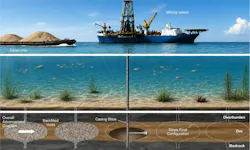
This configuration varies based on the ore physical properties, its depth, thickness, and separation beneficiation details, among others. As an example, Figure 3 presents a heavy mineral sands mining vessel with sorting equipment.
Economic analysis approach
It is important to recognize that, from a technological standpoint, borehole mining cannot be directly compared with seafloor mining or dredging. Borehole mining is a fundamentally different extraction method.
Rather than continuously traversing the seafloor to recover near-surface materials, a borehole mining system remains stationary for extended periods while extracting resources from beneath the seafloor—depths that are generally inaccessible to conventional seafloor mining technologies.
Although small-scale borehole mining systems have been successfully deployed from pontoons to recover minerals from abandoned and flooded open pits in several countries, the technology has not yet been applied in open-ocean environments. As a result, there is currently no operational offshore borehole mining database from which to derive reliable cost or performance benchmarks.
Consequently, the economic evaluation of offshore borehole mining should follow a straightforward project-assessment framework: comparing the market value of the recovered mineral product with the total cost of extraction. These costs include capital expenditures, operating and maintenance expenses, mineral processing, transportation, and all applicable regulatory, permitting, and environmental compliance requirements. Project viability ultimately depends on whether the recovered mineral value exceeds the total life-cycle cost of production while generating an acceptable return on investment.
Based on decades of onshore borehole mining experience, the cost of extracting 1 cu. m of ore varies considerably depending on deposit characteristics, mining depth, high-pressure water pumping rates, energy prices, labor costs and other site-specific factors. Typical onshore extraction costs range from $30 to $80 per cubic meter of ore.
Once technical feasibility has been demonstrated, project economics often improve over time as operating personnel gain experience, equipment reliability increases, and incremental innovations enhance productivity, robustness and overall cost efficiency.
Offshore critical minerals primary candidates
According to studies conducted by the USGS and BOEM, several categories of below the seabed mineral deposits appear particularly well suited for borehole mining. These include:
- Heavy mineral sands containing zirconium, titanium, rutile, thorium, tungsten and rare earth elements (e.g., praseodymium, scandium, samarium, cerium, europium);
- Phosphate-rich sediments containing strategic mineral byproducts;
- Offshore placer gold, silver, titanium, platinum and rare earth elements;
- Metalliferous sediment accumulations mainly containing aluminum, iron and manganese; and
- Lithium-, magnesium- and strontium-bearing solution-mining formations suitable for borehole mining as a process stimulation technology.
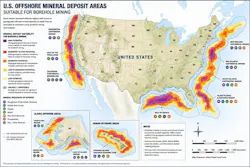
Figure 4 presents a generalized map of selected borehole mining-applicable, subseafloor critical mineral occurrences identified from publicly available USGS and BOEM data. Because borehole mining is most effective in weakly consolidated formations, these deposits may represent logical candidates for initial offshore demo-trial projects.
Practical pathway to first offshore deployment
An ideal candidate for the first offshore borehole mining demonstration would combine several favorable characteristics: shallow water (15-20 m), a relatively thick orebody (3-5 m) located 60-80 m below the seafloor, close proximity to a port (less than two hours transit time), soft and unconsolidated mineralization, and a readily marketable product.
While heavy mineral sands are an excellent target for such a trial, the Atlantic continental shelf offshore southern Georgia appears to be one of the most attractive locations. From Brunswick port, a crew boat could reach the mining site in 1-1.5 hours, simplifying logistics and reducing operating costs.
In addition to obtaining all required permits and approvals, accurate delineation of the orebody is essential. The depths of the upper and lower ore boundaries should be established within 10-15 cm. To achieve this, a 6-inch core hole is recommended. Following geological confirmation, the same borehole can be underreamed to 12-13 inches to accommodate a 10¾-inch casing, with its shoe positioned just below the upper boundary of the orebody. Open-hole drilling would then continue to a depth of about 1.5-2 m into the bedrock. A heavy mud would be used to maintain wellbore stability until the 8⅝-inch borehole mining tool is installed.
Borehole mining starter kit
A realistic first-step pilot could be executed using a relatively modest and commercially available equipment package, including:
- A jackup or vessel providing about 100 tons of available payload capacity for birehole mining equipment;
- A high-pressure water pump rated at 200 m³/h and 100-150 bar;
- A borehole mining tool (to keep the demo budget lower, an 8⅝-inch OD recommended); and
- An onboard slurry collection tank or support barge.
The main objective of Demo #1 is not to maximize production or project economics. Rather, its purpose is to prove that offshore borehole mining can be conducted safely, reliably and efficiently using existing offshore drilling infrastructure under real-world operating conditions.
Once this proof of concept has been established and initial operating data obtained, the case for developing larger and higher-capacity offshore borehole mining systems becomes significantly stronger.
Looking ahead
Borehole mining builds upon proven offshore drilling, fluid circulation and remote operating technologies already used throughout the marine energy sector.
Thus, rather than representing an entirely new industrial platform, offshore borehole mining should be viewed as an extension of existing marine drilling technology into a development of resources beyond oil and gas. This compatibility may offer significant advantages in terms of deployment, training, logistics and capital requirements.
By leveraging existing infrastructure and industry expertise, it provides a practical pathway for accessing subseafloor mineral resources that are difficult, impractical, controversial or impossible to recover using conventional mining methods.
As an AI-enabled and digital twin technology, borehole mining is well suited for advanced monitoring, real-time optimization and predictive operations.
Borehole mining's versatility extends its application beyond oil and gas reservoir stimulation to mineral extraction and, potentially, the commercial development of offshore methane hydrates.
As the US seeks secure domestic supplies of critical minerals, offshore borehole mining may expand the portfolio of resources available for development while minimizing the need for large-scale seafloor excavation.
For an industry seeking growth opportunities beyond traditional hydrocarbons, borehole mining represents a convergence of resource recovery, digital innovation and offshore engineering expertise. Critical minerals beneath the seafloor may therefore constitute not only a new source of strategic materials, but also a significant new frontier for the application of offshore technology in the decades ahead.
Key takeaway:
Offshore borehole mining applies established drilling systems to access subseafloor critical mineral deposits that are beyond the reach of conventional seafloor extraction methods.
Acknowledgment:
The author expresses special thanks to Dr. David Faulder, PE, reservoir engineer, Homestead Resources LLC, for review of the manuscript, assistance and advice.
References:
Seabed Mining for Critical Minerals on the U.S. Outer Continental Shelf: Issues for Congress, US Congress, 6/22/2026, https://www.congress.gov/crs-product/R48302
Critical Minerals Occurring Offshore, BOEM, https://www.boem.gov/marine-minerals/critical-minerals/critical-minerals-occurring-offshore
America's Offshore Critical Minerals, BOEM, https://www.boem.gov/factsheet/americas-offshore-critical-minerals
Heavy-mineral resource potential of surficial sediments on the Atlantic continental shelf offshore of North Carolina; a reconnaissance study, USGS, https://www.usgs.gov/publications/heavy-mineral-resource-potential-surficial-sediments-atlantic-continental-shelf
Resource Evaluation of Critical and Hard Offshore Mineral Programmatic Reference (PDF), BOEM, 2023, www.boem.gov/research/mineral-resource-evaluation/bureau-ocean-energy-management-resource-evaluation-critical
Atlantic Continental Shelf and Slope of the United States - Heavy minerals of the continental margin from southern Nova Scotia to northern New Jersey, USGS, 1970, https://www.usgs.gov/publications/atlantic-continental-shelf-and-slope-united-states-heavy-minerals-continental-margin
Ferromanganesse Regions, USGS, https://geonarrative.usgs.gov/globalmarinemineraldataviewer/Prospective-Regions/World-Regions-of-Interest/index.html
About the Author

Dr. Gregory Abramov
Dr. Gregory Abramov is president and CEO of Borehole Mining International Inc. (est. 1995) and a recognized expert in borehole mining (BHM) with more than 50 years of experience in the development and application of BHM technologies. Since relocating to the US in 1992, he has continued advancing BHM applications for mineral, energy and offshore resource development.