Innovative P&A techniques can overcome structural constraints of older offshore wells
Key highlights:
- Legacy offshore wells often feature outdated hardware that complicates plug and abandonment operations, requiring innovative engineering solutions.
- BOP tethering systems can significantly reduce loads on wellheads, enabling safer intervention from floating rigs in challenging conditions.
- Small refinements in operational strategies, such as adjusting riser tension and environmental parameters, can dramatically improve wellhead fatigue life.
- Using intervention risers instead of full drilling risers reduces load and fatigue, making P&A feasible in wells with structural limitations.
- Custom retrofit hardware, like support frames, is essential for wells with damaged or corroded components, ensuring safe BOP landing and operation.
By Mahesh Sonawane, Steven Johnson and Ryan Koska, 2H Offshore
Everything has a lifetime, and this of course applies to offshore oil and gas wells. Plug and abandonment (P&A) operations represent the end of life for a well that is no longer suitable for cost-effective natural resource production. While P&A is considered to be a non-value-adding activity in the well lifecycle, it is imperative for safe decommissioning, environmental protection and regulatory compliance.
However, older offshore wells come with a variety of unique challenges that make the P&A process less than straightforward. Older wells are characterized by legacy hardware from the early offshore developments, with smaller conductors, less rigid wellhead locking arrangements, and connector designs with lower fatigue resistance than those commonly used today. These wells were designed to be drilled and completed using early generation rigs and smaller BOPs that are no longer in use.
To plug and abandon a subsea well, operators need access to the well by latching on to the subsea production tree and subsea wellhead using a riser system deployed from a floating rig. Modern drilling and intervention vessels typically deploy larger BOP stacks, heavier subsea equipment, and operating philosophies that impose substantially higher loads on the wellhead and conductor system. The result is a recurring mismatch between legacy well equipment and modern intervention demand, which typically presents itself in three ways:
- The well’s structural capacity is exceeded due to higher loads imposed by the BOP and extreme vessel offsets.
- Instability of the well conductor while supporting the heavy intervention equipment.
- Excessive fatigue damage accumulation in the components with poor fatigue properties.
The goal here is to explore real-world case studies in which various technologies, such as BOP tethering, alternate subsea intervention packages, retrofit hardware solutions, and different operating strategies have been implemented to successfully overcome these common well P&A challenges.
Phantom wells
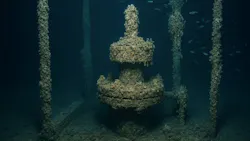
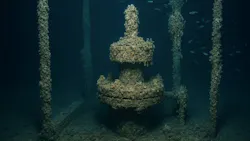
A large proportion of older wells are classified as “phantom” wells. Phantom wells are assets inherited during mergers, acquisitions, or asset transfers and typically have incomplete or missing documentation; some may not even be visible on current maps or databases. Nonetheless, these wells still carry regulatory responsibilities and environmental liabilities, especially for plug and abandonment. Missing documents can become a huge challenge when it comes to evaluating the feasibility of P&A and assessing wells for compatibility with planned operational equipment. There have been instances when operators were unable to determine if the well conductor is a 30-in. or 36-in. pipe based on the available documentation. In these cases, the only option is to conduct an ROV survey of the well equipment to gather as much information as possible in order to make judgments regarding well specifications (Figure 1).
BOP tethering
P&A operations are conducted using either a dynamically positioned (DP) drillship in deeper water or with a moored semisubmersible in shallow waters. For DP vessels, the well equipment must have enough strength capacity to allow sufficient vessel excursions and enable an emergency disconnect of the BOP from the well, in the event of loss of station-keeping and uncontrolled drift-off. Similarly, for moored vessels, well equipment loads must remain within the allowable offsets of the mooring system.
For older wells, however, the strength of the wellhead and conductor often restricts the operating limits. The combination of vessel offset and environmental loading in conjunction with a heavy BOP produces bending loads exceeding the capacity of the well equipment.
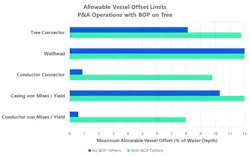
A feasibility assessment of P&A operations for a 30-in. conductor well offshore Trinidad and Tobago in 500 ft of water depth involving landing a BOP on the subsea tree showed that the allowable vessel offset was less than 1% of water depth (5 ft), limited by the yield strength of the conductor. Operations were not feasible due to the excessive loads imparted on the conductor by the BOP stack. To enable operations, a BOP tethering system was explored. By anchoring the subsea stack to the seabed, the bending loads in the wellhead and conductor were significantly reduced, enabling a larger vessel offset for connected operations. This is demonstrated in Figure 2 where the allowable vessel offset based on conductor capacity increases from less than 1% to 8% of water depth with the use of the BOP tethering system.
While the benefit of implementing a BOP tethering system is clear in terms of reducing loading on the wellhead, it should be noted that they are not a complete solution for P&A operations of older offshore wells. There are practical aspects which must also be accounted for, such as anchoring requirements, soil conditions, anchor placement and crowded seabed layouts.
Making small changes
While P&A operations are not long in duration, fatigue life is an important consideration since the wells have a history of previous drilling and intervention operations which have caused some level of fatigue accumulation in the wellhead. This is particularly true for shallow-water wells where even modern-day high-specification equipment faces challenges in meeting design life requirements. This is due to the minimal damping that takes placed between the wave-induced loading at the surface and the well at the seabed. In some instances, where fatigue life is marginal, small refinements to the riser equipment, well-defined operational philosophy, and proverbially sharpening the analysis pencil can lead to material improvements in the predicted fatigue performance.
For example, in the assessment of a legacy shallow-water well offshore Trinidad and Tobago, the predicted fatigue life was less than 10% of the target duration for the operations. Sensitivity studies were performed to evaluate the benefits of different changes to the riser space-out and operating environment as follows:
- Applying reduced top tension in the riser and using lighter mud density showed improvement in wellhead fatigue life by 50%.
- Using a reactive flexible joint (RFJ) to provide a restoring bending moment to counter riser loads and reduce wellhead bending loads improved fatigue life by 30%.
- Replacing the drilling riser buoyancy joints with slick joints is feasible in shallow water because of low top tension requirements. This change improved the fatigue life by a factor of 3.2.
- In addition to evaluating different design options to help improve fatigue response of the wellhead system, limiting connected operations to low environmental sea states improved wellhead fatigue by up to 80%.
- The safety factor on fatigue calculations was reduced from 10 to 3 supported by detailed risk assessment and implementing a fatigue monitoring philosophy (subject to regulatory approval).
While all these changes may seem small, by aggregation of these marginal gains, the overall fatigue life of the wellhead system improved by a factor of 37, and hence the operations were deemed feasible.
Bigger is not always better
Not all wells need full access and use of a marine drilling riser. In those cases, an alternative approach is to reduce loading at the source by replacing a conventional drilling riser package with an open-water intervention riser system (OWIRS). Compared to a full drilling riser and larger BOP stack (weighing 500,000 to 800,000 lbs), a drill pipe riser string with an intervention stack (50,000 to 125,000 lbs) typically imposes a lower weight, reduced hydrodynamic loads, and smaller bending moment on the well architecture, which directly benefits both strength and fatigue performance at the wellhead and conductor. This makes OWIRS one of the most useful options for legacy wells that cannot safely accommodate a conventional drilling riser system.
A case from offshore Australia demonstrates the difference clearly. The well, installed in approximately 1,200 ft of water depth, was screened for abandonment using either a mobile offshore drilling unit (MODU) with a 21-in. drilling riser or a semisubmersible intervention vessel with a 7-5/8-in. intervention riser. The feasibility of each option was assessed in terms of operating windows. For the conventional MODU drilling riser, the allowable vessel offset was less than 6% of water depth due high bending loads in the conductor induced by the heavy BOP stack, which caused the low-pressure housing extension joint to yield. The allowable vessel offset was insufficient to provide enough time to disconnect in the event of loss of dynamic positioning. By contrast, for the lighter intervention riser package, the allowable vessel offset increased to more than 11% of water depth, which was sufficiently large to provide adequate time to activate the emergency disconnect sequence. This shows that intervention risers effectively reduce loading on the well equipment relative to drilling riser systems due to the smaller subsea stack.
While it is recommended to conduct P&A operations using an intervention riser where possible, that does not mean they are always the best answer. Their suitability depends on the pressure-control philosophy, barrier requirements, and the specific downhole tasks required during the abandonment sequence.
Retrofit hardware
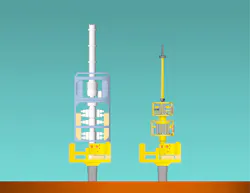
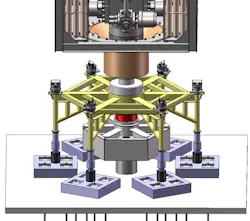
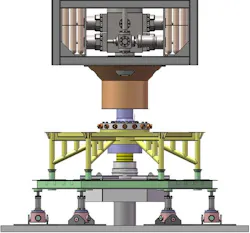
No amount of analytical refinements or smaller subsea intervention packages are sufficient for wells that have sustained damage or have functional issues. In such cases, design of custom retrofit hardware is essential to enable operations. For example, a 50-year-old well in the Gulf of America, previously plugged and abandoned, required re-entry to verify the plugs and satisfy environmental requirements. However, there was uncertainty of the structural stability of the wellhead and downhole casing, and some of the guide bases installed on the wellhead had completely corroded and fallen to the seafloor. The operator was not willing to accept the risk of landing the BOP on the wellhead and potentially critically damaging the well. A support frame structure was designed so that the BOP loads were not transferred to the wellhead and instead the weight of the BOP was supported by the soil, as shown in Figure 4. Such fit-for-purpose, custom-engineered hardware solutions enable operators to safely execute P&A operations on aging assets that would otherwise be considered non-viable.
Conclusion
Older offshore wells were not designed for the load environment created by modern plug and abandonment equipment, and that mismatch can narrow operating windows, increase downtime, and complicate safe execution. However, field experience shows that these constraints can often be managed through engineering screening and careful selection of the intervention method. The common solution is not a particular technology, but judicious use of available equipment supported by a detailed structural and operability assessment to identify the most suitable approach for each well for risk mitigation.
For the extensive inventory of wells awaiting P&A, there is no one “magic pill” to solve all issues as each asset or well will have its own specific set of challenges. In addition to the solutions presented here, alternative options to achieve feasibility of abandonment operations do exist. Where equipment data may be outdated or derived from traditional conservative methods, the original equipment manufacturer can be engaged to reduce the level of conservatism in any assumed data. A wellhead fatigue monitoring program can be implemented to mitigate risk during campaigns where fatigue is a concern. Or, an ROV survey can be conducted to confirm the condition of soil support around the conductor, and any obvious damage and growth or subsidence of the wellhead system, which is critical for fatigue calculations.
Operators are using one or a combination of these philosophies to overcome anticipated P&A hurdles. While legacy wells pose immediate challenges often requiring creative solutions and adaptation of available resources, today’s wells are being designed with end of life in mind. More robust hardware, comprehensive lifecycle data, established fatigue tracking practices and on-going technological advances mean that when the time comes, these wells will be better prepared for more efficient and reliable P&A operations.
About the Author
 Mahesh Sonawane
Mahesh Sonawane
Mahesh Sonawane is a Technical Advisor for Drilling and Completions with 2H Offshore in Houston. He holds a Master of Science degree in Mechanical Engineering from Texas A&M University and has more than 15 years of experience in global riser analysis. His expertise includes drilling and completion risers, HP/HT equipment, and riserless well intervention systems for offshore applications.
 Steven Johnson
Steven Johnson
Steven Johnson is a Senior Engineer based in 2H Offshore’s Houston office, where he specializes in drilling and completion riser analysis. Steven holds a Bachelor of Engineering degree in Mechanical Engineering and a Master of Applied Science degree in Oil and Gas Engineering from Memorial University of Newfoundland. He has eight years of experience in global riser analysis for shallow and deepwater drilling and completion riser systems.
 Ryan Koska
Ryan Koska
Ryan Koska is a Principal Engineer in 2H Offshore’s Houston office and has been with the company since 2007. He holds a Bachelor’s degree in Ocean Engineering from Texas A&M University. Ryan has extensive experience in the design and analysis of production risers and subsea rigid jumpers, as well as operability and fatigue analysis of drilling riser, wellhead, and conductor systems.