Baker Institute launches Eastern Mediterranean Energy Center to support offshore investment and regional collaboration
Why this matters:
- Reinforces the Eastern Mediterranean as a developing offshore gas and infrastructure hub
- Highlights growing need for cross-border collaboration to advance offshore projects
- Signals opportunities for operators, contractors and investors to engage early in regional development efforts
- Connects policy, research and commercial decision-making in a geopolitically complex offshore market
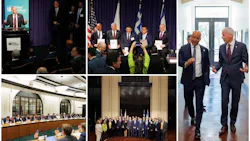
The Baker Institute for Public Policy at Rice University has launched an Eastern Mediterranean Energy Center in partnership with the US Department of Energy, an initiative designed to support investment, infrastructure expansion and policy dialogue across one of the world’s emerging offshore energy regions.
The center will focus on generating research and facilitating collaboration among regional stakeholders to help unlock the Eastern Mediterranean’s substantial offshore resource potential. With significant gas discoveries already made offshore Israel, Cyprus and Egypt, the initiative is expected to place particular emphasis on offshore development opportunities and the infrastructure needed to bring those resources to market.

“The new center will be focused on understanding pathways to unlock greater investment in resource development and infrastructure expansion across the energy landscape in the region,” said Ken Medlock, senior director of the Baker Institute’s Center for Energy Studies, told Offshore. “Given the resource endowments of the East Med, there will be a significant focus on offshore opportunities, as well as the collaborative pathways that can be leveraged for success across countries in the region.”
A key objective is to deepen regional energy markets by supporting infrastructure buildout and encouraging broader participation among governments, operators and investors. The center also plans to work with institutions across the Eastern Mediterranean to produce research aimed at informing policy discussions and industry decision-making.
According to Medlock, the initiative is intended to bring together stakeholders to address commercial and geopolitical challenges while improving overall project outcomes.
“A principal aim is to facilitate a deepening of energy markets through infrastructure investment and market participation,” he said. “The center will work with other institutions in the region to generate research that will inform various dialogues and convenings to elevate critical issues so that decision makers in governments and industry can work toward more efficient, successful, Pareto improving outcomes.”
While the Eastern Mediterranean already has a favorable outlook for offshore oil, gas and energy transition projects, the center is expected to act as a catalyst for further development by providing a platform for multidisciplinary research and knowledge exchange.
“The region’s outlook is promising regardless of this initiative,” Medlock said. “The aim for the East Med Energy Center is to facilitate deep, multi-disciplinary research that serves as a multiplier for the region.”
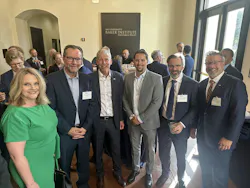
Source: Joshua Clover | LinkedIn
For offshore operators, service providers and investors, engagement with the center could offer a strategic advantage as regional energy markets evolve. Medlock emphasized that active participation will be critical for companies seeking to navigate the region’s complex investment landscape.
“It is important to be part of the conversation,” he said. “Companies across the value chain with active investment interests in the region will be much more successful by being directly engaged… Better outcomes are achieved by working together toward a common goal.”
The launch of the center comes at a time of increasing global focus on energy security and regional supply diversification, positioning the Eastern Mediterranean as a potentially important offshore growth area in the years ahead.
Source: Rice University YouTube
Exclusive content:
 drillship offshore Namibia
 Offshore equipment on the coast of the Persian Gulf at the Saudi Arabia port
About the Author
 Ariana Hurtado
Ariana Hurtado
Editor-in-Chief
With more than a decade of copy editing, project management and journalism experience, Ariana Hurtado is a seasoned managing editor born and raised in the energy capital of the world—Houston, Texas. She currently serves as editor-in-chief of Offshore, overseeing the editorial team, its content and the brand's growth from a digital perspective.
Utilizing her editorial expertise, she manages digital media for the Offshore team. She also helps create and oversee new special industry reports and revolutionizes existing supplements, while also contributing content to Offshore's magazine, newsletters and website as a copy editor and writer.
Prior to her current role, she served as Offshore's editor and director of special reports from April 2022 to December 2024. Before joining Offshore, she served as senior managing editor of publications with Hart Energy. Prior to her nearly nine years with Hart, she worked on the copy desk as a news editor at the Houston Chronicle.
She graduated magna cum laude with a bachelor's degree in journalism from the University of Houston.