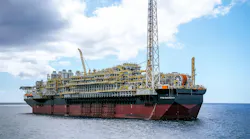
MODEC has provided an update on its Solid Oxide Fuel Cell (SOFC) power systems development for FPSOs, a collaboration with Eld Energy.
What does the qualification milestone mean?
The duo has completed the Technology Feasibility and Concept Verification stage under ABS’ New Technology Qualification (NTQ) process. According to the companies, the milestone confirms the safety, reliability and regulatory compliance of the SOFC technology for offshore applications.
Interest in alternative FPSO power generation technologies has grown as operators seek to reduce emissions, improve energy efficiency and support broader decarbonization goals. SOFCs can generate electricity from fuel gases through an electrochemical process rather than combustion, potentially lowering emissions while maximizing the use of produced gas.
Eld’s 40-kW power module is designed to harness gas produced on FPSOs and hydrogen-rich gas recycled from integrated carbon capture systems. The partners said the system could achieve overall power generation efficiency of up to 70%.
For comparison, conventional offshore gas-fired power generation systems typically operate at lower efficiency levels, making fuel-cell-based approaches increasingly attractive for emissions-reduction initiatives.
“SOFC technology has real potential to change the emissions profile of FPSO power generation," said Matt Tremblay, SVP of Global Offshore Markets at ABS. “The ABS NTQ process gives MODEC and Eld Energy a structured way to demonstrate that the technology as claimed and that the risks are understood and managed before it goes offshore. The milestones they have achieved to date reflect serious, systematic engineering work, and that's the kind of progress that moves this technology closer to routine offshore use.”
Next steps toward offshore deployment
MODEC plans to integrate the technology into an operational FPSO to monitor the system’s performance in actual offshore conditions, subject to completing an NTQ prototype validation stage and associated ABS engineering reviews for the installation.
Results from the offshore pilot test campaign should support subsequent development phases, including scaling up to a 120-kW module ready for integration with carbon capture systems, followed by a multi-MW Class solution.
Aside from the independent ABS review, the partners have conducted HAZID, HAZOP and FMEA risk assessments.