Simulation and VR training: Preparing offshore crews before it matters
Offshore energy operations leave little room for error.
Long before a worker steps foot on a rig—or a critical decision is made—training sets the foundation for what happens offshore.
Today, high-fidelity simulators offer some of the most realistic training environments available, and an increasing number of companies are also investing in virtual reality as a workforce development tool.
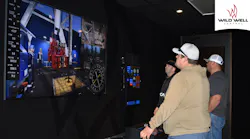
Recently, the Offshore team toured both the Maersk Training facility and Noble Corporation’s NobleAdvances training center in Houston to better understand how simulation and immersive technologies are reshaping preparation for offshore work.
Maersk Training
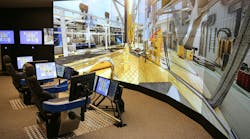
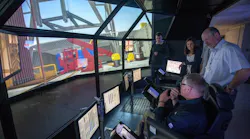
At Maersk Training's advanced training center, immersive simulators place crews into complex offshore scenarios. Teamwork, communication and decision-making are tested under pressure.
The focus isn't just technical competence. It's about human performance – how people react when conditions change, information is incomplete and time matters.
Maersk Training uses advanced immersive drilling simulators to support this learning. These give workers familiarity and realism before operating offshore.
Its drilling simulator represents deepwater rig systems and allows instructors to customize scenarios around critical risks unique to each contractor.
These simulations also emphasize communication, alert strategies and downhole monitoring.
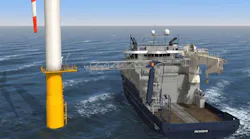
There are also maritime bridge simulation rooms, which are designed to replicate real-life marine environments, allowing instructors to introduce failures and challenging scenarios that crews may encounter at sea.
Noble Corp.
At Noble, training and operations are tightly linked.
The Noble Operational Risk Management System – known as NORMS - is a centralized planning and learning center that shares lessons from across the fleet so each critical operation benefits from the experience gained on other rigs.
NORMS is reserved for senior personnel with extensive offshore experience. A rotating group of subject matter experts works with real-time operational data, focusing not on crisis management, but on identifying and mitigating risks before they escalate.
Meanwhile, NobleAdvances Training Center delivers simulator-based drilling training through interconnected rig simulations and virtual classrooms.
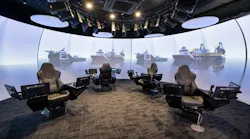
For entry-level workers, Noble has collaborated with Kongsberg to develop a simulation room capable of replicating virtually any marine environment. With wraparound screens and the same control panels found on offshore rigs, trainees can experience challenging and worstcase scenarios in a controlled setting rather than offshore.
Noble’s drilling simulator programs typically span several days, progressing from equipment familiarization to increasingly complex problem-solving exercises. The combined client and rig crew sessions conclude with instructor feedback tailored to each participant.
The company also expects mobile simulators to be available starting this year, an effort aimed at reducing travel while keeping employees closer to home.
Virtual reality
Both Maersk Training and Noble also use virtual reality training for new hires.
VR courses provide practical, hands-on exposure to tasks such as working in confined spaces, working at heights, and performing safe mechanical lifting and driving activities.
As these platforms continue to evolve, artificial intelligence is beginning to add another layer of realism. AI-enabled tools can help assess responses to simulated scenarios and, in early applications, evaluate elements of soft skills, such as communication and engagement during challenging conversations.
In summary
Simulation allows companies to capture fleetwide knowledge and share lessons learned before workers ever set foot offshore.
Across the offshore oil and gas industry, simulation and immersive technologies are becoming central to workforce development.
From advanced simulators to virtual and mixed reality environments, training is shifting away from one-time events toward continuous preparation, without putting people, assets or production at risk.
Want more content like this?
 Saipem has launched its Drilling Training Centre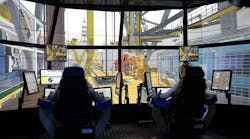
 Kongsberg Simulator 2022 03 17 084702
 Decommissioning Simulator
About the Author
 Ariana Hurtado
Ariana Hurtado
Editor-in-Chief
With more than a decade of copy editing, project management and journalism experience, Ariana Hurtado is a seasoned managing editor born and raised in the energy capital of the world—Houston, Texas. She currently serves as editor-in-chief of Offshore, overseeing the editorial team, its content and the brand's growth from a digital perspective.
Utilizing her editorial expertise, she manages digital media for the Offshore team. She also helps create and oversee new special industry reports and revolutionizes existing supplements, while also contributing content to Offshore's magazine, newsletters and website as a copy editor and writer.
Prior to her current role, she served as Offshore's editor and director of special reports from April 2022 to December 2024. Before joining Offshore, she served as senior managing editor of publications with Hart Energy. Prior to her nearly nine years with Hart, she worked on the copy desk as a news editor at the Houston Chronicle.
She graduated magna cum laude with a bachelor's degree in journalism from the University of Houston.