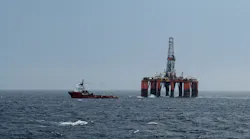
CIMC Raffles has completed the hull of Petrobras FPSO P-84 at its Yantai yard, a milestone in one of Brazil’s largest new floating production units and in Petrobras’s push toward lower-emission offshore plants.
The hull was finished on September 3, 2026. Chinese state media described the vessel as the first large FPSO built around an all-electric architecture, and the largest FPSO hull project yet undertaken by a Chinese yard. Project manager Luo Xi said P-84 is also among the biggest units in Petrobras history, with a design oil rate of 225,000 barrels per day.
The completed hull measures 345.3 meters long, 64.8 meters wide and 34.3 meters deep, with a steel weight of more than 100,000 tonnes. Storage is about 2 million barrels of crude. Gas handling capacity is 10 million cubic meters per day. The unit is destined for the Atapu field in the Santos Basin pre-salt, roughly 200 kilometers off Rio de Janeiro. Sister ship P-85, following the same design, is intended for Sépia.
P-84 is not battery-powered and will still generate electricity from produced gas. “All-electric” here means process pumps and compressors are driven by electric motors rather than mechanical take-off from gas turbines, combined with waste-heat recovery, variable-speed drives, deep-seawater cooling, cargo-tank hydrocarbon blanketing, flare-gas recovery and zero routine flaring and venting.
Petrobras and contractor Seatrium have said the package should cut greenhouse-gas intensity by about 30% versus earlier large Brazilian FPSOs.
Seatrium, the Singapore group formed from Sembcorp Marine and Keppel Offshore & Marine, holds the main EPC contracts awarded by Petrobras in 2024, valued at about $8.16 billion for the P-84/P-85 pair. CIMC Raffles, a CIMC Group yard, is a subcontractor for the hulls, living quarters and the M15B module. The two companies are not affiliated. Steel cutting for the P-84 hull took place in Yantai in November 2024.
The hull is only the first major block. Topsides fabrication for P-84 began in June 2025 at Seatrium’s Angra dos Reis yard in Brazil, formerly BrasFels. KBR is providing topsides engineering; ABB is supplying electrical systems, eHouses and substation automation for hull and topsides. Seatrium’s plan remains module work across Brazil, China and Singapore, then integration and commissioning in Singapore before tow-out to Brazil. First oil is still targeted around 2029–2030.
For CIMC Raffles the delivery continues a run of Petrobras hull work that already includes P-71 and hulls or blocks for later P-series units. For Petrobras it is a step in a standardized, higher-capacity, lower-intensity FPSO design. The processing plant that will make the all-electric concept work is still being built.