Barents Sea Castberg partners sanction first subsea tieback
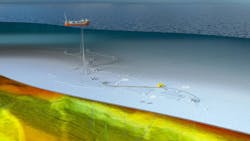
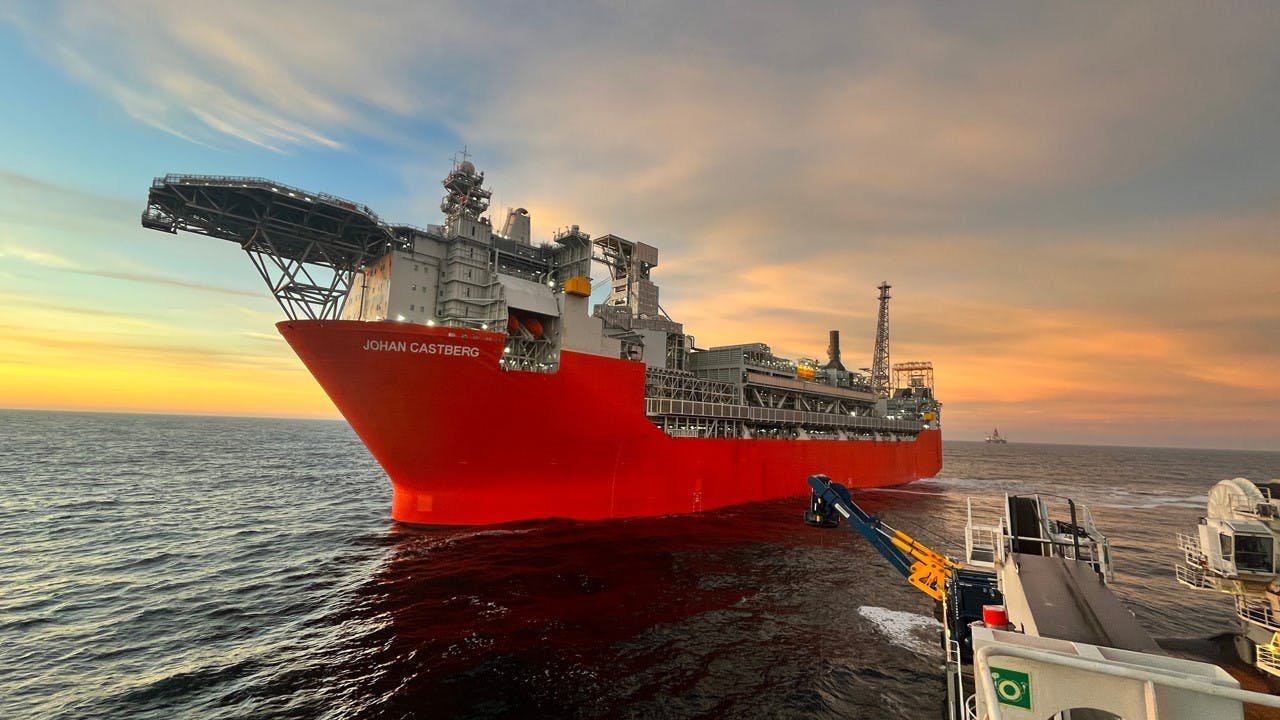
Equinor and partners Vår Energi and Petoro have sanctioned the first subsea tieback to the Johan Castberg FPSO in the Barents Sea, which started operations in March.
The NOK4 billion-plus (US$990 million) tieback of the 46-MMbbl Isflak discovery, made in 2021, will involve drilling two wells from a new subsea template that will be connected via pipelines and umbilicals to the Castberg subsea infrastructure.
Isflak could go onstream in first-quarter 2028.
As the planned new facilities are wholly within the current Johan Castberg license (PL 532), Equinor is seeking confirmation from Norway’s Ministry of Energy that it has already fulfilled the impact assessment obligation for the new project, and it can therefore expect to waive the requirement for a plan for development and operation (PDO).
The company added that it had assessed global combustion emissions in line with new practice on the Norwegian Continental Shelf (NCS).
“A rapid development is possible because we can copy standardized solutions from Johan Castberg,” said Trond Bokn, Equnior's senior vice president (SVP) for project development. “The reservoir is in the same license and is similar to the discoveries we have developed previously, which means that we can copy equipment and well solutions. Johan Castberg has been developed as a future hub in the area. Isflak from 2021 is the first of several discoveries that are now being matured as additional volumes.”
The Johan Castberg Field, comprising the 2011-14 Skrugard, Havis and Drivis discoveries, is 240 km offshore Hammerfest and 100 km north of the Snøhvit gas-condensate field.
Current production is 220,000 bbl/d, and further new projects and wells are planned to extend plateau production. Equinor continues to estimate Castberg’s recoverable volumes in the range 450 MMbbl to 650 MMbbl, but it insists the actual total could be higher.
Grete Birgitte Haaland, Equinor's SVP for Exploration & Production North, said, “We see opportunities to add 250 to 550 million new recoverable barrels that can be developed and produced over Johan Castberg. The partnership is already planning six new wells for improved oil recovery, and we will explore more in the area.”
Earlier this year, Equinor drilled a discovery in a new section of the Johan Castberg license, Drivis Tubåen, as an exploratory extension from a production well. The partners are in talks with the authorities on bringing it quickly into production.
What is an FPSO?
Floating production storage and offloading units (FPSOs) are pivotal in offshore oil extraction, especially in remote and deepwater environments, leveraging digital twins, modular design and automation to improve efficiency, safety and sustainability.
*Offshore’s new “What Is…?” educational series provides concise, practical explainers for emerging professionals.
The Johan Castberg FPSO is connected to 30 wells on 10 subsea templates and two satellite structures.
Partners Equinor Energy (operator, 46.3%), Vår Energi (30%) and Petoro (23.7%) have identified four additional prospects that they plan to drill in 2026 and 2027, Vår Energi reported. Their ultimate goal is to develop more than 1 Bbbl from the area and to sustain plateau production out to 2030.
"Equinor's ambition is to maintain the production level on the NCS from 2020 until 2035, although production from the current fields will decline,” Haaland added. “A significant part will come from new wells and projects. We are planning about 75 subsea developments in the next few years, and this project is a good example of how this can be done efficiently working closely with license partners and authorities."
About the Author

Jeremy Beckman
Staff Writer / Editor, Europe
Jeremy Beckman has been Editor Europe, Offshore since 1992. Prior to joining Offshore he was a freelance journalist for eight years, working for a variety of electronics, computing and scientific journals in the UK. He regularly writes news columns on trends and events both in the NW Europe offshore region and globally. He also writes features on developments and technology in exploration and production.