Autonomous subsea monitoring gains traction in the Gulf of Mexico
Key highlights:
- Bedrock Ocean operates one of the largest private fleets of AUVs, enabling scalable and flexible subsea data collection across multiple projects.
- The use of autonomous vehicles reduces vessel time, personnel requirements and turnaround times from days to minutes.
- Future developments include multi-AUV deployments that support safer, more frequent inspections and precise asset location for decommissioning.
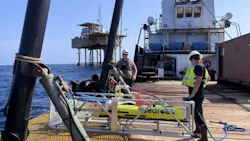
As offshore operators in the Gulf of Mexico (GoM) look to improve subsea visibility while controlling costs, autonomous underwater vehicles (AUVs) play a growing role in inspection and monitoring programs.
Bedrock Ocean, a Richmond, Calif.-based subsea technology company, has expanded deployments across the Gulf, alongside projects in the North Sea, reflecting the rising demand for faster, more flexible subsea data collection.

Bedrock has the ability to mobilize quickly and operate from a range of vessels rather than relying on dedicated survey vessels. According to recently named CEO Matt Tirman, that operational flexibility has proven especially valuable in mature basins where operators are looking to limit vessel time without sacrificing data quality.
“Bedrock’s ability to rapidly mobilize equipment and personnel for efficient surveys at relevant depths has been key to building experience,” Tirman told Offshore. “A major growth driver in the North Sea has been the flexibility to deploy off various vessels of opportunity like supply vessels already on location, eliminating the cost of hiring dedicated survey vessels.”
In the Gulf of Mexico, Bedrock’s current work is focused entirely on oil and gas infrastructure monitoring. Demand is being driven by operators seeking alternatives to traditional inspection workflows, which can be vessel- and personnel-intensive and limit inspection frequency.
“AUV‑based surveys deliver higher quality data with fewer personnel and vessels, and compress turnaround from days to minutes,” he said. “The economics also open the door to more frequent and detailed inspections without added cost.”
Bedrock operates what it describes as one of the largest private fleets of AUVs, allowing the company to scale deployments based on project needs. Tirman noted that fleet scalability, combined with low logistics requirements, changes both project economics and how operators think about survey planning.
“The main benefit of having a scalable fleet of AUVs, with low logistics requirements, is that we can deploy multiple units to best address our customer’s specific work scope requirements,” he said. “We can do this on a wide range of vessels of opportunity, and Bedrock’s proprietary software can handle data from multiple AUVs on the same survey.”
Rather than working exclusively through direct operator contracts, many of Bedrock’s GoM deployments are executed in partnership with offshore service companies. That model, Tirman said, helps accelerate adoption by integrating autonomous data into existing survey deliverables.
“We find that providing the AUV data under a DaaS [data as a service] model allows our customers to gain access to the AUV survey capability and very easily integrate that data product into their survey deliverable,” he added.
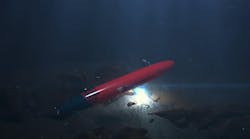 Terradepth AUV survey
Looking ahead, Tirman sees autonomous subsea data collection becoming increasingly central to operations in mature basins like the Gulf, particularly as decommissioning activity accelerates. Multi‑AUV deployments with minimal topside support could enable more frequent surveys, better data quality and safer offshore work.
“The future points to multi‑AUV deployments with minimal topside support, enabling truly autonomous operations and better data quality at greater efficiency,” Tirman concluded. “The technology is also well‑positioned for decommissioning by providing precise asset locations to support divers, reducing dive time and enabling close‑proximity platform surveys that improve data quality over traditional methods.”
This article is part of Offshore's 2026 Gulf of Mexico Regional Report.
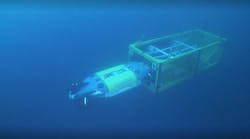 Freedom AUV underwater trials
About the Author
 Ariana Hurtado
Ariana Hurtado
Editor-in-Chief
With more than a decade of copy editing, project management and journalism experience, Ariana Hurtado is a seasoned managing editor born and raised in the energy capital of the world—Houston, Texas. She currently serves as editor-in-chief of Offshore, overseeing the editorial team, its content and the brand's growth from a digital perspective.
Utilizing her editorial expertise, she manages digital media for the Offshore team. She also helps create and oversee new special industry reports and revolutionizes existing supplements, while also contributing content to Offshore's magazine, newsletters and website as a copy editor and writer.
Prior to her current role, she served as Offshore's editor and director of special reports from April 2022 to December 2024. Before joining Offshore, she served as senior managing editor of publications with Hart Energy. Prior to her nearly nine years with Hart, she worked on the copy desk as a news editor at the Houston Chronicle.
She graduated magna cum laude with a bachelor's degree in journalism from the University of Houston.
Related
