Wood Mackenzie: FLNG will be the primary route to supply diversification by 2030
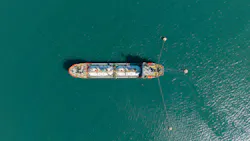
A new report from Wood Mackenzie projects that by 2030, roughly half of global LNG production capacity will reside in two countries – suggesting an opening for new FLNG projects.
The Wood Mackenzie press release related to the report does not name the two countries, but in this market context they are understood to be the United States and Qatar.
Under an extended disruption to Gulf LNG supply, Wood Mackenzie estimates that global availability could run approximately 70 MMtpa below pre-conflict levels to 2035. “Gulf LNG supply” is again not defined, but is understood to be a reference to LNG supply from the Persian Gulf.
The press release notes that seven floating LNG projects sanctioned since 2023, adding 18 MMtpa of new capacity across six countries, represent the market’s most direct response to both pressures.
The new Wood Mackenzie research, drawn from its Wood Mackenzie Lens LNG Asset Discovery and Lens LNG Valuations, identifies four forces shaping whether that momentum will continue: FLNG’s role in supply diversification; its position as a strategic rather than opportunistic tool; the redeployment economics that distinguish it from fixed onshore infrastructure; and a structural gap in commercial ownership that constrains its next growth phase.
“Seven projects sanctioned in three years, backed by infrastructure investors, IOCs, and LNG traders, is not a technology bet,” said Fraser Carson, Principal Research Analyst, Global LNG, Wood Mackenzie. “The cost gap with onshore has closed and floating LNG now competes on merit in the locations that matter. Cost and technology are no longer the constraints. The question is whether commercial structures catch up with the opportunity. One company currently provides FLNG as a service to the entire global market. That single provider sits opposite a pre-FID pipeline of over 80 MMtpa.”
The diversification case is geographic, not volumetric. All proposed new LNG capacity in South America and West Africa is based floating design concepts. For producers in Argentina’s Vaca Muerta and across West African gas provinces, floating LNG is frequently the only credible export route. The technology accounts for less than 10% of new global liquefaction supply but its value lies in reach, opening resources that conventional approaches cannot serve, not in the aggregate volumes it delivers.
FLNG remains a deliberate choice rather than a default, says Wood Mackenzie. Where it competes directly with low-cost modular onshore projects, the economics can be tight. Where it commercializes stranded or offshore resources with no alternative path to market, the case is clear. The question for developers is not whether the technology works, but where.
The economics confirm a cost threshold has been crossed. The June 2026 final investment decision on Delfin LNG FLNG 1, the first floating LNG export facility in the United States and, at 4.4 MMtpa, the largest single FLNG unit sanctioned globally, came in at approximately US$932 per tonne, competitive with recent onshore US LNG FIDs. Conversions and standardized newbuilds can reach market at or below the sector benchmark of approximately US$950 to US$1,000 per tonne. Plant breakevens for recent projects cluster between US$2.3 and US$4.6 per MMBtu. FLNG fleet utilization averaged 88% in 2024 and 2025, above the 85% onshore average. Operating costs remain structurally higher than onshore, running at approximately 3 to 5% of total capex per year.
Redeployment is the investment attribute that distinguishes FLNG most from fixed onshore infrastructure. Redeploying an existing vessel costs a fraction of building new: Hilli’s redeployment costs to date stand at approximately US$350million, against US$1.5 to US$2 billion for a newbuild FLNG. That difference funds a market entry, not a maintenance budget. Golar LNG’s Hilli vessel recovered its approximately US$1.3 billion conversion cost across an eight-year Cameroon charter by 2023, generating approximately US$2.1 billion in tolling EBITDA in the process. A redeployment budget of approximately US$350 million and roughly one year of downtime now unlocks a 20-year charter in Argentina with Southern Energy. That single contract is expected to produce approximately US$5.9 billion in contracted revenues. No fixed onshore plant can replicate that sequence. Moving within a 30 to 35-year hull life also cuts exposure to upstream resource depletion and single-country risk.
The sector’s most visible structural gap is commercial. Of 15 operational and under-construction FLNGs, 12 are project-owned and three are lease-and-operate, all belonging to Golar LNG, which committed to a fourth vessel on a speculative basis in 2026. The lease-and-operate model transfers construction and financing risk to the vessel owner, lowering the capital barrier for frontier producers who lack the balance sheet for a fully integrated project. One provider serving the entire market is a constraint. With well over 80 MMtpa of known FLNG proposals in the pre-FID pipeline, and an additional 160 Tcf of undeveloped upstream assets suited to FLNG globally, the opening for new entrants is substantial.
Summary analysis
In summary, Wood Mackenzie finds that FLNG has moved from a niche workaround to a real supply option, mainly because the market is getting more concentrated and more geopolitically fragile. Wood Mackenzie’s claim has three parts:
- By 2030, about half of global LNG capacity will sit in two countries — the United States and Qatar. At the same time, an extended disruption to Persian Gulf LNG (Strait of Hormuz/Qatar) could leave the market about 70 million tonnes a year short of pre-conflict expectations out to 2035. Concentration plus chokepoint risk is the problem FLNG is being sold against.
2. FLNG is now competitive enough to be the answer in places onshore LNG cannot reach. Seven projects sanctioned since 2023 add 18 million tonnes a year across six countries. Costs have closed on onshore: Delfin in the US came in around $932 per tonne, in line with recent US onshore FIDs, and plant breakevens on recent FLNG sit roughly in the $2.3–$4.6 per MMBtu range. Utilization has also been a bit higher than onshore. It is still not the default where cheap modular onshore works; it is the credible route for stranded or offshore gas, especially in Argentina and West Africa, where Wood Mackenzie says all proposed new LNG is floating.
3. The remaining constraint is commercial, not technical. Most operating and under-construction FLNGs are owned by the project. Only Golar provides lease-and-operate service, and it is the sole provider facing a pre-FID pipeline of more than 80 million tonnes a year. Redeployment is the economic edge fixed plants lack: moving an existing hull costs a fraction of a newbuild and lets the owner escape a depleted field or a single-country risk.
About the Author
 Bruce Beaubouef
Bruce Beaubouef
Senior Lead Reporter / Managing Editor
Bruce Beaubouef is Managing Editor for Offshore magazine. In that capacity, he plans and oversees content for the magazine; writes features on technologies and trends for the magazine; writes news updates for the website; creates and moderates topical webinars; and creates videos that focus on offshore oil and gas and renewable energies. Beaubouef has been in the oil and gas trade media for 25 years, starting out as Editor of Hart’s Pipeline Digest in 1998. From there, he went on to serve as Associate Editor for Pipe Line and Gas Industry for Gulf Publishing for four years before rejoining Hart Publications as Editor of PipeLine and Gas Technology in 2003. He joined Offshore magazine as Managing Editor in 2010, at that time owned by PennWell Corp. Beaubouef earned his Ph.D. at the University of Houston in 1997, and his dissertation was published in book form by Texas A&M University Press in September 2007 as The Strategic Petroleum Reserve: U.S. Energy Security and Oil Politics, 1975-2005.