Hydrocarbons battle brewing offshore California
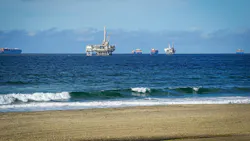
There is a sharp political-regulatory battle underway over oil and gas development offshore California. Right now, activity centers almost entirely on restarting long-idled, grandfathered platforms in federal waters rather than any new drilling or platforms.
The Trump administration has aggressively pushed to revive production at the Santa Ynez Unit (SYU) using federal authority, while California state officials, environmental groups, and local governments are fighting it on safety, permitting, and environmental grounds. This federal-state clash has moved beyond rhetoric — actual production and oil sales have resumed in recent weeks.
Historical context
The 1969 Santa Barbara spill (Platform A, Dos Cuadras field) released roughly three million gallons of crude and became a defining moment for the modern environmental movement. The more recent 2015 Refugio spill — caused by a corroded onshore pipeline in the Santa Ynez Pipeline System — released 140,000–450,000 gallons and shut down the entire SYU for years. Sable Offshore Corp. acquired the assets from ExxonMobil in 2024 and has worked since then to restart operations.
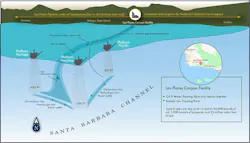
The SYU consists of three fixed platforms (Harmony, Heritage, and Hondo) in the Santa Barbara Channel, 5–8 miles offshore in federal waters. All were installed in the 1970s–1980s on grandfathered leases.
The restart
In March 2026, the Trump administration invoked the Defense Production Act (DPA), with Energy Secretary Chris Wright issuing a formal order on March 13 directing Sable to restart the full SYU and its pipeline system.
Sable Chairman and CEO Jim Flores welcomed the move, stating: “Sable Offshore is putting California consumers first by increasing domestic supply of crude oil into the California market by approximately 17%.”
As follows:
- Platform Harmony: Restarted earlier in 2026; currently producing ~22,000 b/d.
- Platform Heritage: BSEE cleared it for restart in early April after safety inspections; expected to add more than 30,000 b/d.
- Platform Hondo: Targeted for restart by end of 2Q 2026, with potential for another ~10,000-plus b/d.
Combined potential is 50,000–60,000 b/d once fully online. Oil sales via the Santa Ynez Pipeline began around March 30, 2026. As of April 13, the Department of Transportation’s PHMSA confirmed it was on site last week overseeing safe pipeline operations.
California’s pushback
California officials — including Gov. Newsom, Attorney General Rob Bonta, the Coastal Commission, and the State Fire Marshal — have strongly opposed the restart. They have denied key state permits, cited lingering safety risks from the 2015 spill, and filed lawsuits arguing the DPA order is an unlawful overreach that violates the Administrative Procedure Act (APA), the Tenth Amendment, and existing state court orders. The litigation is ongoing and could still create delays, even as oil is now flowing.
Looking ahead
No new platforms have been built or approved offshore California in roughly 35–40 years — the last ones were installed in the late 1980s. A handful of other grandfathered platforms in the Santa Barbara Channel and Ventura areas continue modest production but are not seeing major activity.
Longer term, the Trump administration’s draft 2026–2031 OCS leasing program proposes six new lease sales off California, with the first possible in 2027. This would be the first new federal leasing since 1984. BOEM has already begun early environmental reviews, but California has vehemently opposed the plan, and lawsuits are expected.
The immediate story is the SYU restart, enabled by federal action over state objections. The bigger long-term debate will center on potential new federal lease sales off California. But any new E&P efforts remain years away at best and will face massive state and local opposition.
THUMS Islands: creative camouflage
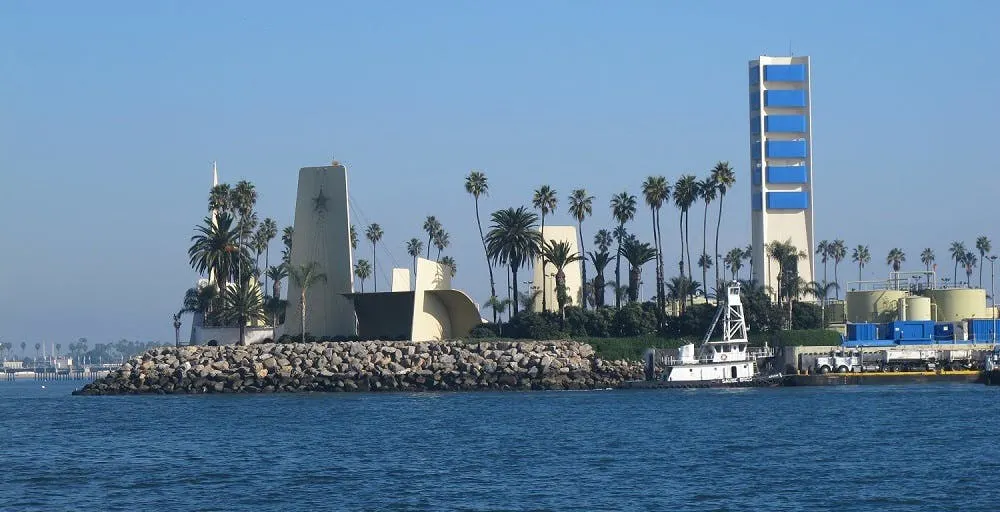
The THUMS Islands off Long Beach offer a classic example of California’s early balancing act between energy development and coastal aesthetics. Built in 1965, these four man-made islands tap the offshore extension of the Wilmington field. A consortium of five majors (Texaco, Humble/Exxon, Union, Mobil, and Shell) created them after Long Beach voters demanded the facilities enhance rather than detract from the harbor’s beauty.
Landscape architect Joseph Linesch (who worked on Disneyland) led the design, which included palm trees, illuminated waterfalls, colorful towers, and abstract screens to hide drilling rigs. The islands were even renamed after fallen astronauts (Grissom, White, Chaffee, Freeman) in 1967. Still producing today under California Resources Corporation, the THUMS Islands remain a unique mid-1960s example of industrial camouflage and continue to intrigue visitors who mistake them for resorts.
About the Author
 Bruce Beaubouef
Bruce Beaubouef
Senior Lead Reporter / Managing Editor
Bruce Beaubouef is Managing Editor for Offshore magazine. In that capacity, he plans and oversees content for the magazine; writes features on technologies and trends for the magazine; writes news updates for the website; creates and moderates topical webinars; and creates videos that focus on offshore oil and gas and renewable energies. Beaubouef has been in the oil and gas trade media for 25 years, starting out as Editor of Hart’s Pipeline Digest in 1998. From there, he went on to serve as Associate Editor for Pipe Line and Gas Industry for Gulf Publishing for four years before rejoining Hart Publications as Editor of PipeLine and Gas Technology in 2003. He joined Offshore magazine as Managing Editor in 2010, at that time owned by PennWell Corp. Beaubouef earned his Ph.D. at the University of Houston in 1997, and his dissertation was published in book form by Texas A&M University Press in September 2007 as The Strategic Petroleum Reserve: U.S. Energy Security and Oil Politics, 1975-2005.