Persian Gulf tensions force several offshore drillers to suspend or scale back operations
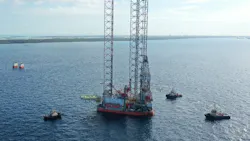
Several offshore drilling contractors operating in GCC waters — the Gulf Cooperation Council region encompassing Saudi Arabia, the UAE, Qatar and other Arab Gulf states — have temporarily suspended or scaled back activities on some rigs due to escalating regional tensions triggered by the ongoing US-Israel military campaign against Iran.
Saudi Arabia’s Arabian Drilling, the largest drilling contractor in the kingdom by fleet size, announced on March 26, 2026, that it had received notifications for the temporary suspension of operations on several of its offshore rigs in the Arabian Gulf. The precautionary step was taken in coordination with clients and in line with the company’s established safety and operational protocols, with personnel safety and asset integrity as the highest priorities.
Fahad Albani, Chief Executive Officer of Arabian Drilling, said: “Safety remains our absolute priority. The temporary suspensions reflect a disciplined and precautionary approach taken in close coordination with our client, with the wellbeing of our people and the integrity of our assets at the forefront.
“Our land fleet serves as the foundation of our operations. With 39 land rigs operating without interruption, we consistently illustrate the resilience of our business model.”
The company stressed that only a portion of its offshore fleet is affected. Its full land-based fleet of 39 rigs continues to operate at full capacity. Arabian Drilling expects minimal financial impact in 1Q 2026 and anticipates a swift resumption once conditions normalize.
“Based on ongoing client discussions and our assessment of recent developments, management believes the suspensions are temporary. The company is prepared to resume operations promptly once regional tensions ease,” it added.
The move follows a similar announcement by fellow Saudi contractor ADES Holding on March 24, which reported temporary suspensions on “a handful” of its offshore rigs in the GCC region due to the same tensions. ADES described the suspensions as short-term.
Borr Drilling also took precautionary action earlier in March, down-manning (significantly reducing crew levels and scaling back operations on) three of its jack-up rigs in Qatar and the United Arab Emirates at the request of customers. Separately, its Arabia III jackup rig offshore Saudi Arabia was shut down on March 7 after an incident occurred on the customer-operated platform it was servicing; the rig was safely secured and all personnel were evacuated with no injuries reported.
These rig-level disruptions come as broader energy operations in the region face pressure from shipping constraints in the Strait of Hormuz, including temporary production adjustments by some GCC producers. All three contractors have indicated that the measures are expected to be brief once regional stability returns, underscoring the relative resilience of onshore fleets amid short-term offshore challenges.
Exclusive content:
 Offshore and OGJ coverage on the conflict in the Middle East
About the Author
 Bruce Beaubouef
Bruce Beaubouef
Senior Lead Reporter / Managing Editor
Bruce Beaubouef is Managing Editor for Offshore magazine. In that capacity, he plans and oversees content for the magazine; writes features on technologies and trends for the magazine; writes news updates for the website; creates and moderates topical webinars; and creates videos that focus on offshore oil and gas and renewable energies. Beaubouef has been in the oil and gas trade media for 25 years, starting out as Editor of Hart’s Pipeline Digest in 1998. From there, he went on to serve as Associate Editor for Pipe Line and Gas Industry for Gulf Publishing for four years before rejoining Hart Publications as Editor of PipeLine and Gas Technology in 2003. He joined Offshore magazine as Managing Editor in 2010, at that time owned by PennWell Corp. Beaubouef earned his Ph.D. at the University of Houston in 1997, and his dissertation was published in book form by Texas A&M University Press in September 2007 as The Strategic Petroleum Reserve: U.S. Energy Security and Oil Politics, 1975-2005.
Related
