Israeli strike on Iranian South Pars gas field escalates Persian Gulf conflict
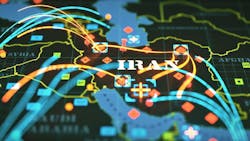
Iran’s South Pars gas field was hit on Wednesday (March 18) in the first reported strikes on Iran’s offshore energy infrastructure stemming from the conflict in the Middle East.
The attack prompted the government in Tehran to announce it would respond with attacks on oil and gas targets throughout the Gulf.
Oil prices shot up after the attack, a major escalation in a war that has already halted shipping from the world’s most important energy-producing region and could now bring lasting damage to its infrastructure. Benchmark Brent crude prices rose around 5% to above $108/bbl.
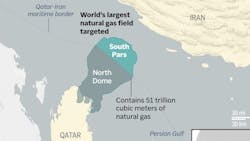
Pars is the Iranian sector of the world’s largest natural gas deposit, which Iran shares with Qatar across the Gulf. Iran’s Fars news agency reported that gas tanks and parts of a refinery had been hit, workers had been evacuated to a safe location and emergency crews were trying to put out a fire. State media later said the fire was under control.
The attack was widely reported in Israeli media to have been carried out by Israel with US consent, though neither country acknowledged immediate responsibility. The Israeli military did not respond to requests for comment.
Qatar, a close American ally which hosts the largest US airbase in the region, blamed the attack on Israel without mentioning any US role. The Qatari foreign ministry spokesperson called it a "dangerous and irresponsible" escalation that put global energy security at risk. The UAE also denounced the attack.
Iran listed an array of prominent regional oil and gas targets belonging to Saudi Arabia, the UAE and Qatar, which it said were now “direct and legitimate targets” and should be evacuated at once before it struck them in the coming hours.
Previously during nearly three weeks of war, the US and Israel had held back from targeting Iran's energy production facilities in the Gulf.
Iran has already shut the Strait of Hormuz where 20% of oil and liquefied natural gas is normally shipped past its coast, but consuming nations have hoped the disruption will be short-lived as long as production infrastructure is spared.
Iran’s warning was directed at Saudi Arabia’s Samref Refinery and Jubail Petrochemical Complex, the UAE’s Al Hosn Gas Field, and Qatar’s Mesaieed Petrochemical Complex, Mesaieed Holding Company and Ras Laffan Refinery.
The threat comes after Iranian state media reported that natural gas facilities associated with its offshore South Pars field – the largest gas field in the world, located off the coast of southern Iran’s Bushehr province – were attacked.
In a statement shared by Tasnim, Iran’s Ministry of Petroleum said that a number of facilities were damaged but no casualties were immediately reported. Iranian state media also reported that a fire at the gas field was under control.
Quoting unnamed sources, Israeli media reported that the country’s air force carried out the attack.
Majed al-Ansari, spokesperson for Qatar’s Ministry of Foreign Affairs, condemned Israel for targeting South Pars, noting that the Iranian gas field is an extension of Qatar’s North Field.
The attack marks “a dangerous and irresponsible step amid the current military escalation in the region,” al-Ansari said in a statement shared on social media. “Targeting energy infrastructure constitutes a threat to global energy security, as well as to the peoples of the region and its environment,” he wrote.
“We reiterate, as we have repeatedly emphasized, the necessity of avoiding the targeting of vital facilities. We call on all parties to exercise restraint, adhere to international law, and work toward de-escalation in a manner that preserves the security and stability of the region.”
 Offshore and OGJ coverage on the conflict in the Middle East
About the Author
 Bruce Beaubouef
Bruce Beaubouef
Senior Lead Reporter / Managing Editor
Bruce Beaubouef is Managing Editor for Offshore magazine. In that capacity, he plans and oversees content for the magazine; writes features on technologies and trends for the magazine; writes news updates for the website; creates and moderates topical webinars; and creates videos that focus on offshore oil and gas and renewable energies. Beaubouef has been in the oil and gas trade media for 25 years, starting out as Editor of Hart’s Pipeline Digest in 1998. From there, he went on to serve as Associate Editor for Pipe Line and Gas Industry for Gulf Publishing for four years before rejoining Hart Publications as Editor of PipeLine and Gas Technology in 2003. He joined Offshore magazine as Managing Editor in 2010, at that time owned by PennWell Corp. Beaubouef earned his Ph.D. at the University of Houston in 1997, and his dissertation was published in book form by Texas A&M University Press in September 2007 as The Strategic Petroleum Reserve: U.S. Energy Security and Oil Politics, 1975-2005.