Executive Q&A: Long-time offshore official takes aim at the deep-sea mining market
Key Highlights
- Deep Sea Minerals Corp. has received NOAA's substantial compliance determination, advancing its regulatory review process for seabed mining activities.
- The company's large Clarion-Clipperton Zone concession provides strategic scale, enabling targeted resource extraction and long-term growth potential.
- Leveraging over 25 years of oil and gas experience, CEO James Deckelman emphasizes risk management, responsible practices, and robust investment criteria for sustainable operations.
- Innovative robotic technology with AI-assisted faunal-avoidance minimizes environmental impact, addressing sediment disturbance and ecosystem recovery concerns.

By Bruce Beaubouef, Managing Editor
Deep-sea mining is moving from concept to regulatory reality as demand for critical minerals stays high amid a tempered energy transition. Companies are racing to secure seabed rights in the Clarion-Clipperton Zone and beyond, while navigating environmental scrutiny and complex permitting.
One of those companies is Deep Sea Minerals Corp. Originally founded in Vancouver in 2022 as a land-based minerals play (then called Copperhead Resources), the firm rebranded in early 2026 and shifted fully underwater after hiring James Deckelman as CEO in January. Deckelman brings more than 25 years of deepwater oil and gas experience from bp, ConocoPhillips, Talisman Energy, and BluEnergies.
Though legally Canadian, the company’s commercial focus is squarely on the US market and investors.
Deckelman recently spoke with Offshore about the firm’s recent NOAA substantial-compliance determination, its large Clarion-Clipperton Zone concession, technology choices aimed at limiting environmental impact, and the case for US investors and policymakers as Deep Sea Minerals pursues a Nasdaq listing.
Offshore: The [US] National Oceanic and Atmospheric Administration (NOAA) recently gave your DSHMRA application (Deep Seabed Hard Mineral Resources Act) substantial compliance. What does this mean for timelines and next milestones?
Deckelman: Receiving a determination of substantial compliance from the National Oceanic and Atmospheric Administration (NOAA) indicates that our application has met the first-stage completeness requirements to move forward with the federal review process.
It is not a license award, nor does it guarantee one, but it moves the application into the next stages of regulatory evaluation established by NOAA under the Deep Seabed Hard Mineral Resources Act. Importantly, it also establishes priority-of-right for the area contemplated in our application.

Offshore: Deep Sea Minerals Corp. has a roughly 150,000 sq km concession in the Clarion-Clipperton Zone. What strategic edge does that scale provide?
Deckelman: A concession of this size can provide scale, optionality, and a platform for long-term growth and cash flow. Regarding scale, a larger area can mean greater value potential. An area of this size allows a concession holder to prioritize areas of highest value for initial harvesting, thereby enhancing a project’s net present value (NPV) and accelerating cash flow.
A concession of this scale can provide optionality. As the distribution and grade of polymetallic nodules are not always uniform, a concession of this size allows a concession holder to selectively target areas with the greatest nodule density and highest nodule grade. It allows a concession holder to reduce exposure to areas that are less prospective through relinquishments, divestments, and/or equity interest assignments.
It can also provide a platform for long-term cash flow and growth. Long-term cash flow creates legacy assets that can sustain a company across commodity-price cycles, create a platform for long-term growth and diversification, attract further investment, and reward its shareholders.
Offshore: With your 25-plus years in the deepwater oil and gas market, what are the most important transferable lessons for deep-sea minerals?
Deckelman: The most important transferable lessons relate to 1) risk management; 2) responsible business practice; and 3) investment decision criteria. Let me go into these aspects individually.
Risk management. Irrespective of the sector, the nature of a business, or the country in which a business is operating, it is imperative to have portfolio and jurisdictional diversification to build a long-term sustainable business. No jurisdiction, no commodity, no sector is immune from risk. To mitigate this, Deep Sea Minerals Corp. is actively pursuing positions in waters beyond national jurisdiction (i.e. the Clarion-Clipperton Zone) as well as those in host country Exclusive Economic Zones such as the Cook Islands. We are also evaluating the American Samoa EEZ, where a lease sale may be held by the US Bureau of Ocean Energy Management.
Responsible, sustainable business practice. Deep Sea Minerals Corp. is a company with a conscience. We work and invest where we can make an enduring, positive impact on the communities with which we work, on the environment in which we work, and on the economies to which we contribute. Responsible business behavior is foundational to our business and to maintaining the trust of all stakeholders.
Robust investment decision criteria. Like offshore oil and gas, ours is a capital-intensive industry, one that has a long cycle time, and it is commodity-based. Yet, it can potentially deliver immense value. As such, a Final Investment Decision (FID), and subsequent investment decisions across a project’s life cycle, require strong project economics at the outset, stress-tested to accommodate the full range of cost uncertainties, scheduling uncertainties, production interruptions, commodity price cycles, the cost of debt, and fiscal regime changes.
Offshore: How will you address sediment plumes, habitat disruption, and the recovery of deep-sea ecosystems?
Deckelman: We plan to address potential environmental effects by first establishing fact-based environmental baselines, conducting continuous environmental monitoring, and deploying harvesting and other operational technologies designed to minimize environmental impact.
To that end, we have recently entered into a technology partnership with Impossible Metals, a company that provides tether-less, autonomous robotic harvesting equipment that hovers above the seafloor, contacting it only with a system of robotic arms to collect polymetallic nodules, one nodule at a time. Its AI-assisted faunal-avoidance technology reduces the potential for contact with marine life. Notably, this technology purposefully collects only a percentage of the nodules, leaving most of the habitat completely untouched.
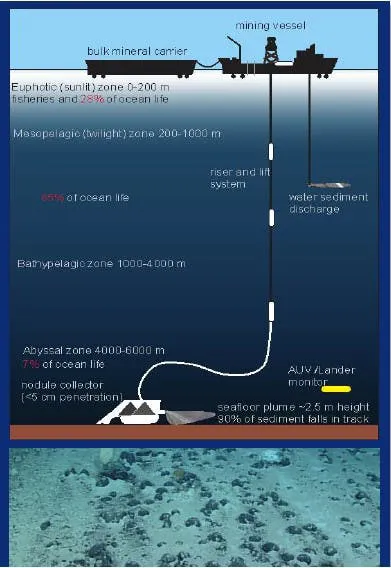
Uniquely, polymetallic nodules rest unattached to the sea floor and do not require drilling, blasting, excavation, deforestation, loss of carbon sequestration, high freshwater usage, or the community displacement sometimes associated with terrestrial mining. We operate below where 97% of marine life exists, and in less than one-tenth of 1% of the world's oceans. Collection activities may generate sediment disturbance, and those effects continue to be investigated.
Offshore: How are critical mineral supply shortages driving seabed interest, and where do these resources fit in the energy transition?
Deckelman: The energy transition relies on critical minerals, and the significant growth in demand for critical minerals is, in large part, a result of this. The IEA forecasts that the combined market value of key energy transition minerals, including cobalt, copper, graphite, lithium, nickel, and rare earths, will increase by 55% to over US$500 billion, by 2030, and will exceed US$700 billion by 2040. To support this growth, approximately US$590 billion in new mining capital investment will be required between 2024 and 2040.
Additionally, there is also a significant and growing supply-chain concentration. For these same minerals, the average market share of the top three producers rose from approximately 82% in 2020 to 86% in 2024, with almost all of this growth coming from the two top suppliers: Indonesia for nickel and China for the other critical minerals.
This is where seabed minerals enter the conversation. In our view, it is not about replacing terrestrial mining or recycling; it is about augmenting and diversifying those sources of supply. It is how renewable forms of energy such as wind and solar relate to oil and gas: they are supply additions, not supply replacements.
Offshore: As you pursue a Nasdaq listing, what is the key message for US investors and policymakers?
Deckelman: The key message for our investors is that a NASDAQ uplist could result in increased liquidity, greater visibility, access to institutional as well as retail capital, and access to a broader and more dynamic marketplace.
As it relates to US policymakers, the key messages are that recent policy initiatives are working and markets are responding. US Government initiatives are stimulating investment in the sector in the interest of securing a resilient and independent critical minerals supply chain for the United States.
About the Author
 Bruce Beaubouef
Bruce Beaubouef
Senior Lead Reporter / Managing Editor
Bruce Beaubouef is Managing Editor for Offshore magazine. In that capacity, he plans and oversees content for the magazine; writes features on technologies and trends for the magazine; writes news updates for the website; creates and moderates topical webinars; and creates videos that focus on offshore oil and gas and renewable energies. Beaubouef has been in the oil and gas trade media for 25 years, starting out as Editor of Hart’s Pipeline Digest in 1998. From there, he went on to serve as Associate Editor for Pipe Line and Gas Industry for Gulf Publishing for four years before rejoining Hart Publications as Editor of PipeLine and Gas Technology in 2003. He joined Offshore magazine as Managing Editor in 2010, at that time owned by PennWell Corp. Beaubouef earned his Ph.D. at the University of Houston in 1997, and his dissertation was published in book form by Texas A&M University Press in September 2007 as The Strategic Petroleum Reserve: U.S. Energy Security and Oil Politics, 1975-2005.