Detecting drones is getting easier but identifying them is the real offshore challenge
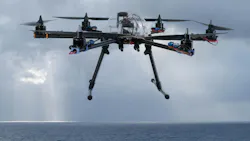
Offshore spoke with four subject matter experts to examine how operators can maintain airspace awareness as drone activity increases offshore and how they can distinguish authorized aircraft from unknown, spoofed or potentially hostile drones.

Editor's note: The analysis, insights and perspectives presented in this article are those of the interviewees (listed below) and do not necessarily reflect the views of the Offshore editorial staff.
-
Nonresident fellow, Baker Institute for Public Policy at Rice University
-
Expertise: National security, policy, regulation, threat environment
-
COO, FlyGuys
-
Expertise: Offshore drone operations, inspection workflows, practical realities
-
Co-founder and president, Powerus
-
Expertise: Counter-UAS technology, detection and response systems
-
Member, Institute for Operations Research and the Management Sciences (INFORMS)
-
Expertise: Data integrity, identity verification, sensor fusion, decision support
By Ariana Hurtado, Editor-in-chief
Offshore operators are deploying drones for everything from flare-stack inspections and structural surveys to pipeline monitoring, environmental programs and post-storm damage assessments. As adoption expands, unmanned aircraft are becoming a routine part of offshore operations, offering safer and more cost-effective alternatives to many traditional inspection methods.
According to Gabe Arrington, nonresident fellow at Rice University's Baker Institute for Public Policy, "You cannot ban your way to security offshore, and you should not want to. Drones are already the most cost-effective tool the industry has for inspecting flare stacks, risers and structural members, for surveying pipelines, and for assessing hurricane damage."
But the growing presence of drones offshore is creating a new challenge: maintaining awareness of increasingly crowded airspace and distinguishing authorized aircraft from unknown or potentially unauthorized drones. Industry experts say the question is no longer simply whether a drone can be detected, but whether operators can confidently determine who is flying it, why it is there and whether it belongs in the vicinity of critical offshore infrastructure.
Manikandan Chandran, a member of the Institute for Operations Research and the Management Sciences (INFORMS), noted that detecting an object is not the same as verifying its identity or intent.
As offshore energy companies expand their use of unmanned systems, experts from the security, technology, aviation and data analytics sectors say airspace awareness is emerging as the next frontier in offshore risk management.
Airspace becomes the next offshore operating domain
For decades, offshore energy operators have focused on managing risks associated with harsh weather, marine environments, process safety and asset integrity. Today, many experts believe another operating domain deserves greater attention: the airspace surrounding offshore installations.
The shift is being driven in part by the rapid adoption of drones for inspection, monitoring, surveying and emergency response. While unmanned aircraft are helping operators improve safety and reduce costs, they are also increasing the complexity of managing activity around offshore facilities. According to DaCoda Bartels, COO of FlyGuys, offshore platforms are already seeing more drone traffic from a wider variety of sources.
"Activity is up significantly, and policy is struggling to keep pace," Bartels said. "The platforms I've worked around are seeing more drone traffic from more sources—inspection, survey, emergency response, research—and the procedures for managing that haven't scaled with it."
From a security perspective, offshore infrastructure presents a unique challenge. Facilities are often located far from shore, difficult to physically secure and critical to national energy supply. Rice University's Arrington argues that operators should think beyond the possibility of a catastrophic attack and recognize the broader challenge posed by unauthorized drone activity.
"The threat is real, it is growing, and the offshore energy sector did not choose to be in this competition. It has been drafted into it," he continued. "The more useful way to frame the question is not whether a catastrophic strike is imminent, but whether the industry is positioned for a threat that is already probing it around the world."
Arrington also noted that offshore platforms face several inherent disadvantages when responding to drone incidents. Assets are located beyond the reach of most land-based security infrastructure, response times can be lengthy, and vessels operating at sea can potentially serve as launch points for unmanned aircraft. At the same time, reported drone sightings near offshore oil and gas facilities in regions such as the North Sea have heightened awareness of the issue among operators and regulators alike.
Yet experts caution that simply detecting a drone is only part of the challenge. Determining whether an aircraft is authorized, and whether it is transmitting trustworthy identification information, may prove even more difficult.
That challenge is compounded by the offshore environment itself. Brett Velicovich, co-founder and president of Powerus, noted that operators must contend with limited infrastructure, harsh weather conditions and large areas of airspace that can be difficult to monitor continuously.
"Small drones flying low over the water can remain difficult to detect until they're relatively close if systems aren't specifically optimized for maritime operations," he said.
As drone adoption continues to expand across offshore operations, experts increasingly view airspace awareness as an operational necessity rather than a future consideration.
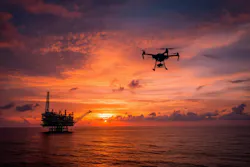
The problem isn't detection but identification
The offshore industry is no stranger to tracking assets across vast stretches of ocean. Yet experts say one of the biggest lessons from maritime domain awareness is that seeing an object and knowing what it is are two very different things.
In the maritime sector, vessel operators, regulators and security agencies have long dealt with ships that disappear from tracking systems, transmit inaccurate information or obscure their movements. According to INFORMS' Chandran, similar challenges are beginning to emerge as drone activity increases around offshore infrastructure.
"The main lesson is that detecting an object is not the same as establishing that object's identity or intent," he said. "A radar, camera, receiver, or satellite may confirm that something is present, while the associated digital information may be missing, incorrect, duplicated or deliberately fabricated."
For offshore operators, that distinction is becoming increasingly important as drones are deployed by operators, contractors, inspection companies, survey teams, emergency responders and research organizations. In many cases, the greater challenge is not determining whether a drone is present, but whether it is authorized to be there in the first place.
"Detection is only the first step," Powerus' Velicovich said. "Operators ultimately need to answer three questions: What is the drone? Is it authorized? And does it represent a threat?"
Those questions can be difficult to answer offshore. Operators may have limited visibility into who launched an aircraft, where the pilot is located or whether the identification information being transmitted can be trusted. According to Velicovich, attribution often becomes more challenging offshore because visual observation is limited and aircraft can be launched from significant distances away.
FlyGuys' Bartels believes the issue is compounded by the lack of standardized procedures and a shared view of offshore airspace.
"Differentiation offshore is far harder than it looks on paper," Bartels continued. "In practice, most operators are still relying on a combination of pre-coordinated flight plans, RF detection at the platform level, and where inspection providers have adopted it, ADS-B transponders on commercial drones." He added that "none of these methods are standardized across the industry, and there's no unified picture of the airspace."
The challenge extends beyond security. An inability to confidently identify aircraft can create operational complications as more drone operators share the same airspace alongside helicopters and other aviation activity. Bartels noted that anything operating outside an authorized flight window is often treated as unknown, but that approach becomes more difficult when multiple contractors are conducting drone operations in the same area.
Experts increasingly argue that offshore operators should focus less on individual sensors and more on building a trusted operating picture from multiple sources of information. Chandran said identification signals should not be treated as definitive proof of an aircraft's identity but instead verified against other data sources.
"The objective should be continuous verification: does the claimed identity remain consistent with the asset's physical location, movement and behavior?" Chandran added.
That concept of trusting but verifying may ultimately define the next phase of offshore airspace awareness. As drone activity grows, experts say the industry's biggest challenge may not be detecting aircraft, but determining which ones belong there and which ones do not.
From detection to decision-making
While experts interviewed for this article approached the issue from different perspectives, they shared a common conclusion: no single technology or process can provide operators with a complete picture of offshore airspace.
For many offshore facilities, drone awareness today still depends heavily on flight plans, contractor coordination and platform-level procedures. That approach can work in controlled environments, but it becomes increasingly difficult as more operators, inspection providers and service companies deploy drones around offshore assets.
Bartels said current procedures remain fragmented and lack a unified picture of offshore airspace.
As a result, experts say offshore operators should focus less on detecting individual aircraft and more on building a trusted operating picture that combines information from multiple sources. Chandran refers to this approach as data fusion.
"The strongest approach is data fusion," he added. "Operators can combine AIS or drone identification data with radar, satellite imagery, cameras, radio-frequency [RF] detection, historical movement patterns and operational records."
He noted that analytics can then identify anomalies such as unexplained transmission gaps, duplicated identities or movements that do not align with the reported asset.
Velicovich sees the industry moving in a similar direction. "The industry is moving toward sensor fusion rather than relying on a single technology," he said. "Radar, RF detection, electro-optical tracking, AI-based behavioral analysis, and remote ID where available all contribute pieces of the overall picture."
Beyond security, experts believe offshore operators could also gain better situational awareness by integrating data from their own authorized drone operations. Bartels said inspection drones already generate telemetry, position and flight data that could support broader situational awareness if integrated with operator monitoring systems.
"The interface points are there, what's missing is the standardization and the operational will to connect them," he said. "If that feed were integrated with the operator's systems, you'd effectively get a baseline picture of authorized drone activity that makes anomaly detection far more practical. Any unknown contact stands out against a known operational picture."
Moreover, Arrington argues that creating that baseline should be a priority.
"A recognized air picture around the platform is the foundation [via an authenticated fleet of authorized drones]," he said. "You cannot defend against what you cannot see."
Ultimately, the goal is not simply to collect more data but to create confidence in the information being used to make operational and security decisions.
As Chandran explained, "The goal is not merely to collect more tracking data. It is to establish whether the data can be independently verified and trusted before an operational or security decision is made."
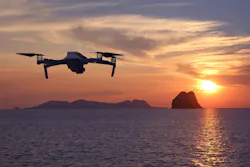
Looking ahead: Airspace awareness becomes a core offshore function
As offshore operators expand their use of drones for inspection, surveying, monitoring and emergency response, experts expect airspace management to become an increasingly important part of day-to-day offshore operations. The challenge extends beyond detecting potential threats; it also involves managing growing volumes of legitimate drone traffic while maintaining safe and efficient operations around offshore facilities.
Many believe the industry is still in the early stages of addressing the issue. While technologies for detecting and tracking drones continue to improve, questions remain around regulation, information sharing, operator responsibilities and the authority to respond to unauthorized aircraft operating around offshore infrastructure.
Arrington argues that fragmented jurisdiction remains one of the sector's biggest vulnerabilities and that closer coordination between operators, regulators and government agencies will be necessary as drone activity continues to increase.
The experts interviewed for this article also agreed that future airspace awareness will depend less on any single sensor and more on the ability to combine data, verify identities and establish a trusted picture of activity around offshore assets.
"Over the next five years, I think we'll see a shift from individual sensors toward fully integrated autonomous defense systems," Velicovich said.
Offshore companies may increasingly treat airspace awareness much like cybersecurity, as a core operational function requiring continuous visibility and risk management.
As Velicovich noted, organizations should focus on maintaining a live understanding of activity around their assets rather than reacting only after an incident occurs.
Experts say the industry's response will ultimately depend on its ability to build a reliable understanding of what is happening in the airspace surrounding offshore facilities, which is a challenge that extends across operations, security, technology and regulation. As drone activity increases, operators will need to know not only that an aircraft is present, but whether it is authorized, why it is there and whether it poses a risk.
Bartels believes those questions will only become more important as offshore operations become increasingly reliant on unmanned systems. "I expect detection requirements to become more explicit in operator HSE frameworks over the next few years, but right now the gap between the operational reality and the formal policy is wider than it should be," he said.
As Arrington put it, "The offshore industry has spent decades engineering against the sea, the weather, and the well. Airspace is simply the next domain it must engineer against."
About the Author
 Ariana Hurtado
Ariana Hurtado
Editor-in-Chief
With more than a decade of copy editing, project management and journalism experience, Ariana Hurtado is a seasoned managing editor born and raised in the energy capital of the world—Houston, Texas. She currently serves as editor-in-chief of Offshore, overseeing the editorial team, its content and the brand's growth from a digital perspective.
Utilizing her editorial expertise, she manages digital media for the Offshore team. She also helps create and oversee new special industry reports and revolutionizes existing supplements, while also contributing content to Offshore's magazine, newsletters and website as a copy editor and writer.
Prior to her current role, she served as Offshore's editor and director of special reports from April 2022 to December 2024. Before joining Offshore, she served as senior managing editor of publications with Hart Energy. Prior to her nearly nine years with Hart, she worked on the copy desk as a news editor at the Houston Chronicle.
She graduated magna cum laude with a bachelor's degree in journalism from the University of Houston.