Poll results: Industry views on reducing offshore POB

Offshore surveyed more than 100 of its readers from April 23 to May 8.
These respondents comprise industry professionals from across the global offshore energy sector, including operators, contractors and service companies, to assess the most effective strategies for reducing personnel on board (POB).
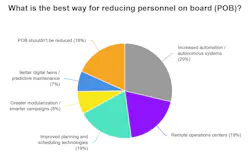
The results show a clear preference for technology-led reduction strategies. Nearly one-third of respondents (28.7%) identified increased automation and autonomous systems as the most effective approach, pointing to strong industry confidence in robotics, AI-enabled workflows and unmanned operations to replace offshore labor.
A second tier of responses underscores the role of onshore integration and operational efficiency. Remote operations centers and improved planning and scheduling technologies were tied at 19.1%, indicating that respondents see significant opportunity in relocating functions onshore while optimizing campaign execution to minimize offshore headcount.
 remote operations concept
At the same time, 18.26% of respondents said POB should not be reduced, reflecting a notable segment of the industry that remains cautious—likely due to concerns around safety, redundancy and maintaining operational resilience offshore.
Other options attracted more limited support, including greater modularization and smarter campaigns (7.83%) and better digital twins and predictive maintenance (6.96%), suggesting these are viewed as supporting enablers rather than primary drivers of POB reduction.
Respondent profile
Offshore surveyed 115 of its readers. The survey reflects a senior and technically focused audience. Executive management roles (27%) and engineering professionals (23%) accounted for half of respondents, followed by management roles such as production or engineering managers (23%) and field professionals (12%). Smaller shares came from consulting (4%) and other roles (12%).
From a company perspective, major oil and gas operators represented the largest cohort (35%), followed by consulting/service-oriented firms (15%) and a mix of independents, national oil companies and EPC contractors (each about 8%). Additional input came from service companies, subcontractors and suppliers, reinforcing a broad cross-section of the offshore value chain.
Some of the poll respondents hailed from the following companies, among others: Superior Energy, Petronas, Stena Drilling, Shell, TotalEnergies, Wood, Acteon, PTTEP, Anadarko, Brava Energia, Brazil's ANP, and ADNOC Offshore.
Geographically, the results were globally distributed, led by the US (27%) and Malaysia (12%), with additional participation from Brazil and Singapore (8% each) and a wide range of countries across Europe, Africa, the Middle East and Asia (generally 4% each).
Takeaway
Overall, the data suggests that while automation and remote operations are widely seen as the primary levers for reducing offshore headcount, the industry remains mindful of the trade-offs. The diverse, senior-level respondent base—spanning global regions and the full offshore supply chain—underscores a pragmatic consensus: POB reduction will depend on balancing digital transformation with safe, reliable operations.
About the Author
 Ariana Hurtado
Ariana Hurtado
Editor-in-Chief
With more than a decade of copy editing, project management and journalism experience, Ariana Hurtado is a seasoned managing editor born and raised in the energy capital of the world—Houston, Texas. She currently serves as editor-in-chief of Offshore, overseeing the editorial team, its content and the brand's growth from a digital perspective.
Utilizing her editorial expertise, she manages digital media for the Offshore team. She also helps create and oversee new special industry reports and revolutionizes existing supplements, while also contributing content to Offshore's magazine, newsletters and website as a copy editor and writer.
Prior to her current role, she served as Offshore's editor and director of special reports from April 2022 to December 2024. Before joining Offshore, she served as senior managing editor of publications with Hart Energy. Prior to her nearly nine years with Hart, she worked on the copy desk as a news editor at the Houston Chronicle.
She graduated magna cum laude with a bachelor's degree in journalism from the University of Houston.
Related
