Case study: Automated tubular running system demonstrates operational gains in the GoM
Key highlights:
- Automated tubular running systems enable remote operation, reducing personnel exposure and improving safety during HP/HT drilling activities.
- Integration with rig safety systems and real-time data monitoring enhances operational consistency and helps predict equipment failures before they cause downtime.
- Global deployments have shown a 40-50% reduction in connection make-up and breakout times.
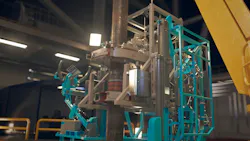
By Jeremy Angelle, Expro
The increasing complexity of Gulf of Mexico (GoM) drilling operations, particularly in deepwater and high-pressure, high-temperature environments, continues to place pressure on operators to improve safety, operational consistency and efficiency on the rig floor.
Tubular running services (TRS), a critical phase in well construction, remain an area where reducing manual intervention while maintaining connection integrity presents an ongoing challenge.
Traditionally, connection make-up processes require personnel to work in close proximity to heavy equipment, exposing crews to safety risks and introducing variability into operations. At the same time, minimizing non-productive time and improving connection performance has become increasingly important as operators seek to optimize well delivery.
Field trial introduces digitally integrated tubular running approach
An automated tubular running system incorporating digital control, real-time data monitoring and machine learning capabilities has recently been introduced to the GoM. Rather than treating tubular running as a standalone activity, the approach focuses on integrating TRS more closely with rig systems and real-time data flows. The deployment forms part of an ongoing field trial with a supermajor operator in deepwater conditions.
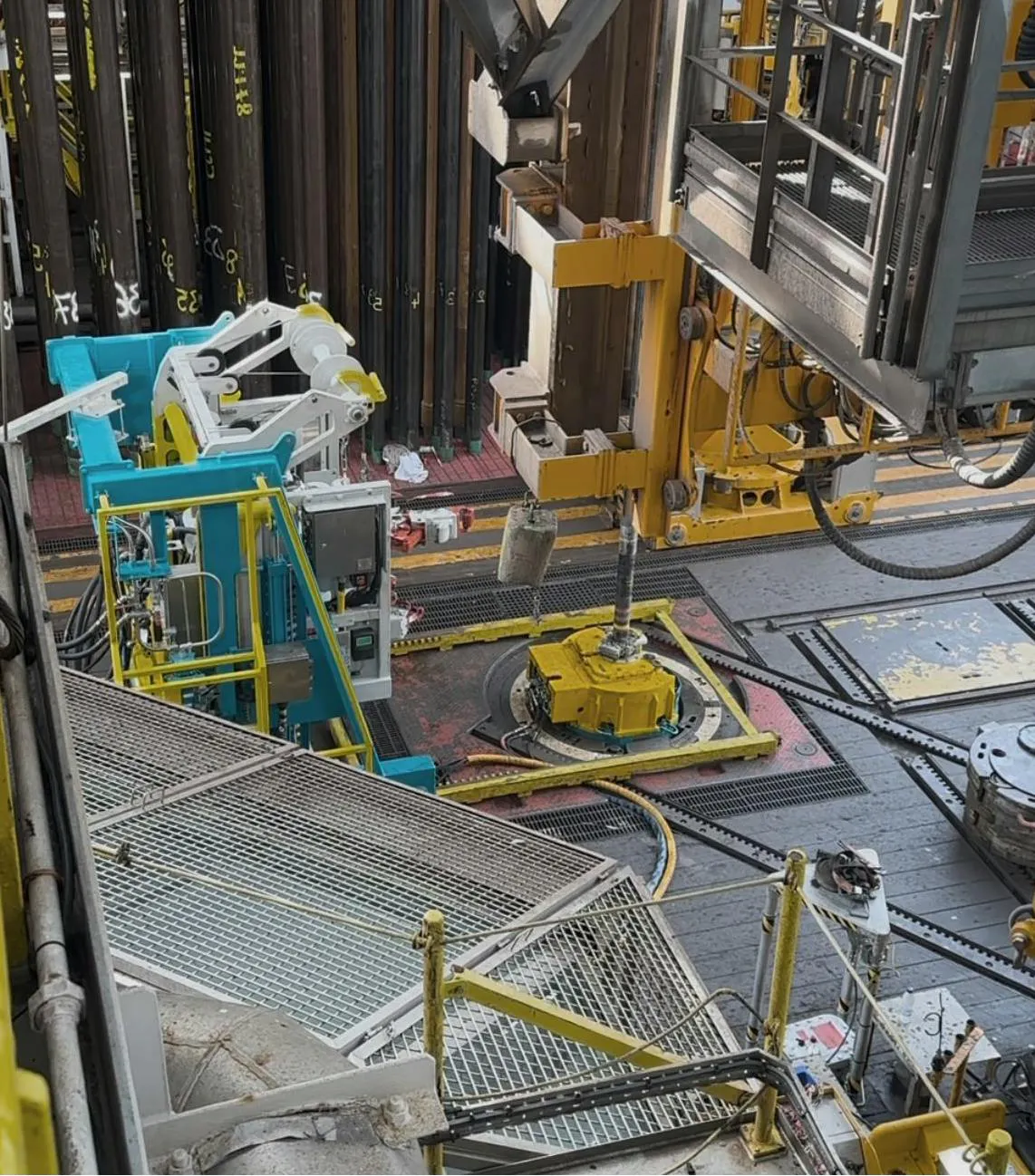
At the core of the system is an intelligent tong (iTONG) capable of executing and verifying connection make-up autonomously. The system can be operated remotely from the driller’s chair or via a tablet interface, allowing full oversight of operations without requiring personnel on the rig floor. Thus, this removes personnel from the “red zone” during high-risk activities.
The system is digitally integrated through a unified programmable logic controller (PLC), enabling communication across rig equipment and continuous real-time data acquisition. Operational parameters are monitored throughout each connection, with machine learning algorithms analyzing performance and comparing results against historical data. This enables consistent make-up verification and supports condition-based monitoring, with the potential to predict issues before they lead to downtime.
Global run history provides performance benchmarks
While the GoM deployment remains in its early stages, the system builds on a broader global run history. Since its introduction in 2021, the technology has been applied across offshore regions including the North Sea and West Africa, where it has been used on both jackup rigs and drillships.
Data from these deployments provides a benchmark for expected performance. In previous applications, connection make-up and breakout times have been reduced by approximately 40-50% compared to conventional methods, driven by automation and process standardization. Although crew sizes in the GoM remain unchanged, the shift to remote-controlled processes reduces direct manual interaction, contributing to safer working conditions.
Safety integration reinforces 'no red zone exposure' objectives
The TRS package has been integrated into the rig’s zone management, pipe interlock and anti-collision systems, allowing it to operate as part of the rig’s safety architecture. This helps reduce the risk of equipment clashes and supports a “no red zone exposure” approach during connection activities.
The system also offers enhanced data visibility. Continuous monitoring of pressure and operating parameters provides a real-time digital profile of equipment health, creating opportunities to predict failures and reduce unplanned downtime as more data is gathered.
 offshore oil and gas workers
Early GoM results point toward scalable deployment
The current GoM campaign forms part of a broader, multi-year project, with the potential for replication across additional rigs following validation. As further runs are completed, more region-specific data will enable a clearer assessment of performance in deepwater conditions.
As offshore operations become more complex, particularly in mature basins such as the GoM, the ability to integrate automation, equipment and data into a more cohesive operating model is becoming increasingly important. Early experience suggests that incremental gains in safety, consistency and efficiency can be achieved without significant changes to existing rig infrastructure. For operators, this highlights the value of more integrated, data-driven approaches to tubular running within wider well construction strategies.
This article is part of Offshore's 2026 Gulf of Mexico Regional Report.
About the Author
 Jeremy Angelle
Jeremy Angelle
Jeremy Angelle, P.E., is the vice president of well construction at Expro. With more than 25 years of experience in well construction, he has held diverse roles across research and development, commercials, operations, technology and engineering. He is the inventor or co-inventor on more than 60 US patents and has authored or co-authored 13 technical publications. He holds a B.S. and M.S. in mechanical engineering and an MBA from the University of Louisiana at Lafayette.