Offshore ammonia advances amid tempered transition goals
Key highlights:
- Engine manufacturers are developing ammonia-compatible engines, with first units expected by 2025–2026, supporting the shift toward ammonia-fueled ships.
- Market activity persists despite high costs and supply chain challenges, driven by regulatory support, technological advances, and the need for decarbonization in maritime sectors.
- Future growth depends on scaling electrolyzers, reducing costs, and building infrastructure, with offshore ammonia poised to become a key component of deep-sea renewable energy and shipping solutions.
Bruce Beaubouef, Managing Editor
Ammonia (NH3) has long served as a cornerstone chemical for fertilizers, but it is now gaining traction as a zero-carbon fuel for maritime shipping and a practical way to store and transport renewable energy.
Its appeal offshore stems from the potential to produce it using renewable resources like wind, along with better storage and transport characteristics than pure hydrogen. While enthusiasm peaked several years ago amid aggressive decarbonization targets, progress continues into 2026 — tempered by technical, economic, and safety realities.
Marine fuel advances
Ammonia offers compelling benefits for shipping, which accounts for roughly 3% of global greenhouse gas emissions. When burned or used in fuel cells, it produces no direct CO2 emissions — only nitrogen and water (though NOx and nitrous oxide byproducts require careful management). Its energy density supports long-haul voyages better than hydrogen in many cases, and the existing global ammonia trade infrastructure can be adapted for bunkering.
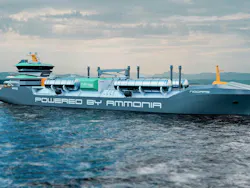
Engine manufacturers such as WinGD and MAN Energy Solutions have developed ammonia dual-fuel engines, with first deliveries expected in 2025–2026. Orders for ammonia-ready ships surged in 2024, and projections suggest ammonia could account for 35–50% of the marine fuel mix by 2050 under IMO net-zero goals. The IMO approved interim guidelines in December 2024 for ammonia as fuel. Further regulatory updates are expected in 2025–2027. Demonstration projects are underway, including small supply vessels already in operation.
However, challenges remain: ammonia is toxic and corrosive, requiring specialized materials, ventilation, and crew training. It also takes up significantly more volume than conventional fuels.
Tying renewables to fuel
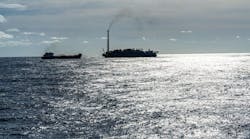
Offshore ammonia production leverages offshore wind (and emerging solar and wave technologies) to generate green hydrogen via electrolysis, then converts it into ammonia via the Haber-Bosch process on floating platforms. This approach avoids expensive subsea cables, reduces land-use conflicts, and places production close to shipping routes. Concepts typically use FPSOs, either converted from existing tankers or purpose-built.
Key projects include:
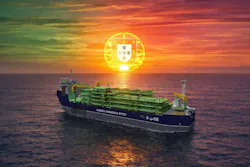
• SwitcH2 (Project Atlantico, Portugal): A 300 MW floating ammonia FPSO powered by wind, solar, and wave energy. It targets 243,000–300,000 tons per year, with FEED ongoing into mid-2026 and potential operations by 2029.
• Samsung Heavy Industries and Lloyd’s Register are advancing similar renewable ammonia FPSO designs.
• Other concepts are under study on the US East Coast, in European ports (e.g., Rotterdam), and in Norway and Asia.
State of the market
With tempered expectations of the energy transition emerging, one has to ask: Has the offshore ammonia market cooled down? The answer is: not entirely. While the post-2021 hype—fueled by IMO ambitions and cheap renewable forecasts—has moderated amid high green ammonia costs (2–3x conventional), supply chain realities, and slower fleet turnover, activity persists. IMO’s 2023 GHG Strategy and EU/national policies provide tailwinds, with carbon pricing potentially closing the gap. Vessel orders and engine testing continue, and floating production projects advance toward FID.
Grey/blue ammonia may bridge gaps, but the drive for true zero-emission shipping currently faces challenges like scaling electrolyzers, ensuring safety, managing nitrogen pollution, and achieving cost parity (exacerbated by higher volumetric needs and a slow rollout). Competition for green molecules from other sectors adds pressure.
Yet analysts see growth: green ammonia markets are projected to expand dramatically between 2030 and 2050, with offshore as a niche enabler for remote, high-wind resources. It is a maturing technology facing hard engineering and economic tests.
Outlook
Offshore ammonia marries maritime decarbonization with renewable scale-up. It will not displace fossil fuels overnight, but with IMO guidelines, advancing FPSO designs, and engine deployments, it positions itself as a practical deep-sea fuel. Success hinges on minimizing non-CO2 impacts, cost reductions via scale and policy, and infrastructure buildout. By the 2030s, floating green ammonia facilities could dot coastlines, supplying ships and exporting energy.
Want more content like this?
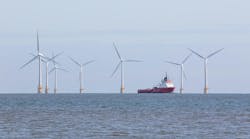 vessel assists with offshore wind operations
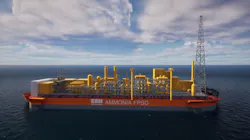
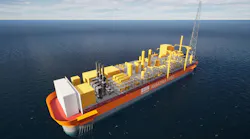 SBM Offshore's blue ammonia FPSO concept
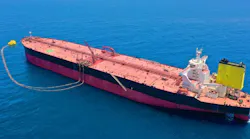 CALM Terminal and Vessel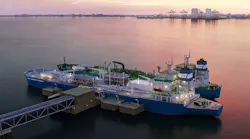
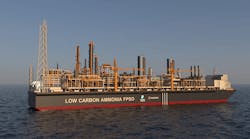 Blue Ammonia FPSO
 FPSO
FPSOAbout the Author
 Bruce Beaubouef
Bruce Beaubouef
Senior Lead Reporter / Managing Editor
Bruce Beaubouef is Managing Editor for Offshore magazine. In that capacity, he plans and oversees content for the magazine; writes features on technologies and trends for the magazine; writes news updates for the website; creates and moderates topical webinars; and creates videos that focus on offshore oil and gas and renewable energies. Beaubouef has been in the oil and gas trade media for 25 years, starting out as Editor of Hart’s Pipeline Digest in 1998. From there, he went on to serve as Associate Editor for Pipe Line and Gas Industry for Gulf Publishing for four years before rejoining Hart Publications as Editor of PipeLine and Gas Technology in 2003. He joined Offshore magazine as Managing Editor in 2010, at that time owned by PennWell Corp. Beaubouef earned his Ph.D. at the University of Houston in 1997, and his dissertation was published in book form by Texas A&M University Press in September 2007 as The Strategic Petroleum Reserve: U.S. Energy Security and Oil Politics, 1975-2005.