bp launches sale of UK North Sea business as portfolio focus shifts elsewhere
Key highlights:
-
bp has formally launched the sale of its UK North Sea business.
-
The portfolio includes major positions in the Clair and Schiehallion areas west of Shetland and the ETAP complex.
-
Rystad Energy estimates the business could be worth about $2.6 billion.
-
Potential bidders may include UK-focused operators such as Neo Next+ and Ithaca Energy.
-
bp is increasingly targeting growth opportunities in other regions, including offshore India.

UK North Sea by the numbers
- ~100,000 boe/d current production from bp-operated UK North Sea assets
- 24 North Sea fields in the portfolio
- Estimated asset value: $2.6 billion
- Up to $3 billion in projected decommissioning liabilities
- About 1,100 employees associated with the business
bp has decided to put its UK North Sea business up for sale.
Which UK North Sea assets is bp selling?
bp's portfolio for sale includes interests in the Clair and Schiehallion developments west of Shetland and the ETAP production hub in the central UK North Sea, among other assets.
“The North Sea remains integral to the UK's energy system,” said CEO Meg O’Neill, who joined the company earlier this year from Woodside Energy. “However, as we focus our portfolio and direct capital to our highest-value opportunities, we believe our North Sea business will be better positioned as part of another company. It has world-class people, resilient assets and a proud heritage, and it is precisely these qualities that can attract an owner ready to back its next chapter.“
The company started oil production in the UK North Sea in the 1970s and went on to develop some of the sector’s largest fields, many of which remain in service today under the stewardship of specialist late-life operators such as EnQuest, Serica Energy and the Neo Next+ joint venture.
Various UK newspapers report that the company presently employs about 1,100 staff for its North Sea operations, which are said to be generating just below 100,000 boe/d of oil and gas.
But the company has not followed other majors that have entered larger joint ventures to sustain UK offshore activity such as Shell, Eni and TotalEnergies.
Rystad Energy assesses the overall value of bp’s North Sea business at $2.6 billion, the Financial Times reported. Rystad analyst Matt Cooper expected UK heavyweights Neo Next + and Ithaca Energy in particular to be monitoring the situation.
Why this news matters:
-
The move marks one of the most significant portfolio changes by a major operator in the UK North Sea, potentially creating acquisition opportunities for independent producers and private-equity-backed operators.
-
The sale adds to a broader shift in UK North Sea ownership, with majors increasingly ceding mature assets to independent operators willing to manage production and decommissioning over the long term.
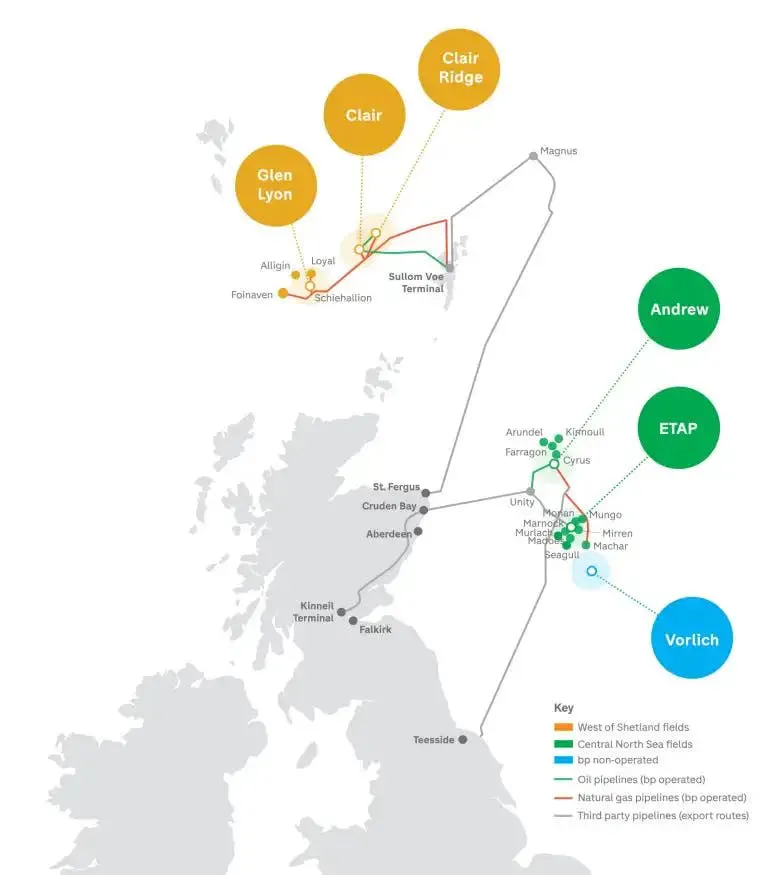
bp’s three UK production strongholds are at the Clair and Schiehallion oil fields west of Shetland (the company was the first to launch developments in this area) and the ETAP complex in the central UK North Sea.
Challenges facing the UK North Sea
Before successive UK governments introduced and then increased windfall taxes on the industry from 2022 onwards, the company had considered a third standalone development of the giant Clair Field, Clair South.
But development of UK fields of all types has stalled in recent times, due to a combination of fiscal conditions, hostility to new exploration licenses and zealous opponents mounting successful legal challenges to planned new projects.
Of the 24 fields that bp operates in the North Sea, the Financial Times reported that half are entering the decommissioning phase with projected decommissioning costs of up to $3 billion. The company may opt to retain those fields, the newspaper suggested, to secure a higher price for the productive part of its business.
bp's growth focus extends beyond the North Sea
It’s not just the UK where the company has sought to scale back its activities. Earlier in July it announced that it would exit the high potential, but also high cost Bay du Nord project offshore eastern Canada, leaving Equinor as the sole owner.
bp sees better growth prospects in other E&P jurisdictions, notably offshore India. In June, the company signed a new technical services contract with operator ONGC. This expands their collaboration from the Mumbai High complex, signed in February 2025, to fields in the Western Offshore Basin.
This should lead to broader deployment of more modern technologies, bp said, across multiple mature hydrocarbon production centers.
While ONGC will retain full operational control of the assets, bp will work with the company’s multi-disciplinary teams to identify opportunities for interventions covering reservoirs, wells and production facilities.
As before, the main goals are to slow natural production declines, boost hydrocarbon recovery and operations efficiency, and support sustained production growth.
Over the first two years of the new contract, bp will receive a fixed fee, to be followed by a service fee linked to a percentage share of revenue generated from net incremental hydrocarbon production.
Comment from chairman of INEOS Energy
Just days after announcing plans to sell its UK North Sea business, bp chief executive Meg O'Neill underscored the message that the UK North Sea is not competitive in its current form, as the Energy Profits Levy (EPL) and policy inconsistency continue to drive investment away from the basin.
In the wake of that announcement, Brian Gilvary, former CFO of bp and chairman of INEOS Energy, offered his comments on the topic. He said: "The challenge for the UK is that unless the government of the day can create stability around the fiscal regime, the UK North Sea remains unattractive. The Energy Profits Levy, coupled with the ban on drilling, has effectively shut down investment, while the Norwegian sector continues to grow, investing at ten times the rate of the UK. More pointedly, Norway exports gas to the UK, with British consumers and taxpayers ultimately footing the bill. The UK still has significant potential to grow production from the basin, supporting jobs, tax revenues and energy security. That is a choice for the government.”
Gilvary also said: “bp’s decision to sell its North Sea assets underlines the consequences of the current approach. When companies reduce their exposure to the UK basin, the impact goes far beyond the energy sector. It means less investment, fewer high-quality jobs, lower tax revenues and a greater reliance on imported energy. The UK’s demand for oil and gas has not disappeared, but increasingly we are choosing to import what we could produce ourselves. If this trend continues, the country risks losing not only production but also the skills, supply chains and economic value that have supported the UK economy for decades.”
INEOS Energy itself illustrates the shift. The company has halted new investment in the UK North Sea, citing the high and unstable fiscal regime (including the Energy Profits Levy), and is instead directing capital to the United States—particularly the Gulf of Mexico (via acquisitions such as CNOOC’s assets and joint exploration with Shell near Appomattox), as well as onshore plays like Eagle Ford in South Texas and positions elsewhere (including Denmark). While it continues to operate existing UK assets such as Breagh and Clipper South and retains midstream interests, the strategic focus has clearly moved away from growth in the UK basin toward more competitive regions.

About the Author
 Jeremy Beckman
Jeremy Beckman
Staff Writer / Editor, Europe
Jeremy Beckman has been Editor Europe, Offshore since 1992. Prior to joining Offshore he was a freelance journalist for eight years, working for a variety of electronics, computing and scientific journals in the UK. He regularly writes news columns on trends and events both in the NW Europe offshore region and globally. He also writes features on developments and technology in exploration and production.