Massive expenditure needed to repair damaged Middle East gas infrastructure
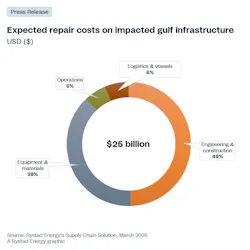
Damage caused to energy infrastructure during the present ongoing conflict could cost at least $25 billion to rectify, according to Rystad Energy report released March 25.
Rystad analysts came up with this figure based on an initial assessment of impacted facilities, and they expect repair costs to rise further.
Much of the expenditure will likely be directed at engineering and construction, according to Audun Martinsen, Rystad’s head of supply chain research.
In Qatar’s Ras Laffan Industrial City, the destruction caused by Iranian missiles to LNG trains S4 and S6 has triggered force majeure and a 17% capacity reduction, he added, equivalent to about 12.8 MMmt/year of LNG.
But a full recovery could take up to five years to achieve, as there are only three OEMs capable of supplying the large-frame gas turbines needed to power LNG main refrigeration compressors.
All these companies, Martinsen pointed out, entered 2026 with production backlogs of about two to four years due to demand from a variety of sectors.
And while theoretically some damaged facilities in the Gulf region could be restored to service in months, others could remain non-operational for years.
Aside from Ras Laffan, the South Pars gas field offshore Iran is the other big casualty.
Iran’s legal exclusion from Western supply chains means it would be dependent on its domestic contractors and Chinese companies for the rehabilitation work.
As things stand, injured parties will likely have to prioritize urgent repairs over planned expansion, Martinsen suggested.
Our Middle East conflict coverage is updated daily:
 Offshore and OGJ coverage on the conflict in the Middle East
About the Author
 Jeremy Beckman
Jeremy Beckman
Staff Writer / Editor, Europe
Jeremy Beckman has been Editor Europe, Offshore since 1992. Prior to joining Offshore he was a freelance journalist for eight years, working for a variety of electronics, computing and scientific journals in the UK. He regularly writes news columns on trends and events both in the NW Europe offshore region and globally. He also writes features on developments and technology in exploration and production.