Advisory Board insights: How the Iran conflict is shaping offshore energy risks and outlook
Key highlights:
- Immediate offshore operational disruptions include safety shutdowns and logistical delays, especially in the Middle East and Mediterranean regions.
- Supply chain pressures are intensifying, with restricted access to key maritime routes like the Strait of Hormuz impacting critical materials and drilling programs.
- Despite short-term price spikes and increased geopolitical risk premiums, offshore rig demand is unlikely to change significantly unless prolonged disruptions occur.
- Market volatility is expected to rise, with traders and nations increasing stockpiles and reassessing energy strategies amid ongoing conflicts.
- Offshore operators and market participants must navigate a fluid geopolitical landscape, balancing operational safety with strategic market responses.
As geopolitical tensions escalate following US and Israeli military action in Iran, the offshore energy sector is being forced to reassess near‑term operational risk, supply‑chain pressures and potential market volatility.
Members of Offshore’s Editorial Advisory Board—Cinnamon Edralin (Westwood Global Energy Group), Matthew Hale (Rystad Energy) and James West (Melius Research)—shared their perspectives on how the fast‑moving conflict may influence offshore drilling activity, rig demand and global oil markets.
Operational disruptions already emerging

According to Cinnamon Edralin, Americas research director with Westwood Global Energy Group, the impact on offshore operations is tangible and immediate. Companies across the Middle East and broader region are taking protective measures to safeguard workers and infrastructure, including temporary shutdowns of offshore drilling activity. She added that restricted airspace is further complicating operations by limiting personnel movements and delaying delivery of critical parts and equipment, a risk that grows with every additional day of military escalation.
"Beyond the immediate challenges for the offshore drilling rig industry, pending campaigns not only in the Middle East, but also in the eastern Mediterranean, may once again be delayed until the parties are satisfied it is safe to proceed. More broadly, it is unlikely that the recent bump in the Brent oil price related to the conflict and the closing of the Strait of Hormuz will affect global offshore rig demand in the short term, as it is generally considered to be temporary for now."
Supply chain and activity constraints if the Strait of Hormuz remains compromised

Matthew Hale, SVP of Drilling & Wells Research at Rystad Energy, highlighted challenges tied directly to the closure or restricted access of the Strait of Hormuz, through which roughly one‑fifth of global oil supply typically flows.
Hale expects OCTG and other critical material supplies into Gulf countries to be increasingly strained. If the strait remains impassable for an extended duration, drilling programs could become “moot,” as curtailed activity would supersede supply concerns.
Additionally, Hale pointed out the contrast between offshore and onshore sector responsiveness. "If strait remained unpassable, US shale production will respond to higher prices with higher activity, increasing crude supply; offshore areas are less able to accelerate drilling and development work in the near term," he said.
Hale added that offshore suspensions are now extending beyond the Gulf. "Offshore operations in the region are increasingly being suspended due to the immediate security risk even extending into the Mediterranean where some Israeli platforms have been shut down," he said.
Market volatility and strategic implications

His analysis anticipates:
- A near‑term crude price spike,
- A renewed geopolitical risk premium,
- Increased stockpiling by major consuming nations, and
- Higher near‑term volatility in energy equities.
West underscores that oil traders are acutely concerned about the Strait of Hormuz. While the US has long maintained contingency plans to keep the strait open, the recent escalation has injected new uncertainty into the market.
"While an Iranian response was expected, simultaneous missile strikes on Bahrain, UAE, Qatar, Kuwait, Jordan and Saudi Arabia we thought would be more targeted and with some delay," he said. "The responses by these countries in the coming days will be important. In addition, the president told the Islamic Revolutionary Guard, the armed forces and the police to lay down their weapons and would be given 'complete immunity.' This could lead to mass defections from the regime."
He also noted that OPEC+ has signaled readiness to increase output, but additional barrels may not stabilize the market if strait disruptions persist or if loading and export facilities suffer damage.
Outlook: A sector on alert but standing firm
Offshore's advisory members agree that offshore operators face increasing operational and logistical challenges, especially within the Middle East and eastern Mediterranean.
The situation remains fluid, but at this stage:
- Safety‑driven shutdowns are the most immediate and widespread operational impact;
- Supply‑chain delays may worsen if airspace and maritime chokepoints remain restricted;
- Offshore rig demand is unlikely to shift materially in the short term, despite price volatility; and
- Global oil markets will remain volatile as geopolitical risk escalates and traders assess potential long‑term implications for the Strait of Hormuz.
As the situation evolves, Offshore will continue providing timely analysis and expert commentary from voices across the global energy sector.
Exclusive content:
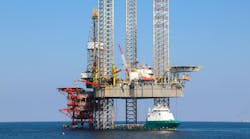 offshore jackup rig in the Persian Gulf of the UAE region
While much of the market focus has centered on oil prices and LNG disruptions, offshore drilling activity across the Middle East and Eastern Mediterranean is emerging as a key but under‑examined, exposure point.
The Middle East remains the largest jackup rig market globally. According to Esgian, there are currently 177 drilling jackups in the region (~36% of the global supply), of which 138 are actively drilling. This high utilization reflects more than just legacy activity. Offshore demand had been recovering across multiple countries, supported not only by Saudi Aramco’s latest multi‑rig jackup tender, but also by ongoing and upcoming rig requirements in Kuwait, the UAE, Saudi Arabia beyond Aramco, and Oman, according to Sofia Forestieri, a senior analyst at Esgian and a 2026 Offshore Editorial Advisory Board member.
About the Author
 Ariana Hurtado
Ariana Hurtado
Editor-in-Chief
With more than a decade of copy editing, project management and journalism experience, Ariana Hurtado is a seasoned managing editor born and raised in the energy capital of the world—Houston, Texas. She currently serves as editor-in-chief of Offshore, overseeing the editorial team, its content and the brand's growth from a digital perspective.
Utilizing her editorial expertise, she manages digital media for the Offshore team. She also helps create and oversee new special industry reports and revolutionizes existing supplements, while also contributing content to Offshore's magazine, newsletters and website as a copy editor and writer.
Prior to her current role, she served as Offshore's editor and director of special reports from April 2022 to December 2024. Before joining Offshore, she served as senior managing editor of publications with Hart Energy. Prior to her nearly nine years with Hart, she worked on the copy desk as a news editor at the Houston Chronicle.
She graduated magna cum laude with a bachelor's degree in journalism from the University of Houston.