Brazil’s pre-salt boom makes it the world’s largest offshore oil producer
Key Highlights
- Brazil’s offshore production growth is driven by Santos Basin pre-salt developments, which now account for roughly 80% of oil output.
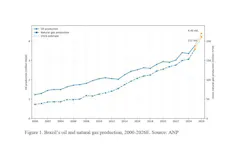
- Oil production rose from about 1.2 MMb/d in 2000 to an estimated 4.4 MMb/d in 2026, with further growth expected from new FPSOs.
- Most natural gas is associated with oil production, and substantial volumes are reinjected to support reservoir pressure and recovery.
- Proved reserves reached 17.5 billion barrels of oil and 573 billion m³ of gas by year-end 2025.
- Petrobras leads development, alongside international partners, while new gas-focused projects could expand the share of production reaching market.

Mark J. Kaiser, LSU Energy Institute
Brazil has become one of the world’s major growth centers for oil and gas production, driven overwhelmingly by the deepwater and ultra-deepwater pre-salt developments of the Santos Basin.
Brazil is now the largest offshore producing country in the world and holds the world’s largest fleet of floating production, storage and offloading systems. Production is expected to average about 4.4 MMb/d in 2026, with roughly 80% coming from the pre-salt Santos Basin.
Since almost all of Brazil’s gas production is associated with its oil field developments, natural gas follows the oil trend closely. The commercial significance of Brazilian gas, however, differs from oil because most of the pre-salt gas is reinjected rather than marketed.
In 1975, Brazil held less than 1 billion barrels of proved oil and 26 billion m³ of proved gas. By year-end 2025, proved reserves had reached 17.5 Bbbl of oil and 573 Bm³ of natural gas, the highest levels in Brazil’s history. Since 2020, development and reserves maturation have outrun depletion increasing Brazil’s proved reserves base.
In the first of a five part series on Brazilian offshore oil and gas development, the goal here is to review a bit of the history that had made Brazil one of the world’s leading oil and gas producers, and to offer some thoughts about its future prospects for offshore hydrocarbon development.
Oil production
Commercial production in the Campos Basin began in 1977 at the shallow water Enchova field, Brazil’s first offshore producer, and in the 1980s and 90s several large deepwater fields were developed including Marlim Sul, Roncador, Albacora, Barracuda, Jubarte, Cachalote.
Crude-oil production increased from roughly 1.2 MMb/d in 2000 to 3.8 MM/d in 2025, and based on 2026 production to date, a full-year average around 4.4 MMb/d appears reasonable.
The central feature of Brazil’s production history is growth and replacement of the country's mature production base by a much larger pre-salt system. Conventional offshore and onshore production has generally stagnated or declined while pre-salt output has risen from essentially zero in 2010 to more than 3.5 MMb/d in 2026.
The transformation has occurred as large FPSO-based developments at Tupi/Iracema, Búzios, Mero, and other pre-salt fields in the Santos Basin were brought onstream as the mature (post-salt) developments in the Campos Basin decline.
Once the country’s most prolific producing region, Campos Basin fields are long on their decline curves and a basin-wide revitalization program has been undertaken to slow the decline rate and increase recoverable reserves.
Pre-salt oil now represents roughly four-fifths of Brazilian production and its percentage contribution continues to increase. In July 2026, ANP reported that pre-salt accounted for about 3.73 MMb/d of the country's 4.5 MMb/d total.
Gas production
Natural-gas production has followed a similar trajectory, rising from about 36 MMm³/d in 2000 to 200 MMm³/d in 2025, with 2026 likely averaging around 210 MMm³/d.
Almost all of Brazil’s natural gas is associated gas produced with pre-salt oil rather than production from standalone gas fields, and thus as oil production in the pre-salt goes so goes gas. One would expect a strong correlation between the two hydrocarbons produced, and indeed this is what we observe.
Using average annual production rates from 2000-2025, oil in MMb/d and gas in MMm³/d, the fitted linear relationship yields:
Gas production = 61.2 × oil production − 53
with R² = 0.97. Without the fixed term, the model relation is:
Gas production = 39.8 × oil production.
Natural gas uses
Brazil now produces more than 200 MMm³/d of gas, but only about one third of production made its way to market. After consumption for fuel and on-site use, substantial volumes are reinjected into reservoirs to maintain pressure and improve oil recovery, leaving only the remaining available for sale.
According to ANP data, in recent years about 45-50% of Brazil’s gross production is reinjected, 8-12% is used for fuel and onboard use, and 2-4% is flared or represent losses. Thus, gas available for export is usually 40% or less. The exact values are tracked by ANP.
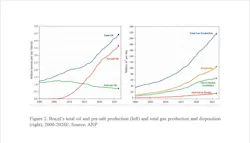
Re-injection has grown faster than gas delivered to market. The divergence started around 2010 as pre-salt production started, and then accelerated (note change in slope in the reinjection gas rates that occurs around 2015) as pre-salt production expanded and greater quantities of associated gas were processed.
Until the economic benefits of bringing incremental gas ashore is more valuable than its reservoir benefits, however, the ability to monetize pre-salt gas is likely to remain constrained.
Gas-oil ratio
Gas–oil ratio (GOR) is commonly used to distinguish oil-dominant (black oil and volatile oil) from gas-condensate and wet gas reservoirs, although the boundaries are approximate and depend on fluid composition (especially heptanes plus fraction), reservoir pressure, temperature, and phase behavior.
Recall that heavy oil reservoirs with its low dissolved-gas content usually have GOR < 700 cf/bbl. Black oils generally fall below 2000 cf/bbl, while volatile oil reservoirs usually range between 2000–3300 cf/bbl. These are all oil fields and they all have associated gas production.
Black oils remain a liquid in the reservoir, but as pressure drops during production, some gas bubbles out. As GOR increases, oils are more sensitive to pressure drops with greater release of gas. Volatile oils represent high-shrinkage oil and are rich in dissolved gas.
At a country level, Brazil’s producing GOR was 1,059 cf/bbl in 2000, so if Brazil was considered one (very large) reservoir, it would be classified as a black oil. In 2025, producing GOR was 1642 cf/bbl, increasing about 2% per year, still characteristic of a black oil, but now with a greater amount of associated gas.
One should not take this analogy too far, however, since a country-wide GOR has no reservoir counterpart, and a reservoir initially classified as black oil does not become a volatile-oil or gas-condensate reservoir simply because its producing GOR increases during depletion. Here we are simply using GOR as an indicator of how gas production relates to oil across Brazil over time.
Reserves
Brazil’s oil-reserve inventory has transitioned from a mature conventional offshore/onshore resource base to a much larger, overwhelmingly deepwater pre-salt resource. The change has not been monotonic, with reserves rising through the early 2010s, before falling as production and reserve revisions outran additions, before returning to growth in the 2020s.
In 1990, Brazil adopted SPE/WPC reserve criteria which increased reported reserves relative to the previous methodology. Part of the 2015 break shown in the reserves trend reflects another reporting change, but this time in the opposite direction when the reserve definitions of ANP Resolution 47/2014 were adopted.
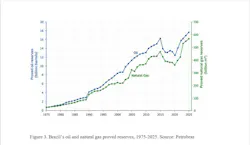
In the early 2000s, Brazil had roughly 8–9 billion barrels of proved (1P) oil reserves. Development of the Campos Basin—particularly fields such as Marlim, Roncador and Barracuda/Caratinga—steadily enlarged the proved base. By the end of 2009, proved reserves had reached 13 billion barrels, already overwhelmingly offshore. This was still fundamentally the Campos Basin era.
The discovery of the Santos Basin pre-salt beginning in 2006 changed the trajectory. Tupi/Lula, Sapinhoá, Búzios, Mero and other accumulations established an enormous new petroleum province. Volumes migrated into the 1P category as capital was spent on appraisal drilling, FPSO commitments and commercial projects demonstrated recoverability.
Since 2020, continued appraisal and development of Búzios, Mero and projects such as Atapu 2, Sepia 2, Jubarte, Sergipe, and others have converted additional resources into reserves faster than production has depleted the reserve base. Technical and economic reserve revisions, and the timing of new development projects contributed to further changes.
At year-end 2025, Brazil reported 17.5 billion barrels of 1P (proved) oil reserves, 24.3 billion barrels of 2P reserves (proved + probable), and 28.9 billion barrels of 3P reserves (proved + probable + possible).
Note that 2026 production of 4.4 MMb/d will remove roughly 1.6 Bbbl from the reserves base over a year, so maintaining an upward trend requires sustained capital spending to replace production volumes and continue adding to the inventory.
Gas reserves correlation
Brazil’s gas reserves should not be interpreted in the same way as that of a country dominated by non-associated gas fields. Much of Brazil’s gas is developed as part of oil projects (with upcoming FPSO Raia and Sergipe developments notable exceptions), and decisions about reinjection, export pipelines and FPSO processing capacity strongly affect how quickly that reserve can be monetized directly.
Not surprisingly, Brazil’s proved oil and natural gas reserves track one another closely, similar to the production rates observed previously. Using the year-end oil reserves reported in billion bbl and gas reserves in billion m³ from 2000–2025 yields:
Gas reserves = 38.9 × Oil reserves − 128
with a model fit R² = 0.95. Without the fixed term, we have:
Gas reserves = 29.4 × Oil reserves.
Brazil reported proved reserves of 20.2 Tcf natural gas and proved + probable reserves of 24.5 Tcf.
There are expectations that the pre-salt recoverable volumes can reach 40 Bboe with some optimistic estimates up to 100 Bboe.
Top 10 oil fields
Brazil’s five largest oil fields by remaining proved and probable (2P) reserves are generally considered to be Búzios, Tupi/Iracema, Mero, Sépia and Atapu, although their precise ranking depends on the reserve estimates and reporting dates used, which are often confounding.
Table 1 is an approximate ranking by remaining resource potential and not based on audited 2P reserves estimates. Petrobras publishes company-wide reserves but does not disclose a field-by-field 2P ranking on an annual basis. Original recoverable resources should not be confused with remaining 2P reserves, especially for mature fields such as Tupi and Roncador.
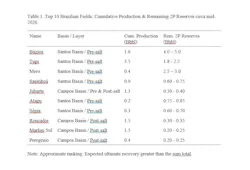
Búzios is Brazil’s largest oil field, with historical estimates of roughly 9–11 Bbbl of recoverable oil. It is the country's largest producing asset and is still in expansion, with three FPSOs scheduled to come online in 2027.
Tupi/Iracema, which began production in 2009, has estimated original recoverable resources of approximately 7–8 Bbbl. It is a mature giant field, now fully built out, with about 4 Bbbl cumulative production. Ongoing reservoir management and additional well development is part of its future development.
Mero, within the Libra area, is another super giant, with recoverable-resources of approximately 4–6 Bbbl. Its development involves four large FPSOs and advanced gas-handling technology, including subsea separation.
Atapu and Sépia complete the group of major pre-salt fields. Historical estimates put Atapu’s remaining reserves at approximately 1.8 Bbbl and Sépia’s at 1.5 Bbbl, before subsequent production and reserve revisions. Both are undergoing expansion with additional FPSOs scheduled for 2029 and 2030.
Brazil’s largest producing oil fields by remaining 2P reserves are concentrated in the Santos Basin’s pre-salt province, with Roncador, Jubarte, Marlim Sul and Peregrino in the Campos Basin. The ranking shown in the table is indicative because independently verified field-level 2P reserves are not publicly available.
Ownership
Petrobras is the dominant operator, but international companies including Shell, TotalEnergies, Equinor, CNPC and CNOOC participate in important developments with substantial working interests and a growing share of production.
According to ANP, Petrobras accounted for about 2.51 MMb/d of oil in October 2025 and operated 17 of the top 20 producing fields in the country.
The largest foreign producer was Shell at about 413 kb/d, followed by TotalEnergies at 189 kb/d, CNOOC at 145 kb/d, and Petrogal/Galp at 98 kb/d. In the next few years, CNOOC will vie for second place with TotalEnergies as production ramps up at Buzios, and Atapu 2 and Sepia 2 are brought online.
Foreign participation is concentrated in the large pre-salt developments. Tupi, for example, is held by Petrobras 65%, Shell 25% and Petrogal 10%. Mero is even more diversified: Petrobras 40%, TotalEnergies 20%, Shell 20%, CNODC 10% and CNOOC 10%. In Buzios, Petrobras has 89%, CNOOC Petroleum Brasil 7.3%, and CNODC Brasil 3.7%.
Atapu and Sépia also have substantial foreign participation following the transfer-of-rights surplus auctions. For Atapu, Petrobras has 73.24%, Shell 15.917%, and TotalEnergies 9.843%. For Sepia, Petrobras has 30%, TotalEnergies 28%, Petronas 21%, and Qatar Energy 21%.
American companies have almost no participation in Brazil's pre-salt developments. ExxonMobil’s principal producing asset is Bacalhau, and it also holds interests in exploration blocks in the Santos, Campos, Sergipe-Alagoas, and Foz do Amazonas basins.
Chevron formerly operated Frade, which began production in 2009, but subsequently sold its interest. Frade is now associated with Brazilian operator PRIO. Chevron's current upstream strategy in Brazil is predominantly exploration. Murphy Oil also has a small exploration portfolio in Potiguar and Sergipe-Alagoas.
Future oil
Brazil’s oil production is expected to continue increasing over the next several years, driven principally by the expansion of its pre-salt developments. Following average production of approximately 4.4 MMb/d in 2026, Brazil could approach 4.8–5.0 MMb/d by 2028–2030.
Looking ahead, growth will be supported by the commissioning and ramp-up of new FPSOs, particularly at Búzios, Atapu and Sepia, as well as production from established fields undergoing revitalization. The additions should more than offset declining production from the many mature offshore fields over the near term.
Petrobras plans to invest approximately $70 billion in exploration and production during 2026–2030, with almost two-thirds of its investment directed toward the pre-salt. The company projects that its own oil production will reach approximately 2.7 MMb/d in 2028.
Future gas
Brazil’s first large gas-oriented FPSO developments are under construction. Raia is perhaps the most important. Operated by Equinor (35%) with Repsol Sinopec (35%) and Petrobras (30%), the Campos Basin project has estimated recoverable resources exceeding 1 billion boe and approximately $9 billion in planned investment.
Its distinguishing feature is that the FPSO will process gas to sales specifications offshore, allowing direct export through an approximately 200-km pipeline to Cabiúnas without requiring further onshore gas processing. With 126 kb/d oil processing capacity and 16 MMm³/d gas capacity, its E-GOR = 4480 cf/bbl. First production is expected in 2028.
Two additional FPSOs in the Sergipe-Alagoas Basin also deserve attention. In May 2026, Petrobras signed contracts with SBM Offshore for the development of the SEAP-1 and SEAP-2 FPSOs.
SEAP-1 (P-81) is scheduled for 2031 and SEAP-2 (P-87) is scheduled for 2030. Both units have 120 kb/d oil capacity, and 10 MMm³/d and 12 MMm³/d gas capacity, respectively, or E-GORs of 2,942 and 3,530 cf/bbl. SBM Offshore is the contractor. Petrobras is the operator.
Together, the two projects represent more than $11 billion of Petrobras investment and are expected to recover over 1 billion boe. The planned gas-export pipeline faces regulatory uncertainty, making its execution a schedule risk.
About the Author
 Mark J. Kaiser
Center for Energy Studies
Mark J. Kaiser is Professor at the Energy Institute at Louisiana State University. His research interests cover the oil, gas, and refining industry, and relate to cost assessment, fiscal analysis, infrastructure modeling, and valuation studies. Kaiser has led several studies and published extensively on decommissioning in the Gulf of Mexico. He holds a Ph.D. from Purdue University.
Related
 Brazil Offshore
 Karoon Energy Fpso
