CNOOC reports four offshore discoveries, 16 successful appraisals in first half
Why this news matters:
-
CNOOC's discoveries in Bohai Bay and the South China Sea support China's ongoing efforts to increase domestic offshore oil and gas production.
-
The results show CNOOC advancing multiple energy-transition initiatives alongside conventional developments, including floating offshore wind, AI-enabled field operations and offshore carbon capture.
CNOOC first-half 2026 highlights
-
Four discoveries
-
16 successful appraisals
-
Discoveries in Bohai Bay and South China Sea
-
Three offshore China developments brought online
-
New exploration acreage secured in Brazil and Indonesia
-
Haiyou Anlan floating wind platform connected to grid
-
Offshore carbon capture project fully commissioned
CNOOC achieved four discoveries and successfully appraised 16 oil and gas accumulations in the first half of this year.
The update was included in CNOOC's 2026 interim results and highlights continuing exploration success across the Bohai Bay and South China Sea regions, alongside progress in offshore energy transition projects.
Offshore China discoveries drive exploration success
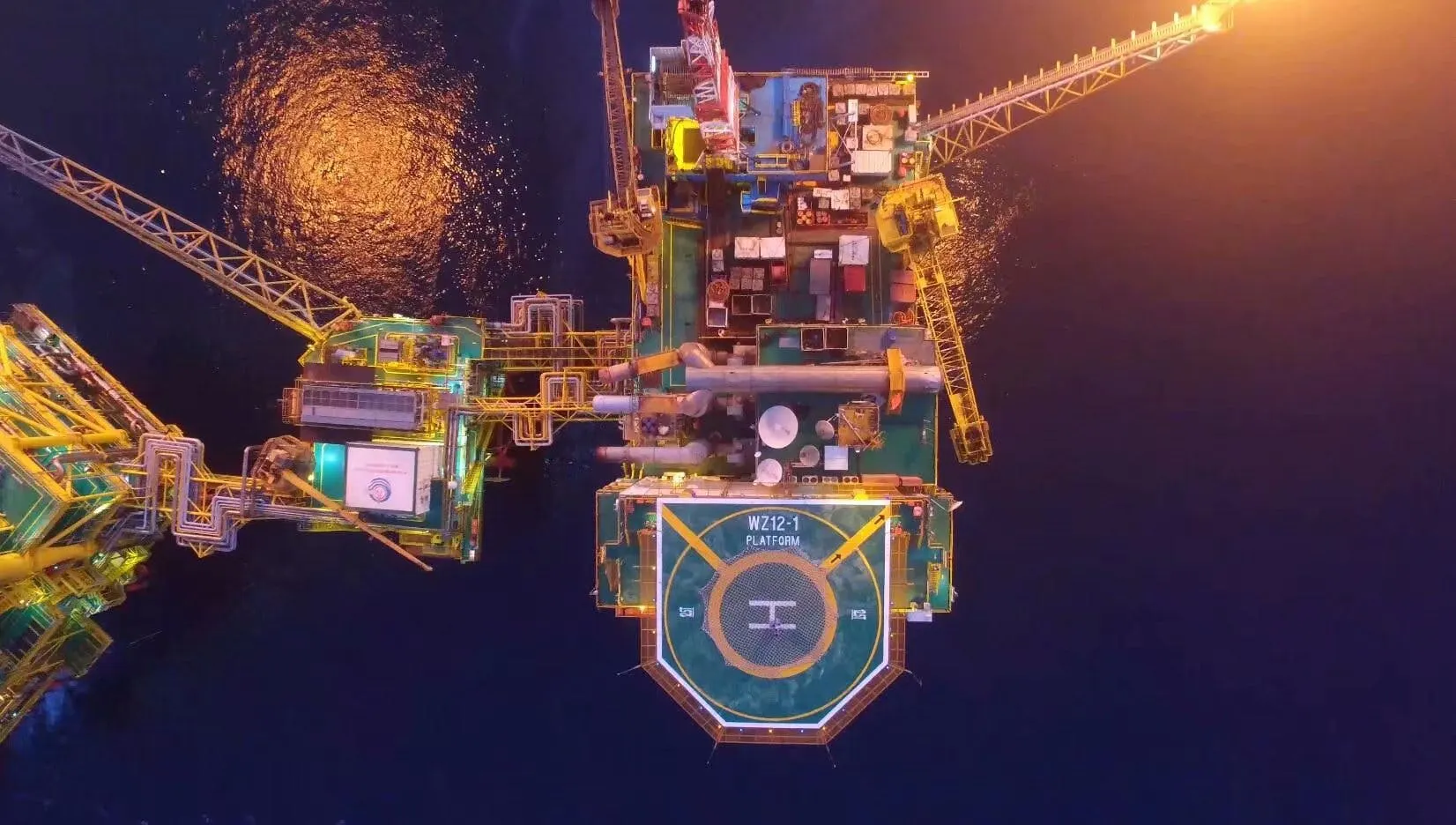
Offshore eastern China in Bohai Bay, the company discovered the Luda 16-1 and Qinhuangdao 30-3 fields and appraised Kenli 10-6.
In the South China Sea, the Enping 11-1 discovery could lead to a fast-track development through existing offshore facilities. And the appraisal of Wenchang 19-3 represented an advance in exploration of volcanic buried-hills in the Pearl River Mouth Basin, the company added.
Overseas, the company entered three exploration blocks in Brazil and Indonesia, including a new block in the presalt Santos Basin offshore Brazil, which CNOOC will operate.
New developments start production
Developments that came onstream in the period offshore China included the Penglai 19-3 Oilfield 1/2/3/8/9 Area Secondary Adjustment Project, Weizhou 10-3 Oilfield West Area Development Project, and Huizhou 25-8 Oilfield Comprehensive Adjustment Project.
CNOOC adapted its management of reservoirs to control the natural decline rate of certain offshore oilfields and enhance recovery. Various adjustment wells and workover operations also delivered incremental volumes, while breakthroughs in drilling offshore extended-reach wells allowed the company to access further reserves.
Digitalization, offshore wind and carbon capture advance
The company devised its Digital & Intelligent CNOOC initiative, deploying the Haineng-Zhiqing digital platform, and strengthened its digital foundation for intelligent oil and gas fields.
CNOOC’s intelligent injection-production interaction scenario for offshore oilfield production was highlighted at the 2026 World Artificial Intelligence Conference. In addition, the company installed more unmanned offshore platforms.
China’s first tension-leg floating wind power platform, Haiyou Anlan, was connected to the grid and should supply 54 million kWh/year of electricity annually to an oil field.
Finally, the company progressed construction of its deepsea wind power demonstration project CZ7,and fully commissioned China's first offshore carbon capture and utilization project.
Regional news:
About the Author
Jeremy Beckman
Staff Writer / Editor, Europe
Jeremy Beckman has been Editor Europe, Offshore since 1992. Prior to joining Offshore he was a freelance journalist for eight years, working for a variety of electronics, computing and scientific journals in the UK. He regularly writes news columns on trends and events both in the NW Europe offshore region and globally. He also writes features on developments and technology in exploration and production.