Pipelay technologies advancing to meet market needs
Key Highlights
- Recent advances in pipelay technology and systems have concentrated on tangible operational gains rather than entirely new vessel classes.
- Emphasis has been placed on making existing S-lay and reel-lay assets more productive, safer, and better suited to the specific constraints of current deepwater and high-pressure work.
- In today’s environment of capital discipline, contractors are extracting more performance, predictability, and flexibility from the fleet they already operate.
- The practical effects include shorter weather windows lost to waiting-on-weather, reduced personnel exposure during repetitive high-risk tasks, and the ability to install heavy-wall pipe for ultra-high-pressure reservoirs by reel-lay.
Bruce Beaubouef, Managing Editor
Pipelay contractors have introduced several practical innovations in offshore pipelay over the past 2–3 years (roughly 2023–early 2026), focused on automation, safety, efficiency, sustainability, and monitoring. These have aligned with announcements around vessel upgrades, new methods, and proprietary tools.
Allseas and Saipem are leading the way in the technologies designed to improve larger diameter pipelay, while Subsea 7 has introduced a number of advances related to reeled pipelay.
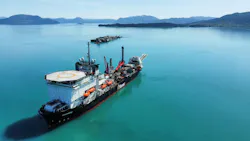
For Allseas, one key advance has been its “bowstring” start-up method, first deployed in late 2024 and early 2025. This technology was deployed on the Lorelay for a fast-track 22-km, 16-in. multiphase platform-to-platform pipeline off Trinidad (Mento A area, ~60–70 m water depth). With this method, the pipeline start-up head is connected directly to the platform jacket leg. On Mento A, the technique enabled completion in about 10 days (including mattress placement over existing lines). It was the first use of such a method in Allseas’ 40-year history and supported tight first-gas timelines.
Another innovation was Allseas’ Sandpiper shallow-water pipelay barge conversion and automated systems, operational from ~2023–2024. Here, Allseas converted an idle barge into a high-performance S-lay unit for shallow waters (up to ~150 m). The key innovation is an in-house fully automated 10-point anchor positioning system, with central console controls winches via setpoints/software instead of multiple manual operators/ joysticks. This speeds positioning, reduces errors, uses lightweight self-floating lines (no midline buoys in many cases), and improves safety/efficiency in congested areas. Other upgrades included a redesigned stinger for harsher sea states, the latest Phoenix automated welding, Dolphin phased-array ultrasonic testing (AUT), and automated field joint coating/wrapping. It has handled projects like the Darwin pipeline duplication nearshore section.
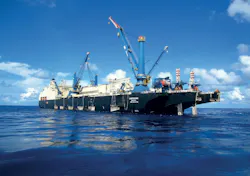
Allseas also modernized the double-joint factory (DJF) on its Solitaire vessel in early 2025, and carried out pipelay projects with the upgraded vessel later that year and in 2026. Here, the company updated one of the longest-serving (~1998) double-joint production lines (12 m singles welded into 24 m doubles) on one of the world’s largest S-lay vessels. The upgrade included advanced automated pipe handling, tracking, welding, inspection, and structural updates for faster lay rates, better weld quality/consistency, higher automation, and data-driven processes. Separate from the new DJF system, Allseas has also enhanced the vessel’s propulsion, automation, and hybrid power systems. These upgrades position the Solitaire to carry out upcoming deepwater campaigns in the US Gulf of Mexico, which is expected to include more than 320 miles of deepwater pipelay related to Enbridge’s upcoming Canyon oil and gas export systems, which will run from the Keathley Canyon area to existing hubs and platforms in the Green Canyon and Garden Banks areas. The Solitaire will perform the offshore campaign in 2027–2028 and will employ the modified DJF.
Additional work for the Solitaire will include the deepwater section of the ~150 km, 24-in. Rome Pipeline, which will run from Green Canyon 19 toward the Louisiana coast), scheduled for Solitaire in 2028. These upgrades fit into a broader two-year international campaign that also includes work in West Africa, Taiwan, and Australia and is expected to deliver more than 1,250 km of pipeline in total. The upgraded DJF and vessel systems are intended to support the higher automation, consistency, and efficiency needed for these deepwater jobs.
Other related efforts include electrification of launch-and-recovery systems (eLARS) on vessels like Solitaire, Lorelay, and Pioneering Spirit for ROV operations (lower environmental impact, efficiency, remote capability) and continued automation in welding/ inspection/coating systems.
Meanwhile, Saipem has been developing a suite of tools aimed at safer, more sustainable pipelay with reduced environmental impact and personnel risk. Several of these tools moved forward through 2023–2025 with qualifications, testing, and project use:
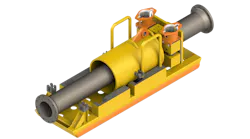
- Integrated Acoustic Unit (I.A.U.). This is a non-intrusive acoustic (reflectometry) system for real-time monitoring of pipeline integrity/ piggability during lay. It is said to detect and localize ovalization, deformations, buckles, scratches, water ingress, and obstacles by injecting/ analyzing acoustic signals using the pipe as a waveguide. It stores data and integrates with vessel systems (supports digitalization). The I.A.U. received a DNV Statement of Qualified Technology (for larger diameters like 30 to 36-in.); won a 2024 OTC Spotlight on New Technology Award; and has been used or tested on a number of projects including the Scarborough project. It is designed to avoid the risks of traditional mechanical detectors.
- Hands-Free Lifting Beam (HFLB). This is an automated system for transferring pipe joints from supply/cargo vessels to the pipelay vessel. It is designed to remove personnel from the “line of fire” during repetitive high-risk lifts. Development targeted deployment on projects from around 2023 onward.
- Underwater Cold Bending (UCB). This is an ROV-operated subsea bending machine that is able to form controlled vertical cold bends directly on the pipeline catenary near the touchdown point, without stopping continuous lay. It is designed to enable crossing steep slopes/escarpments with minimal or no seabed preparation/ excavation, thereby reducing environmental impact and cost. The technology has progressed with DNV statements (Feasibility and Endorsement of Qualification Plan) toward full Qualified Technology status.
- Anti-Flooding Tool (AFT). This is a remotely operated internal tool that runs in the already-laid (safe) section of the pipeline. It is designed to automatically plug the line in a wet-buckle/flooding event, protecting the laid portion. It avoids or reduces need for large dewatering spreads, chemicals, and associated costs/environmental impacts.
Additional Saipem work includes exploring machine learning/AI to speed prediction of potential plastic deformations (e.g., ovalization) during lay (as an alternative or complement to extensive FEA simulations) and broader pipeline technology upgrades (e.g., internal lining options qualified for offshore/subsea use).
Elsewhere, Subsea 7 has focused on developing new pipelay and related digital operability tools, ultra-high-pressure (20K) capabilities, and advanced flowline systems, including heat-trace systems and towed bundles. These advances have emphasized efficiency, extended vessel uptime, enabling previously inaccessible reservoirs, lower-carbon solutions, and cost reduction in deep/ultra-deepwater environments.
Subsea 7’s approach leans heavily on its differentiated strategy (early engagement, integrated services, digital solutions, enabling products, and alliances such as Subsea Integration Alliance with SLB OneSubsea). Vessels such as Seven Vega (advanced reel-lay for complex PiP, EHTF, and mechanically lined systems up to ~3,000 m), Seven Borealis (S-lay/J-lay/heavy lift), and others remain central to its strategy.
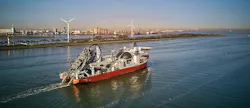
Key examples in recent years have included a range of digital tools for enhanced vessel operability, notably its 4Insight/ODST/DynOps software suite. Developed by Subsea 7’s 4Subsea business, this software combines high-resolution real-time vessel motion data, weather forecasts, and algorithms to automate operational decisions and extend the weather window for pipelay and other activities. In 2025, it was rolled out across parts of the fleet and delivered a notable impact on the flagship reel-lay vessel Seven Vega: approximately 35 additional operational days (over 10% uplift versus standard planning assumptions). The software is designed to reduce waiting-on-weather downtime, improve predictability, increase fuel efficiency, and increase collaboration between onshore/offshore teams. It has also been applied to offshore wind installation and crew transfers.
Other Subsea 7 advances include enhancements to its high-pressure (20K/20,000 psi) pipeline fabrication and installation capabilities. Here, Subsea 7 has developed materials and methods for installing rigid pipelines for reservoirs up to 20,000 psi, building on earlier 15K experience. Critical elements include complex welding of heavy-wall pipe (up to ~50 mm thickness) with tight acceptance criteria. Capabilities were advanced via the company’s technology center in Glasgow (UK) and welding facilities in the United States.
In 2025, Subsea 7 completed engineering, fabrication, and installation for Beacon Offshore Energy’s Shenandoah project (the third such ultra-high-pressure field for the company) and extended reel-lay capabilities for heavy-wall 20K pipe. This follows the region’s first 20K riser work at Chevron’s Anchor and supports further projects such as Monument (scheduled ~2026). These technologies should help operators tap into hydrocarbons in high-pressure reservoirs in upcoming deepwater US Gulf plays.
Subsea 7 has also helped to advance flow assurance techniques, particularly the Electrically Heat-Traced Flowline (EHTF) system developed with partner ITP Interpipe. EHTF combines ultra-high-performance insulation with low-voltage electric heating (helically wound trace wires) and fiber-optic temperature monitoring. It is installed primarily by reel-lay and is said to enable cost-effective long-distance single-line tiebacks while mitigating wax/hydrate risks and reducing reliance on chemical injection (e.g., MEG). It has demonstrated operational reliability (TRL 7 per API 17Q), with strong thermal performance track records (e.g., ~0.38–0.54 W/m²K) on Aker BP’s Ærfugl phases offshore Norway. Benefits are said to include lower capex/opex, production enablement for remote reservoirs, and significant GHG savings (e.g., ~5 million tonnes CO₂ equivalent claimed versus MEG injection on Ærfugl).
Subsea 7 also continues to advance its pipeline bundle technology, with multiple pipelines, controls, and heating systems integrated into a single carrier pipe, prefabricated onshore, commissioned, then towed and installed via the controlled depth tow method using conventional anchor-handling tugs. Recent milestones include successful installation of multiple long bundles for Aker BP’s Yggdrasil development (e.g., 7.7 km South Bundle and others launched from the Wester site in Scotland and towed hundreds of kilometers). Bundles are said to enable faster field development, lower vessel requirements, and include features such as active heating or re-float/reposition capability. Onshore handling has been supported by specialized equipment (e.g., high-capacity Liebherr pipelayers at Wester).
Conclusion
The technological advances described above—many of which have already been deployed on real projects—have concentrated on tangible operational gains rather than entirely new vessel classes. Across the three contractors, the emphasis has been on making existing S-lay and reel-lay assets more productive, safer, and better suited to the specific constraints of current deepwater and high-pressure work.
Collectively, these developments reflect a market in which capital discipline has limited investment in new deepwater pipelay capacity, so contractors are extracting more performance, predictability, and flexibility from the fleet they already operate. The practical effects include shorter weather windows lost to waiting-on-weather, reduced personnel exposure during repetitive high-risk tasks, lower chemical and dewatering requirements in some scenarios, and the ability to install heavy-wall pipe for ultra-high-pressure reservoirs by reel-lay.
At the same time, the pending Saipem–Subsea 7 merger (targeting completion as Saipem7 in the second half of 2026, subject to approvals) could further consolidate some of these complementary capabilities, though the commercial and technical outcomes remain to be seen. In short, recent progress has been incremental but field-proven, aimed at delivering measurable improvements in schedule, safety, cost, and the ability to access more demanding reservoirs with the vessels and methods already in service.
About the Author
 Bruce Beaubouef
Senior Lead Reporter / Managing Editor
Bruce Beaubouef is Managing Editor for Offshore magazine. In that capacity, he plans and oversees content for the magazine; writes features on technologies and trends for the magazine; writes news updates for the website; creates and moderates topical webinars; and creates videos that focus on offshore oil and gas and renewable energies. Beaubouef has been in the oil and gas trade media for 25 years, starting out as Editor of Hart’s Pipeline Digest in 1998. From there, he went on to serve as Associate Editor for Pipe Line and Gas Industry for Gulf Publishing for four years before rejoining Hart Publications as Editor of PipeLine and Gas Technology in 2003. He joined Offshore magazine as Managing Editor in 2010, at that time owned by PennWell Corp. Beaubouef earned his Ph.D. at the University of Houston in 1997, and his dissertation was published in book form by Texas A&M University Press in September 2007 as The Strategic Petroleum Reserve: U.S. Energy Security and Oil Politics, 1975-2005.