PT Prima Petroleum Energy (Prima Energi) has taken FID on Phase 1 of the Ande-Ande Lumut (AAL) oilfield development in the Natuna Sea, offshore western Indonesia.
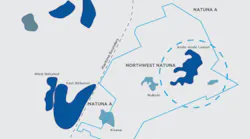
AAL is in 70 m of water in the 461-sq-km Northwest Natuna PSC working area, 510 km northeast of Singapore and Batam, and 1,300 km north of Jakarta.
The field was discovered in 2000, with three follow-up wells drilled between 2006 and 2016. The three wells in the central segment all tested successfully.
Development of the AAL oilfield is currently underway, with first oil targeted by 2028.
AAL has certified resources of 56.4 MMbbl. Prima Energi estimates capex for the Phase 1 development of $515 million.
Indonesia’s regulator SKK Migas approved the Plan of Development Revision 1 in March 2024, with further studies and FEED work conducted since to refine the development concept.
Prima Energi expects to award an EPCI contract shortly for a wellhead central processing platform. It has also ordered long-lead equipment items, with drilling planning said to be strongly advanced.
Future development phases will be influenced by lessons learned from Phase 1.
The six-pile platform will feature 16 well slots, capable of accommodating 26 wells, and processing capacities of 20,000 bbl/d of oil, 100,000 bbl/d of water, and 110,000 bbl/d of liquids.
Ten horizontal production wells will be initially drilled and completed, and optimized to handle heavy oil recovery.
In addition, the company plans to charter a spread-moored FSO vessel providing about 600,000 bbl of oil storage, with utility support and offshore accommodation.
Installation and hookup of the platform and FSO are currently scheduled for the period after the 2027/2028 monsoon season. Development drilling should begin in mid-2028, followed quickly by first oil, with production then ramping up toward the facility oil design capacity of 20,000 bbl/d.
Future development phases could bring additional wells, increased processing capacity and expanded production infrastructure.