McDermott details Vashishta and S1 subsea installation campaign
Offshore staff
CHENNAI, India– ONGC has achieved first gas from the deepwater Vashishta and S1 development project in the Krishna-Godavari basin off eastern India, according to McDermott International Inc.
The Vashishta field lies in water depths between 500 and 700 m (1,600 and 2,300 ft), about 31 to 35 km (19 to 22 mi) from the Amalapuram coast. The field is estimated to produce 9.56 bcm over a period of nine years with peak production reaching 3.55 MMscm/d during the first five years.
The S1 field is in water depths between 250 and 600 m (800 and 2,000 ft), about 26 to 29 km (16 to 18 mi) from the Amalapuram coast. It is expected to deliver 6.22 bcm over a period of eight years with a peak production of 2.2 MMcm/d for the first five years.
In December 2015,McDermott and consortium partner LTHE, a wholly owned subsidiary of Larsen & Toubro Ltd., received an engineering, procurement, construction, and installation (EPCI) contract for the project’s subsea infrastructure.
The consortium was responsible for the engineering, supply, and installation of a series of pipeline end terminations (PLETs) and in-line tee structures (ILTs), a pipeline end manifold structure (PLEM), rigid jumpers, and about 50 km (31 mi) of umbilicals. The pipeline scope included 93 km (58 mi) of 14-in. dual rigid pipelines extending from the shallow water shore line to a maximum water depth of 700 m (2,300 ft).
Ben Delves, McDermott’s Vashishta Project Director, said: “Engineering design for the Vashishta project was no easy feat due to the iterative nature of the design process which had to reconcile many factors such as soil conditions, jumper/spool loads, connector capacities, in-place environmental loads, pipeline expansion loads, installation weather limitations, vessel envelope constraints, and mission equipment constraints.”
Typical weights for Vashishta PLETs and ILTs ranged from 35 to 85 metric tons (27 to 93 tons) and the PLEM weight was 200 metric tons (220 tons).
“A combination of soft soils and the significant weight of permanent equipment has contributed to some large structures,” said Delves, “which made the interfaces with the installation vessel challenging.”
The installation of the subsea infrastructure was particularly challenging, according to McDermott, as the company only had four months out of the year to work offshore before the monsoon season hit the field with bad weather and strong sea undercurrents.
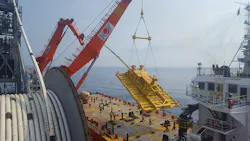
During the installation phase, McDermott deployed itsDerrick Barge 30, Lay Vessel North Ocean 105, and North Ocean 102. The company also deployed its portable spoolbase at the LTHE base in Kattupalli, India, to fasttrack the production of pipeline stalk for loading onto the installation vessels.
04/25/2018