Offshore names its Top 5 five oil and gas discoveries of the year
Key Highlights
- Infrastructure-led and near-field exploration dominates this year’s Top 5 offshore discoveries.
- Geologically, Miocene sandstones feature prominently in the larger non-Norwegian finds.
- Regionally, Africa (Angola and Egypt) and Southeast Asia (Indonesia) account for the three largest finds, underscoring sustained interest in these basins amid efforts by host governments.
- Norway’s results, with two of the five top discoveries, illustrate the ongoing productivity of near-field drilling on a mature shelf.

Bruce Beaubouef, Managing Editor
Operators and producers have announced a number of new offshore oil and gas discoveries this year, ranging from the always-desired “large elephants” – traditionally those fields holding 500 million barrels of oil or more – to smaller and medium-sized fields. In today’s never-ending search for energy, none are unimportant.
Exploration success in 2026 produced several notable offshore finds, but the largest by published volume estimates were concentrated in Indonesia, Egypt, and Angola. Smaller near-field discoveries on mature shelves, particularly in the Norwegian North Sea, fill out the list.
To place this year’s discoveries in context, Offshore has compiled “The Top 5 offshore discoveries of 2026.” These have been based on announcements and preliminary assessments issued through early November 2026, and the ranking below prioritizes preliminary in-place or recoverable figures released by operators or regulators. These numbers remain early-stage and will evolve with appraisal.
The Top 5 discoveries are, from largest to smallest:
1. Geliga-1 (Eni, Kutei Basin, Indonesia)
2. Denise West (Eni/bp, Temsah Concession, Egypt)
3. Algaita-01 (Azule Energy, Block 15/06, Angola)
4. Omega Sør Alfa/Omega South (Equinor, Norwegian North Sea)
5. Grimsnes (Equinor, Norwegian North Sea).
These discoveries are detailed below, followed by thoughts on common themes and trends, and some honorable mentions.
Geliga-1
Announced on April 20th, Eni’s Geliga-1 well in the Ganal PSC delivered the year’s largest discovery. Preliminary estimates indicate approximately 5 trillion cubic feet of gas and 300 million barrels of condensate in place in the targeted Miocene interval. The well was drilled in roughly 2,000 meters of water about 70 km off East Kalimantan to a total depth of around 5,100 meters and encountered what Eni described as a “significant” gas column with “excellent” petrophysical properties. A subsequent drill-stem test confirmed high productivity, supporting sustainable rates on the order of 200 million standard cubic feet per day of gas and about 10,000 barrels per day of condensate. The find sits adjacent to the undeveloped Gula discovery (roughly 2 Tcf of gas in place). Combined, the two could support incremental production of around 1 billion cubic feet per day of gas and 80,000 barrels per day of condensate, opening the possibility of a third production hub in the Kutei Basin. Eni operates with an 82% interest; Sinopec holds 18%. Development planning is advancing alongside the broader Eni-Petronas Searah joint venture portfolio.
Denise West
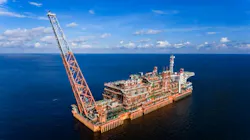
On April 7th, Eni and partner bp announced the Denise West discovery via the Denise W-1 well in the Temsah Concession in the Eastern Mediterranean. Preliminary estimates stand at about 2 trillion cubic feet of gas initially in place and 130 million barrels of associated condensate. The well was drilled about 70 km offshore in roughly 95 meters of water and found a high-quality gas-bearing sandstone reservoir with approximately 50 meters of net pay. Its location less than 10 km from existing infrastructure makes it a strong candidate for fast-track development. Partners have targeted a final investment decision in the near term, with first gas potentially within about two years. Eni operates the Denise Development Lease with a 50% working interest alongside bp. The discovery supports Egypt’s efforts to offset declines at mature fields and increase domestic gas supply.

Algaita-01
Azule Energy (the Eni-bp joint venture) and partners made a significant oil discovery at the Algaita-01 well in Block 15/06 in the Lower Congo Basin in early February. Initial estimates point to approximately 500 million barrels of oil in place in multiple Upper Miocene sandstone intervals with excellent petrophysical properties. The well was drilled in 667 meters of water, about 18 km from the Olombendo FPSO. Proximity to existing production facilities improves the development case and could allow a relatively capital-efficient tieback. Azule operates the block. This ranks as one of the larger oil finds of 2026 and adds to a long track record of successes in Block 15/06.
Omega Sør Alfa/Omega South
Equinor and partners discovered oil on the Omega Sør Alfa prospect in production license 057 near the Snorre field in March. Preliminary estimates place recoverable volumes between 25 and 89 million barrels of oil equivalent. The well, drilled in 381 meters of water, encountered oil in sandstone layers totaling more than 200 meters in thickness, with “good reservoir properties in a substantial portion of the interval,” according to Equinor. The partnership has planned a rapid subsea tieback to existing facilities in the Tampen area, consistent with Equinor’s push to bring near-field discoveries online in two to three years. This is a solid infrastructure-led result in a mature province.
Grimsnes
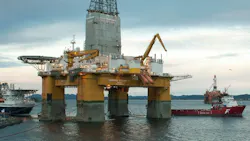
Equinor, Petoro, and TotalEnergies made an oil and gas discovery at the Grimsnes well near the Oseberg field in October. Preliminary recoverable volumes are estimated at 19 to 50 million barrels of oil equivalent. The well encountered a combined oil and gas column of 54 meters in the Tarbert Formation. Partners intend a subsea tieback to the Oseberg Sør platform, with an investment decision possible as early as summer 2027 and production potentially within three years. Like Omega Sør, it exemplifies the continued productivity of near-field exploration on the Norwegian Continental Shelf.
Common themes and trends
Several clear themes emerge from the top five 2026 offshore discoveries by estimated size. Infrastructure-led and near-field exploration dominates. Four of the five (Denise West, Algaita-01, Omega Sør, and Grimsnes) sit close to existing production facilities or platforms, enabling faster, lower-cost tiebacks rather than standalone developments. Denise West is less than 10 km from infrastructure in Egypt’s Temsah area; Algaita-01 is about 18 km from the Olombendo FPSO in Angola; and the two Norwegian finds are designed as rapid subsea satellites to mature fields (Snorre and Oseberg). Even Geliga-1, while larger and more of a hub-scale opportunity, benefits from proximity to other recent Kutei Basin discoveries and planned infrastructure. This reflects a broader industry preference for shorter-cycle projects that can leverage already-paid-for facilities and accelerate time to first production.
Geologically, Miocene sandstones feature prominently in the larger non-Norwegian finds. Geliga-1 tested a Miocene interval with excellent properties in Indonesia’s Kutei Basin, while Algaita-01 encountered multiple high-quality Upper Miocene oil-bearing sandstones in Angola’s Lower Congo Basin. Denise West also found high-quality gas-bearing sandstone. The Norwegian discoveries target more mature Jurassic plays near existing fields.
The targeted hydrocarbon types are mixed: the two largest are gas-condensate (Geliga-1 and Denise West), Algaita-01 is oil, and the Norwegian pair includes both oil and oil-gas. Water depths range widely—from shallow (~95 m at Denise West) to deepwater (Geliga-1 at ~2,000 m and Algaita-01 at 667 m)—showing continued activity across the spectrum.
Regionally, Africa (Angola and Egypt) and Southeast Asia (Indonesia) account for the three largest finds, underscoring sustained interest in these basins amid efforts by host governments to reverse production declines and attract investment through concession renewals and favorable terms. Eni (directly or via the Azule Energy joint venture with bp) is involved in three of the five, highlighting its active exploration program. Norway’s results illustrate the ongoing productivity of near-field drilling on a mature shelf. Specific advanced drilling techniques such as managed pressure drilling or horizontal wells are not highlighted in the public announcements for these particular wells; the emphasis has been on reservoir quality, proximity to infrastructure, and the potential for accelerated development rather than novel drilling methods.
Honorable mentions
Several other 2026 discoveries attracted attention but lack published volume estimates and therefore cannot be ranked by size. Petrobras’s Morpho well in block FZA-M-59 in Brazil’s Equatorial Margin (Foz do Amazonas) confirmed three oil-bearing intervals in ultra-deep water (2,886 meters), roughly 175 km off Amapá. Drilling and data acquisition are complete, but Petrobras has released no resource numbers. The result is significant as an early opening of a major frontier basin, yet commerciality and scale remain unproven.
Planet One’s Nya Gyidie-1X well offshore Ghana similarly confirmed hydrocarbons in a carbonate reservoir—the first successful test of a Cenomanian-Turonian carbonate play in the country—in 2,289 meters of water. No volume estimates have been issued.
Chevron’s 105-4X well in Angola’s Block 0 encountered a hydrocarbon column exceeding 600 meters with more than 90 meters of net pay in excellent-quality Pinda reservoir rock, and it is being assessed for a potential tieback to existing facilities. Again, no quantified resource figure has been released.
If the ranking criteria expanded beyond estimated reserve size to include factors such as local job creation and new or sustained energy infrastructure, several of these unquantified or smaller finds would likely rise. Morpho stands out for its potential to open an entirely new producing province, which could eventually support major infrastructure investment and employment over the longer term.
The Angola discoveries, particularly 105-4X and the smaller but very rapid Acacia-5 (TotalEnergies, Block 17), benefit from proximity to existing FPSOs and platforms; Acacia-5, for example, is expected to add production via the Pazflor FPSO within months of discovery. Near-field Norwegian finds such as Omega Sør and Grimsnes also score well on these metrics because they extend the life of mature fields with relatively low-cost subsea developments and support ongoing activity and jobs on the Norwegian Continental Shelf.
Murphy’s Lac Da Trang North-1X offshore Vietnam, with about 40 meters of net oil pay near the newly producing Lac Da Vang field, fits a similar infrastructure-led pattern.
In short, Geliga-1, Denise West, and Algaita-01 clearly lead on published volume. Morpho, Nya Gyidie, 105-4X, and various near-field tieback discoveries remain important for different reasons—frontier opening or rapid monetization—but they fall outside a pure size ranking until resource estimates are released. Appraisal results in 2027 will refine all of these assessments.
Offshore readers weigh in
Back in October, we asked our readers which discoveries made this year would be the most notable and have the biggest impact.
It should be noted that more qualifiers (or questions) were placed with this poll, as opposed to the related feature article. Readers were asked to weigh in on which discovery would have the most impact in terms of commercial reserves, local jobs, and infrastructure construction. (The feature article’s lone metric is estimated commercial reserves.)
The poll ran online from October 21 to November 6.
Interestingly, none of the readers’ Top 5 corresponded to our Top 5. This is most likely perfectly explainable, at least in part, by the fact that readers went with at least a couple of discoveries that are quite likely to have huge impact, but the operators have not yet issued estimated reserves for.
Readers chose:
- Morpho (Petrobras, Block FZA-M-59, Foz do Amazonas Basin, offshore Amapá, Brazil) (42%)
- 105-4X (Chevron/Cabinda Gulf Oil Company, Block 0, Lower Congo Basin, offshore Angola) (12%)
- Lac Da Trang North-1X (Murphy Oil, Block 15-1/05, Cuu Long Basin, offshore Vietnam) (11%)
- Acacia-5 (TotalEnergies, Block 17, Lower Congo Basin, offshore Angola) (8%)
- Gullfaks South Gas (Equinor, Gullfaks production licence / PL 050 area, Norwegian North Sea) (7%).
 The Algaita-01 discovery, which was in our Top 5, came in sixth place for readers at six percent.
A few thoughts on the reader choices:
- Morpho (frontier Brazil) and 105-4X (Angola tieback potential) are the clearest examples of discoveries that ranked highly on impact criteria (jobs, infrastructure, strategic value) even without published reserve numbers.
- Lac Da Trang North-1X and Acacia-5 are both infrastructure-led near-field finds (Vietnam and Angola respectively), which likely boosted their appeal under the poll’s broader criteria.
- Gullfaks South Gas is a very small near-field gas addition on a mature Norwegian asset — consistent with why it would score lower on pure volume but still register with some readers.
The poll could be answered anonymously. However, some profile or job-related information from respondents included:
- Some of the poll respondents were with BPRL Brasil, NNPC, QatarEnergy, Subsea7, Woodside, among others.
- Of those that chose to share, 15.38% are with a service company, 23.08% are with an independent oil and gas company, 23.08% are with a national/state oil company, 7.69% are with a consulting company, 7.69% are with an EPC contractor, 7.69% are with a pipeline/installation contractor, 7.69% are with a financial services/capital provider, and 7.69% are with an education institution/government agency/research laboratory
- Of those that chose to share, 30.77% identified their job title as in engineering, 15.38% in management, 15.38% geology or geophysics, 7.69% executive management, 7.69% CTO/CIO/VP Technology/VP Digital or other technical executive, 7.69% field professional, 7.69% consulting, and 7.69% other.
- Of those that chose to share, they said their purchasing influence for equipment and services is: 53.85% Recommend, 38.46% Approve, 23.08% None, and 7.69% Specify.
- Of those that chose to share, 15.38% of the poll respondents said they are from Nigeria, 23.08% are from Brazil, 7.69% are from Australia, South Korea, Mexico, Norway, Qatar, Turkey, Trinidad and Tobago, and the US.
It should be noted that the percentages in the job-title and purchasing-influence sections add up to more than 100% in places. This is common when respondents can select multiple options or when “of those that chose to share” is a subset.
About the Author
 Bruce Beaubouef
Senior Lead Reporter / Managing Editor
Bruce Beaubouef is Managing Editor for Offshore magazine. In that capacity, he plans and oversees content for the magazine; writes features on technologies and trends for the magazine; writes news updates for the website; creates and moderates topical webinars; and creates videos that focus on offshore oil and gas and renewable energies. Beaubouef has been in the oil and gas trade media for 25 years, starting out as Editor of Hart’s Pipeline Digest in 1998. From there, he went on to serve as Associate Editor for Pipe Line and Gas Industry for Gulf Publishing for four years before rejoining Hart Publications as Editor of PipeLine and Gas Technology in 2003. He joined Offshore magazine as Managing Editor in 2010, at that time owned by PennWell Corp. Beaubouef earned his Ph.D. at the University of Houston in 1997, and his dissertation was published in book form by Texas A&M University Press in September 2007 as The Strategic Petroleum Reserve: U.S. Energy Security and Oil Politics, 1975-2005.
Related
 Offshore's Top 5 Oil and Gas Discoveries
