NSTA lists operators behind schedule with P&A obligations

Britain’s North Sea Transition Authority (NSTA) has identified 13 offshore operators that it says have fallen behind in their decommissioning obligations for their UK North Sea fields.
All are named in the NSTA's first published table of the North Sea well decommissioning deficit. The table lists those companies that have failed to meet their consent deadlines for full decommissioning of a total of 153 inactive wells.
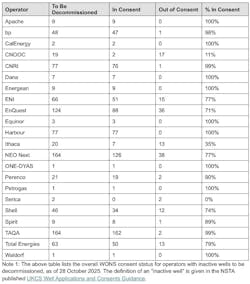
These are located throughout the UK sector, with the largest concentration in the central North Sea.
“The number of wells in this table demonstrates the size of the task facing [the] industry. The NSTA is well aware of the potential cost, and the logistical difficulties, but while many operators are delivering, too many are failing to meet obligations. Delays can impact on cost and cause reputational damage. It is our expectation that companies will take immediate action to improve compliance, placing contracts with the supply chain for the wells that are overdue or applying for consents where none exist.”
—Pauline Innes, NSTA director of Supply Chain and Decommissioning
The NSTA’s table includes 22 operators that operate a total of 780 wells; nine of the operators are said to have complied with consent deadlines.
An inactive well is classified as:
- Being out of consent if the operator has not applied for but been granted consent; or
- If the consent was granted but the operator failed to decommission the well within the designated timeframe.
In July, the NSTA published its latest Decommissioning Cost and Performance Update, which estimated that £44 billion ($58.9 billion) remains to be spent on decommissioning North Sea infrastructure at current prices. Well P&A accounts for half that total.
The report warned operators of the pressing need to tackle the backlog of wells, to prevent drilling contractors transferring idle rigs from the North Sea to other regions, with a knock-on impact on the UK’s supply chain.
In total, there are almost 1,000 inactive wells in the North Sea that will need to be fully decommissioned, though many of those are within consent.
Subsea7 to remove North Sea Alba, Greater Stella Area subsea structures
Ithaca Energy has contracted Subsea7 to provide decommissioning services for the Alba FSU and Greater Stella Area Field FPF-1 semisubmersible production platform in the central UK North Sea.
Subsea7’s work scope, to be managed from the company’s offices in Aberdeen, includes flushing of the subsea pipelines, diver support vessel services and seabed clearance.
Offshore activities are due to start next spring.
UKCS decommissioning costs on the rise
Offshore Energy UK’s recently published 2025 Decommissioning Report found that last year decommissioning expenditure across the UK Continental Shelf exceeded £2 billion ($2.64 billion) for the first time.
“Operators and suppliers are collaborating to control costs by developing innovative contracting models to decommission multiple assets using a campaign approach with technical solutions being deployed across all regions of the UKCS. Early engagement with the supply chain and advanced planning tools are helping to make the most of resources and manage peak decommissioning activity.”
—Ricky Thomson, OEUK’s head of decommissioning
The report predicts that close to 2,000 wells in UK waters will need to be decommissioned by 2034. Subsea infrastructure removals will also intensify; more than 95,000 mt of structures are planned for removal over the next decade, including concrete stabilization mattresses and large subsea manifolds, and 883 km of pipelines.
In addition, the report found that decommissioning accounted for 15% of total oil and gas spending across the UK sector last year, with the percentage set to exceed 30% by the end of the decade.
At current rates of activity, decommissioning costs could surpass offshore oil and gas capex by 2028 if current investment conditions persist.
The UK’s Energy Profit Levy (EPL), which the government confirmed last week would remain in place until 2030, is one of the main factors that have led to an increase in cessation of production decisions being brought forward, OEUK added.
The report estimates that 78 platform wells, 40 subsea wells, and six exploration and appraisal wells were decommissioned in 2024.
In total, 4,750 mt of subsea infrastructure were removed, with 10 topsides (38,833 mt) and 12 substructures/jackets (10,924 mt) dismantled and removed.
North Sea Kilmar wells plugged, Energean says
Energean recently reported that the Kilmar (UK) well plugging and abandonment (P&A) activities were completed in September, marking the end of its UK well P&A campaign. It added that the campaign was completed below budget, ahead of schedule and with zero
LTIs. The Tors and Wenlock platforms are now hydrocarbon safe and will remain in lighthouse mode until the 2026 removal campaign.
About the Author
 Jeremy Beckman
Jeremy Beckman
Staff Writer / Editor, Europe
Jeremy Beckman has been Editor Europe, Offshore since 1992. Prior to joining Offshore he was a freelance journalist for eight years, working for a variety of electronics, computing and scientific journals in the UK. He regularly writes news columns on trends and events both in the NW Europe offshore region and globally. He also writes features on developments and technology in exploration and production.