Worley Rosenberg constructing flow conditioning system for Mikkel gas field offshore Norway
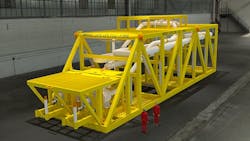
Equinor has issued an engineering, procurement and fabrication contract to Worley Rosenberg for a subsea flow conditioning unit (FCU).
This will be installed at the Åsgard subsea compression manifold station (SCMS-A) in the Norwegian Sea and connected to existing offshore infrastructure via subsea spools.
The main purposed of the FCU will be to manage and stabilize the flow of liquids and gas from the satellite Mikkel Field. It will control pressure and temperature to ensure steady transport of the wellstream through subsea pipes, in line with the liquid handling capacity of the Åsgard subsea compression station.
Worley Rosenberg expects to deliver the completed structure in second-quarter 2027.
Mikkel, discovered in 1987, is in the eastern Norwegian Sea in 220 m of water and started production in 2003. It has been developed via two subsea templates tied back to the Åsgard B platform.
The field, which produces gas and condensate from Jurassic sandstone in the Garn, Ile and Tofte formations, comprises six structures separated by faults, with a reservoir depth of 2,500 m.
Upon arrival at Åsgard B, the condensate is separated from the gas and stabilized before being shipped as light oil, commingled with condensate produced from the Åsgard Field.
Mikkel’s rich gas heads via the subsea Åsgard Transport System to the Kårstø terminal in western Norway for separation of the natural gas liquids. The dry gas is then sent through the Europipe II pipeline in the North Sea for export to markets in Europe.
Mikkel owners are Vår Energi (48.38%), Equinor (43.97%) and Repsol Norge (7.65%).
Exclusive content:
 EPC contracts awards in 2026 expected to total some $59 billion
About the Author
 Jeremy Beckman
Jeremy Beckman
Staff Writer / Editor, Europe
Jeremy Beckman has been Editor Europe, Offshore since 1992. Prior to joining Offshore he was a freelance journalist for eight years, working for a variety of electronics, computing and scientific journals in the UK. He regularly writes news columns on trends and events both in the NW Europe offshore region and globally. He also writes features on developments and technology in exploration and production.