Predictive ocean intelligence on the rise in offshore operations
Key highlights:
- Operators are shifting from reactive to anticipatory planning by using probabilistic forecasts combined with real-time measurements.
- Vessel motion parameters, such as heading and wave direction, are now central to operational decision-making, improving safety and stability.
- Data integrity, provenance and synchronized timestamps are critical for operational defensibility and regulatory compliance.
- Despite challenges, predictive intelligence reduces standby hours, stabilizes execution and enhances decision consistency across offshore operations.

As offshore operations grow more complex and weather‑sensitive, the industry is entering a new phase of environmental intelligence. Jonas Røstad, CCO of Miros AS, said operators are moving beyond static forecasts and reactive weather checks toward a model built on real‑time measurements, probabilistic planning and vessel‑specific motion insight. The goal is reduced uncertainty at the work site and more defensible, consistent operational decisions.
A fundamental operational shift

Røstad sees offshore teams transitioning from “observe and react” to “anticipate and schedule.” The shift is most visible in how planning windows are constructed. Rather than depending on a single deterministic forecast or a morning briefing, operators now use probabilistic forecasts combined with live verification. Planners want confidence bands and clarity on which factor (e.g., waves, wind, current or vessel response) is most likely to break the plan, Røstad said.
Vessel motion is also taking center stage. For decades, significant wave height defined operational limits, but this is changing.
"Vessel motion assessment is becoming a first-class decision variable, not an afterthought," he added.
This is driven by parameters like heading, encounter period, local wave directionality and current shear. These response drivers help operators understand what motions will occur at the work site and how to adjust strategy to remain within limits.
Safety‑critical decisions are following the same path. Dynamic thresholds, documented rationale and traceable decisions are becoming standard for lifts, gangway transfers, DP operations and subsea intervention—areas where consistency across shifts is crucial for risk management and regulatory defensibility.
 wind turbine stands resilient amidst turbulent ocean waves
Climbing the sea‑state insight ladder
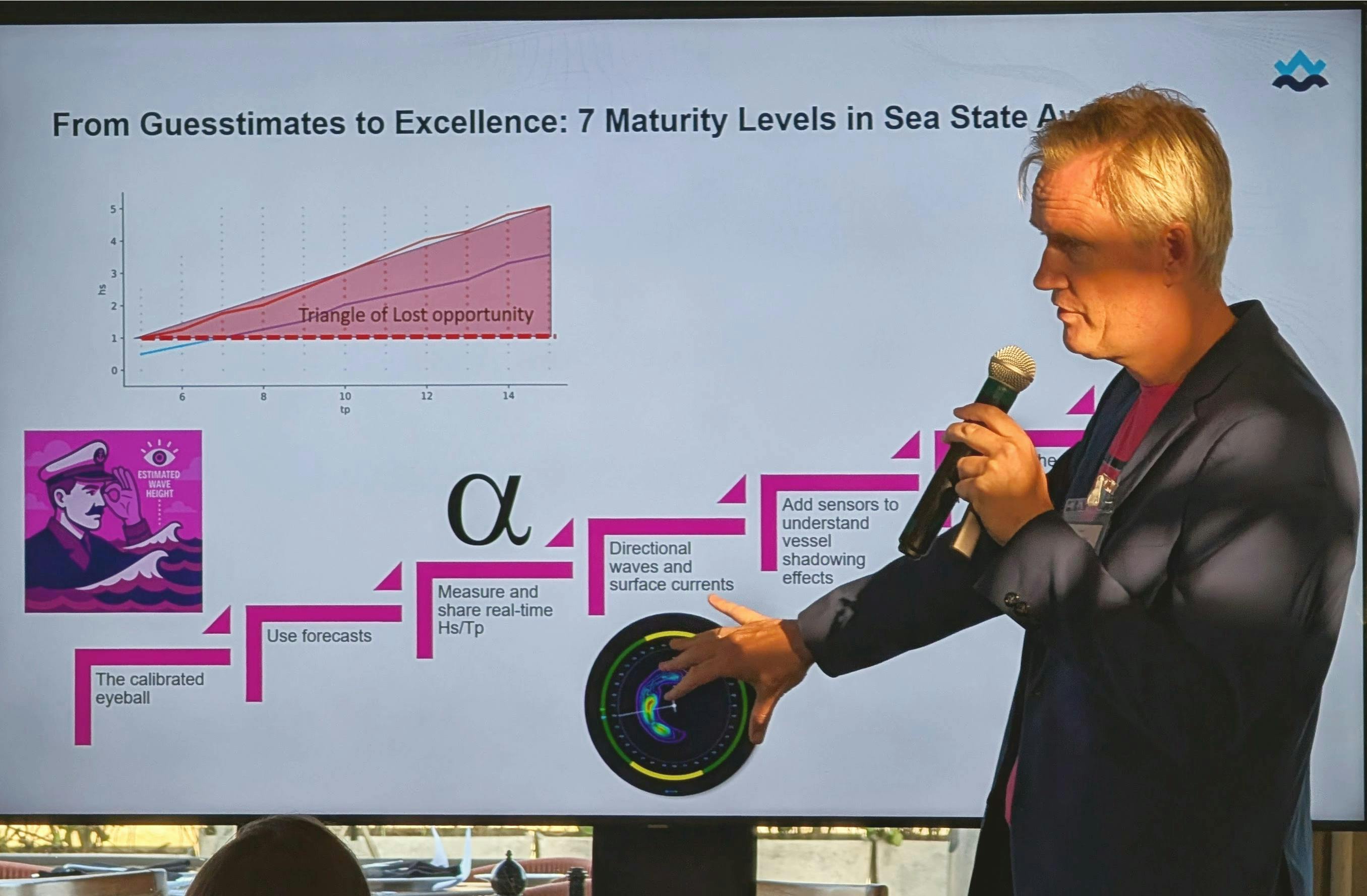
To describe how operators mature in their use of ocean intelligence, Røstad outlined a five‑step “sea state insight ladder.”
Organizations begin with basic awareness, relying primarily on visual checks supported by a metocean feed. They advance to instrumented reality, where onboard sensors provide measured sea state close to the asset. The next step, contextualization, combines measured data with metocean forecasts and operational context such as heading and mode.
As teams gain confidence, they move into operationalization, tying environmental intelligence to planning gates, permits, lift plans and SIMOPS constraints, Røstad explained. The highest maturity level, optimization and learning, uses post‑operation reviews to compare forecast, measurement and actual outcomes—closing the loop and refining thresholds over time.
Progress up this ladder depends on organizational clarity around who “owns” metocean decisions; technical readiness, including sensor placement, quality control and synchronized timestamps; and workflow integration.
Røstad stressed that predictive insights must be embedded where decisions occur (e.g., daily planning, the DP desk, lift planning) or they remain theoretical rather than operational.
Where trust in predictive insights comes from
Predictive tools must prove themselves. Røstad said operators validate environmental and vessel‑motion forecasts using a layered approach.
Validation starts with back‑testing, comparing modeled outputs with historical measured data for the same region and season. During operations, live verification becomes critical, with teams continually comparing forecasts against measured sea state and vessel response. This real‑time feedback is where trust forms, he said.
Next, operators conduct operational outcome checks, which entails "correlating predictions with what actually mattered—achieved workability hours, aborted lifts, DP excursions, green‑water events and gangway limits," he added.
Finally, model governance ensures that acceptance criteria, “out‑of‑family” detection and override rules are clearly defined.
As Røstad puts it, the best operators “treat forecasts as hypotheses and use measurements to confirm or adjust.”
Data integrity and traceability as operational safeguards
As reliance on data grows, so does the need for defensibility. Røstad emphasized that offshore data integrity is fundamentally operational.
Key mechanisms include provenance metadata (e.g., timestamps, location, sensor ID, calibration state, processing version and QC flags). Immutable logs document who accessed data and which thresholds guided decisions.
Time synchronization is essential; inconsistent clocks across systems can undermine post‑event reviews. "Consistent time source across sensors and systems avoids 'the data said X' disputes," Røstad explained.
Teams also depend on version control for models and processing algorithms to know exactly which version produced a given insight. And controlled sharing protocols govern how data moves outside the organization, particularly during investigations or regulatory reporting.
What operators are gaining today
Across recent deployments, Røstad reported several recurring benefits as predictive intelligence becomes embedded in planning and marine operations.
Operators experience fewer stand‑by hours, especially when high‑risk tasks (e.g., lifts, walk‑to‑work transfers, ROV and subsea operations) are aligned with narrow but workable windows. Execution becomes more stable, with crews adjusting heading and station‑keeping strategy to reduce motions.
Go/no‑go decisions become more consistent, driven by measured and predicted conditions rather than individual judgment, Røstad said. And post‑job learning accelerates, with operators comparing predicted and observed conditions and outcomes to refine future decision criteria.
Røstad also noted that Miros’ role typically sits at the intersection of local measurement and contextual insight, reducing uncertainty when local conditions diverge from area‑averaged forecasts.
Barriers to full digital adoption
Despite expanding interest, several challenges continue to slow industry‑wide adoption of predictive, cloud‑enabled environmental intelligence.
The biggest is change management. "People trust what they can see," Røstad added. "Predictive tools must earn trust through consistent verification."
Connectivity limitations, inconsistent data standards and the integration burden of standalone portals also hinder uptake. Additionally, as algorithms influence decision‑making, questions of accountability arise around sign‑offs and overrides, he said.
AI shifts workflows but humans stay in control
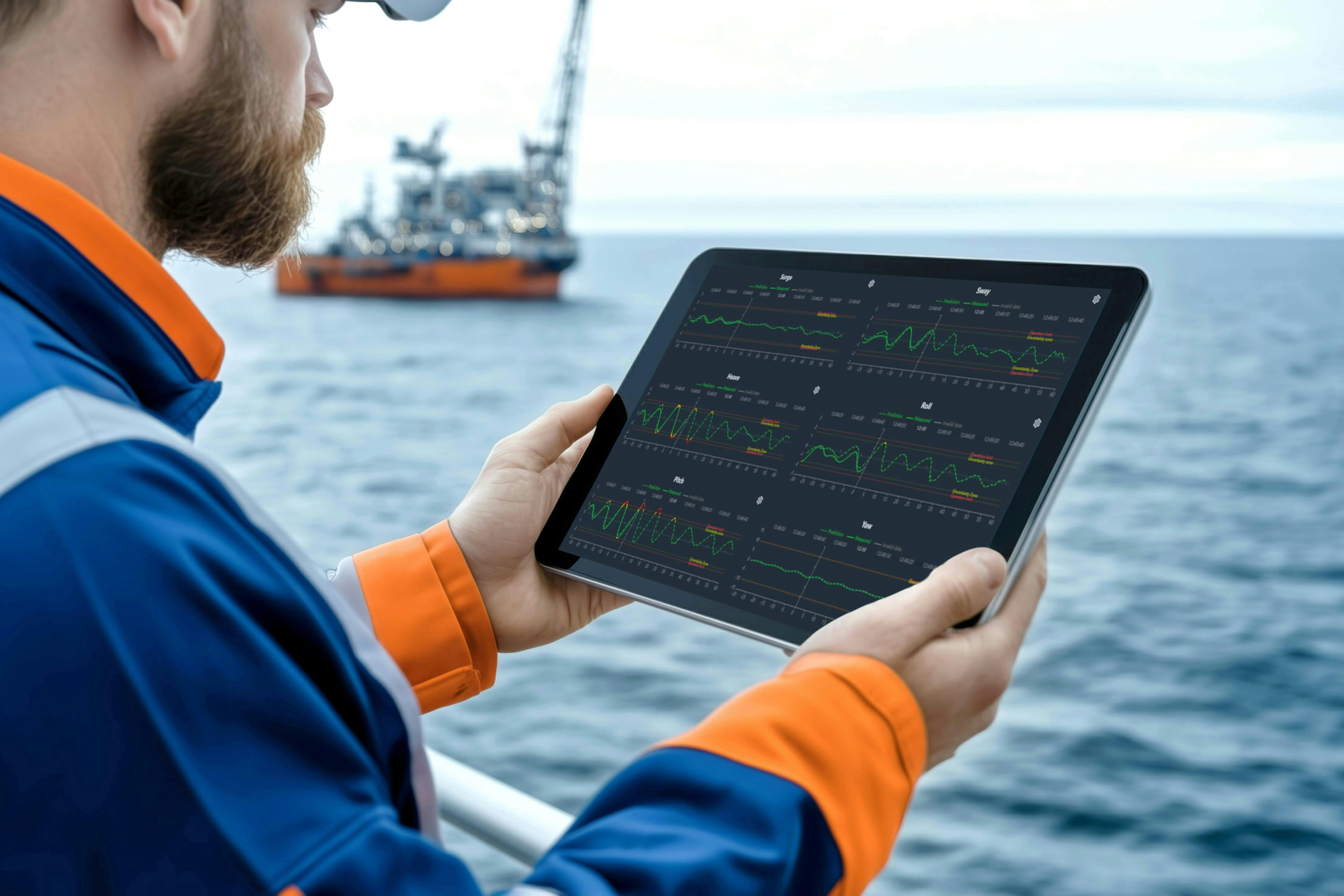
As AI tools enter the mainstream, the most successful offshore teams are adapting organizationally, not just technically. Røstad sees more structured forecast briefings, explicit “weather gates” and defined triggers for reassessment.
"AI supports planning, but human judgment remains essential especially for 'edge cases,'" he said.
In addition, standardized playbooks outline responses when forecast confidence drops or measurements deviate. Training now emphasizes interpreting uncertainty, confidence intervals and leading indicators.
“Teams that succeed treat AI as an operational assistant, not an oracle,” Røstad says.
Where predictive intelligence will have the biggest impact
Looking ahead, Røstad sees the strongest value in operations where both risk and cost of delay are high: heavy lifts and complex construction, subsea construction/intervention, walk‑to‑work/gangway transfers, drilling logistics, and spill response and environmental monitoring.
Exclusive content:
 DeepOcean pipeline inspection
About the Author
 Ariana Hurtado
Ariana Hurtado
Editor-in-Chief
With more than a decade of copy editing, project management and journalism experience, Ariana Hurtado is a seasoned managing editor born and raised in the energy capital of the world—Houston, Texas. She currently serves as editor-in-chief of Offshore, overseeing the editorial team, its content and the brand's growth from a digital perspective.
Utilizing her editorial expertise, she manages digital media for the Offshore team. She also helps create and oversee new special industry reports and revolutionizes existing supplements, while also contributing content to Offshore's magazine, newsletters and website as a copy editor and writer.
Prior to her current role, she served as Offshore's editor and director of special reports from April 2022 to December 2024. Before joining Offshore, she served as senior managing editor of publications with Hart Energy. Prior to her nearly nine years with Hart, she worked on the copy desk as a news editor at the Houston Chronicle.
She graduated magna cum laude with a bachelor's degree in journalism from the University of Houston.
Related
