A decade of ultra-wide streamer vessels reflects shifting offshore acquisition priorities
Key takeaways:
- Vessel design priorities have remained consistent: Wide-azimuth towing capacity, stability and system redundancy continue to underpin efficient seismic acquisition, particularly in deepwater and frontier environments.
- Performance metrics have evolved beyond production rates: Operational efficiency is increasingly measured by uptime, repeatability, safety and emissions intensity per survey area, reflecting a more integrated view of acquisition outcomes.
- Large-scale case studies highlight operational realities: Frontier campaigns such as the Brazil Equatorial Margin 3D survey demonstrate the importance of sustained vessel performance, consistent geometry control and data quality in complex, high-cost exploration settings.
By Igor Marino and Paul Courtenay, TGS
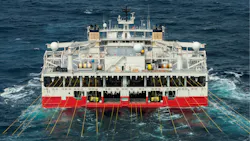
Titan, Atlas, Tethys and Hyperion, a class of ultra-wide stern seismic vessels introduced in the early 2010s, are now completing their first decade in service. In an offshore sector shaped by commodity cycles and rapid technology shifts, vessel longevity reflects engineering resilience, operational adaptability and sustained seismic performance.
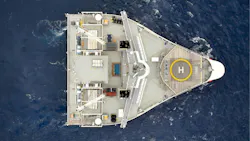
When the first vessel entered the market in 2013, offshore exploration demanded wider-azimuth coverage, long-offset streamer spreads, improved 4D repeatability and safer operations. The T-Class vessel features unconventional hull geometry and integrated acquisition architecture. Its ultra-wide stern, support for up to 24 tow points, multiple independent source-array handling booms and automated deck systems were designed to improve acquisition density and operational continuity.
Beyond vessel size, the design prioritized tow stability and equipment redundancy. Three direct-drive propellers and separate twin-engine rooms allow continuous operations despite partial propulsion or machinery outages. The hull and stability design also support safe towing during rough sea conditions, reducing interruptions and improving survey efficiency.
A decade later, these design choices remain aligned with industry priorities. In deepwater and frontier basins, where survey campaigns involve long durations and complex logistics, consistent towing performance and operational resilience continue to influence project economics.
Case study: Brazil’s Equatorial Margin acquisition campaigns
A recent example of these dynamics is provided by large-scale 3D seismic acquisition programs offshore Brazil’s Equatorial Margin. This region, including the Pará-Maranhão Basin, has attracted industry attention due to its geological similarities to producing basins offshore Guyana and Suriname.
TGS’ PAMA 3D multi-client program launched in 2024 covers more than 30,000 sq km across multiple survey phases in deepwater acreage. Campaigns of this scale highlight the continuing role of high-capacity seismic vessels in frontier basin evaluation, where consistent performance over extended periods is essential.
Operational challenges in the region include variable weather conditions, complex subsurface geology affecting imaging quality, and the logistical constraints associated with long-duration offshore campaigns. In this context, vessel capability is not defined solely by towing capacity, but by the ability to maintain stable acquisition parameters across large survey areas.
The program integrates broadband acquisition methods and multisensor streamer configurations to enhance low-frequency response and improve imaging beneath complex overburden. Reliable geometry control during acquisition is also important, as it supports consistent illumination of subsurface targets and reduces the need for re-acquisition.
Another development influencing acquisition workflows is the use of low-Earth-orbit (LEO) satellite systems to enable faster vessel-to-shore data transfer. While not eliminating traditional data handling constraints entirely, these capabilities can support more rapid preliminary data delivery and early-stage interpretation, potentially accelerating exploration decision-making.
In frontier basins, where well costs remain high and licensing timelines are compressed, seismic availability and quality directly affect bid competitiveness, prospect evaluation and drilling risk management.
Automation, safety and performance metrics
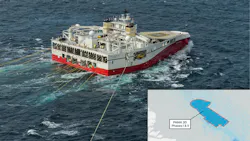
Automation has become a defining feature of modern seismic operations, particularly for large-scale towed streamer campaigns. Early adoption of automated streamer deployment and retrieval systems reduced manual intervention on deck, lowering safety risk while improving operational efficiency.
Automated handling systems also contribute to shorter turnaround times between acquisition phases. This is increasingly important as operators and multi-client survey providers aim to maximize productive acquisition days within limited seasonal weather windows.
In parallel, advances in acquisition technology—such as multisensor streamers, broadband sources, and steerable streamer systems—have improved bandwidth and data quality. These developments support more consistent subsurface illumination and enable better control of acquisition geometry, which is particularly important in 4D seismic programs where repeatability is critical.
The industry’s definition of vessel efficiency has evolved. Metrics such as streamer count or daily production rates are now supplemented by measures including uptime, repeatability, fuel consumption, crew safety and environmental footprint per survey area. This shift reflects a more integrated view of acquisition, where operational efficiency is tied directly to subsurface imaging outcomes and overall project value.
Higher-density acquisition can improve imaging in geologically complex settings by increasing azimuthal coverage and data redundancy, reducing uncertainty earlier in the exploration cycle. When combined with lower downtime and the ability to perform certain maintenance activities offshore, these factors can shorten survey timelines and reduce emissions intensity on a per-square kilometer basis.
Implications for offshore exploration
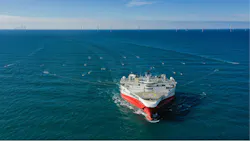
The experience gained over the past decade suggests that vessel scale alone is not the defining factor in seismic acquisition performance. Rather, the combination of stable towing, system redundancy, automation, and integration with evolving acquisition technologies appears to be key to maintaining operational efficiency across a range of offshore environments.
As exploration activity expands into more technically challenging and environmentally scrutinized regions, these capabilities are likely to remain important. At the same time, operators and survey providers face increasing pressure to balance acquisition scale with cost, emissions, and regulatory considerations.
Looking ahead, high-capacity seismic vessels are expected to continue playing a role in frontier exploration, basin-scale imaging, and potentially in emerging applications such as carbon storage site characterization and offshore wind site surveys. The ability to acquire large volumes of consistent, high-quality data efficiently will remain a central requirement as subsurface targets become more complex and investment decisions more data-driven.
More exclusive content:
About the Author
 Igor Marino
 Igor Marino
Igor Marino is technical marketing manager at TGS, where he leverages his 15+ years of geophysical experience to translate complex subsurface concepts into clear, relevant messages that resonate with both technical and commercial audiences. Based in Houston, he brings deep expertise in seismic acquisition, imaging workflows, full-waveform inversion and machine-learning applications in geosciences. He regularly shares insights on how integrated acquisition and imaging solutions enhance subsurface understanding. His work bridges technical depth with market relevance, contributing perspectives that help translate complex geoscience into practical exploration decisions.
 Paul Courtenay
 Paul Courtenay
Paul Courtenay is vice president of global operations at TGS, where he leads strategic offshore acquisition initiatives and supports the company’s global marine operations portfolio. He brings more than 40 years of experience in the offshore geophysical and energy industries, with extensive expertise in marine seismic acquisition, operations management, project delivery and business leadership. Throughout his career, Courtenay has held senior operational and executive roles focused on advancing offshore survey capabilities and delivering complex acquisition programs worldwide.
Related
