Right-sized vessels and HVO100 fuel reduce offshore survey emissions
Key highlights:
- Purpose-adapted vessels powered by renewable HVO100 fuel reduce emissions by about 90% compared to traditional diesel-powered vessels.
- Smaller vessels and remote operations enable lower fuel consumption, enhanced manoeuvrability and improved data quality in constrained environments.
- Flexible mobilization strategies, such as land-based vessel deployment, optimize transit efficiency and reduce overall fuel use.
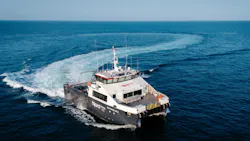
By Philip Ljungström, Njord Survey
In 2026, Njord Survey began executing the offshore scope of a multi-year framework agreement covering pipeline inspection and integrity surveys across European waters. The work combines high-resolution geophysical acquisition, including multibeam, side-scan and sub-bottom profiling, with visual inspection to support robust integrity assessments.
Campaigns are delivered using two purpose-adapted vessels operating on renewable HVO100 fuel, with the objective of pairing inspection-grade data quality with the lowest practicable fuel consumption per kilometer surveyed.
Fleet design and fuel strategy
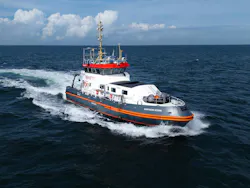
The operational model centers on right-sizing the fleet to the scope. A larger platform supports offshore operations requiring full geophysical and inspection spreads, while a smaller unit is deployed for nearshore corridors, shallow tie-ins and shorter inspection campaigns. This approach has significantly reduced overall fuel consumption compared to traditional deployment models.
The transition to renewable fuel further strengthens the emissions profile, with remaining emissions handled under a carbon-neutral operating framework (including emissions accounting and offsetting) agreed with the client.
Reducing fuel consumption and emissions
Traditionally, vessels that do the same type of operations consume between 5,000 and 10,000 liters of diesel every day. By contrast, Njord Survey has developed an operating model with lean crew manning on board, supported by remote operations. This reduces HSE risk, lowers emissions from offshore crew changes and reduces costs.
The company has also adopted Volvo Penta engines with the supplier. With these engines, its full-spread geophysical vessels consume about 500 liters of fuel per day.
At this lower consumption level, both the client and contractor can run on HVO100 biofuel while remaining competitive. When operating on HVO100, emissions are reduced by about 90%, resulting in CO2-equivalent emissions comparable to about 50 liters of diesel per day. While the fuel itself is close to carbon neutral, residual emissions are associated with refining and transportation to the vessel.
The company has invested over the past six years to enable its fleet to operate on biofuel.
Flexible mobilization strategies
Flexible mobilization strategies have been a key enabler.
For selected scopes, the smaller vessel is transported over land and launched close to the work location, effectively removing the need for long marine transits. This has proven to be an efficient solution, particularly for shorter campaigns where transit would otherwise dominate fuel consumption.
Data quality considerations on smaller platforms
From a data perspective, smaller platforms offer both advantages and challenges. Reduced acoustic noise and improved manoeuvrability enable high-resolution inspection of pipeline features, particularly in constrained or shallow environments.
At the same time, careful consideration of motion compensation and survey planning is required to ensure consistent results. A structured onboard quality control process has been key to delivering reliable results across both vessel types.
Autonomous vessels and low-noise operations
Njord Survey also deploys an autonomous vessel platform in selected projects, where appropriate. These vessels are electric-powered and are primarily used to support nearshore survey operations. Most of Njord Survey’s work remains offshore, including geophysical survey, ROV inspection and cable tracking.
The company continues to emphasize lean-crewed vessel operations as a core strategy. Survey data acquisition is highly sensitive to acoustic conditions, and reducing onboard activity and mechanical noise improves signal quality. Lower noise levels in the water enable stronger raw signal returns from survey equipment, reducing processing time and increasing the likelihood of improved outcomes.
Operational challenges and planning considerations
Early campaigns highlighted two main operational considerations:
- Optimizing vessel positioning and campaign planning to minimize transit distances for offshore operations; and
- Availability and certification of renewable fuels across European ports, requiring detailed pre-mobilization planning and supplier qualification to ensure full traceability in emissions reporting.
Lessons learned for survey operations
Fleet right-sizing is one of the most effective ways to reduce emissions, often exceeding the impact of fuel switching alone.
Alternative mobilization strategies can significantly outperform traditional approaches when applied to the right scope.
Finally, credible carbon-neutral operations depend on robust fuel sourcing and transparent emissions accounting, addressed early in the planning phase.
About the Author
 Philip Ljungström
Philip Ljungström
Philip Ljungström is co-owner and project director with Njord Survey. He's been with the company for six years.
Prior to his time with Njord Survey, he served in various management roles with MMT for about 10 years. For nearly six of those years, he held the role of offshore manager, responsible for overseeing offshore survey operations, ensuring contract compliance, HSE and quality standards, and managing all client and project communications onboard.