Pioneering Spirit vessel raising the bar for ultra-heavy topsides single lifts
Key highlights:
- The TLS upgrade increases Pioneering Spirit’s lift capacity by 25%, allowing single-lift removal of larger platforms.
- Structural reinforcements focused on critical load-bearing beams and replacing levers with lighter, higher-capacity components without altering topside preparation requirements.
- The vessel’s future projects include decommissioning major North Sea platforms and installing large offshore wind substations, with contracts extending into the 2030s.
By Jeremy Beckman, Editor, Europe
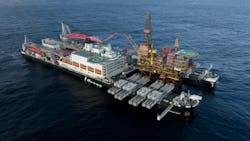
Allseas is upgrading its heavy-lift Pioneering Spirit vessel to accommodate topsides loads of up to 60,000 metric tons. The 25% lift capacity increase, first envisioned in 2019 for the single-lift removal of the 50,000-mt Statfjord A GBS platform topsides in the North Sea, has since evolved into a comprehensive structural and mechanical enhancement of the vessel’s topsides lift system (TLS).
The program for the new system, designed and executed in-house by Allseas teams, has focused on reinforcing critical load-bearing components of the TLS to safely increase lifting and holding capacity, while maintaining operational reliability and flexibility. Phased load testing of the upgraded system, with full certification to 60,000 mt, is targeted within the next 12 months.
Project Manager Vincent van Dinter and Proposals Manager Jesper Schoen shared the rationale behind the upgrade, its technical scope and what it means for Pioneering Spirit’s future work.
Offshore: When and where does Allseas foresee topside removal or installation projects taking place that will suit the new lifting capability?
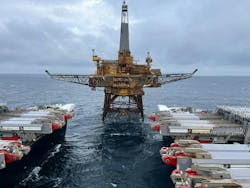
Schoen: The TLS upgrade is a standalone development that significantly extends Pioneering Spirit’s single-lift envelope, particularly for the largest North Sea platforms that were previously beyond the vessel’s reach.
On the decom side, the best example is Equinor’s 50,000-mt Statfjord A topsides, for which Allseas has already been awarded the removal contract, with execution now planned towards the end of this decade.
On the installation side, we also see a strong trend towards heavier and larger offshore wind converter platforms, most notably the 2-GW HVDC substations being developed for North Sea and Baltic Sea wind projects. The increased TLS capacity allows these assets to be installed with fewer lift points, reducing fabrication complexity, offshore preparation time and overall project cost. The same efficiency gains apply to decommissioning, where minimizing offshore preparation is a key driver.
Offshore: What were the extra risks/stress points identified in raising the TLS’ lift capacity, and will the higher loads necessitate new preparations on the topsides prior to lift-off?
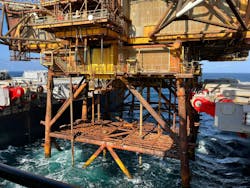
Van Dinter: The key challenges related to working within the constraints of the existing beam structures, managing logistical complexity, and ensuring crews were properly trained to install and maintain new specialized components. Despite limited access inside the beams, recent load tests have confirmed that the upgraded design performs as intended.
By deepening our understanding of the TLS’ structural integrity and system dynamics and mechanics, we were able to increase capacity efficiently. Implementing the required reinforcements was a creative engineering process, resulting in a minor structural reinforcement scope inside the beams, while the lifting levers became a primary focus area. Replacing the original lever design with new, higher-capacity components proved to be the most effective solution. Despite their higher capacity, the new levers are lighter than the original design.
Importantly, these upgrades do not change the requirements for topsides preparation. Preparations remain governed solely by the characteristics of the topsides themselves, not by the vessel or TLS.
Offshore: Can you elaborate on Allseas’ statement that the enhanced capacity will also suit future types of offshore wind converter platforms that are narrower, demanding a higher lift curve?
Van Dinter: Next-generation 2-GW offshore wind substations are not only heavier, but their geometry often demands greater outreach during lifting. This combination results in higher bending movements in the TLS beams. The upgrade directly addresses this by strengthening and optimizing key components to handle both higher loads and increased outreach. In practical terms, it allows Pioneering Spirit to safely lift these platforms within the required lift curve, without compromising system integrity.
Offshore: What is the current status of the upgrade program and all its various components?
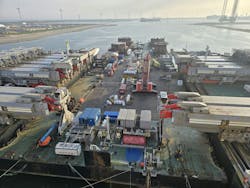
Van Dinter: Six of the 16 beams have already been fully upgraded and successfully load tested across two campaigns conducted in 2024 and 2025. These tests were conducted in pairs (forklifts) using Allseas’ cargo barge Iron Lady in Rotterdam harbor; this vessel can be ballasted with high precision to achieve the required loads. The remaining 10 beams are currently being upgraded and tested, with completion expected this summer.
Schoen: The final system load test is scheduled for late 2026 to early 2027 and will use Allseas’ new cargo barge Braveheart. This will follow an interim 48,000-mt test as part of Pioneering Spirit’s five-year recertification cycle. For final certification, each of the 16 beams will be individually tested to 5,000 mt, confirming the full 60,000-mt system capacity.
Offshore: Were any other parties involved in the present TLS development?
Van Dinter: Like the original TLS, the upgrade was designed and is being executed entirely in-house. The project brings together multiple departments, including Capital Projects, Innovations, Procurement, Fabrication, Technical Department and Vessel Operations, under an approach that prioritizes fast iteration and close cross-disciplinary coordination.
A substantial portion of the machined components was produced by our machine shop, Machinefabriek Schaap, while Allseas Fabrication in Heijningen manufactured a variety of additional items. Specialist suppliers in South Korea, Spain, Germany and the Netherlands supported the fabrication of selected components, including the new lifting levers.
Offshore: Is the company considering further modifications over the longer term to other equipment items, such as the TLS’ fast-lift cylinders or to the more recently installed jacket lifting system?
Van Dinter: No major structural, mechanical or hydraulic upgrades are currently planned. The 60,000-mt upgrade was implemented with a holistic, forward-looking approach that aligns system capability with expected topside weights.
We are, however, actively developing new lifting tools to expand operational options, such as conductor removals and pile installations, and are continuing to ensure that system controls remain futureproof. As no two lifts are the same, we continuously learn from operations and pursue opportunities to standardize and rationalize designs while further improving system versatility
Offshore: Are there plans to also broaden the vessel’s pipelay capabilities, following the addition of a J-lay spread for the Greater Tortue Ahmeyim trunkline installations offshore Mauritania/Senegal in 2004?
Van Dinter: Allseas continuously assesses its fleet to identify opportunities for improvement programs, modifications or upgrades. The capabilities are being enhanced with next-generation handling, welding, inspection and coating systems that increase automation, improve accuracy and further boost offshore productivity. At present, there are no concrete plans to further increase the pipelay capacity of Pioneering Spirit, which we believe is already the highest in the industry.
It is worth noting that some projects labelled as 'J-lay' are, in practice, executed using S-lay techniques. For example, during the Greater Tortue Ahmeyim project offshore Mauritania and Senegal, Pioneering Spirit installed the pipeline using S-lay, with only specific structures installed in J-mode. This approach will also be applied on upcoming SURF projects offshore Brazil, to be conducted by Audacia.
Offshore: What is the current forward contract schedule for Pioneering Spirit?
Schoen: The vessel has pipelay and heavy-lift commitments extending into the 2030s, with a strong focus on oil and gas decommissioning and the installation of large HVDC converter stations for offshore wind—supplying a combined 28 GW of power to European markets. Preparation is also underway for the Gippsland Basin campaign offshore southeast Australia—the largest offshore decommissioning project in the country’s history. The program, commissioned by ExxonMobil, involves the removal by Pioneering Spirit of up to 12 topsides and 11 steel jackets during an intensive three- to four-month campaign starting in late 2027.
In the UK northern North Sea, the vessel will continue to perform decommissioning work for TAQA under a program that covers the removal of the Eider Alpha, Tern Alpha, North Cormorant and Cormorant Alpha platforms. Allseas has also been awarded the removal of the 33,000-mt Brae Alpha topsides in the central UK North Sea, with execution planned between 2028 and 2032.
This year, the vessel will mark its first decade in operation. She has delivered more than 460,000 mt of offshore facilities in single lifts, including 290,000 mt of platform removals and 170,000 mt of installations.
About the Author
 Jeremy Beckman
Jeremy Beckman
Staff Writer / Editor, Europe
Jeremy Beckman has been Editor Europe, Offshore since 1992. Prior to joining Offshore he was a freelance journalist for eight years, working for a variety of electronics, computing and scientific journals in the UK. He regularly writes news columns on trends and events both in the NW Europe offshore region and globally. He also writes features on developments and technology in exploration and production.
Related
