FPSO group builds financial muscle to tackle marginal field revival
Opportunities appearing in new regional plays
Jeremy Beckman
Editor, Europe
Arecent report from Drewry Shipping Consultants in London noted that early this year, 132 floating production systems were either in service or under construction.
The comparable figure in 2003 was 104, suggesting that marginal fields have become more attractive to investors following the surge in oil and gas prices.
These types of fields are still best suited to fast-track developments based on tanker conversions. Drewry foresees strongest demand in Brazil and West Africa, followed by China, Australia, India, Indonesia and Malaysia. It also sees possibilities off the Falkland Islands, depending on the results of near-term drilling.
Missing from that list are the North Sea and New Zealand, two regions where Vanguard Oil & Gas Developments is currently bidding for projects.
The London-based company is fronted by Michael Barraclough, a pioneer of small-field FPSOs. He first came to the UK in 1990 on behalf of P&O Australia to set up a joint venture with Bluewater, which at the time had a fleet of three floaters operating in the Asia-Pacific region.
Two years later, P&O withdrew, and Barraclough left to form his own company, Victoria Oilfield Development, with financial backing from a Greek shipowner. Victoria undertook two of the industry’s earliest extended well tests, both on behalf of BP in the UK sector, using Diamond Offshore drilling rigs and modern tankers from the Knutsen fleet for offloading/storage.
In 1994, Barraclough and Jonathan Priest of Sea Tankers formed a new company, Vanguard Floating Production, pursuing a similar type of business, but without any formal links particular asset owners. However, rig availability had tightened, putting a dampener on the well test market in Europe, so Vanguard decided to look for new opportunities in the Far East and Australasia. With investment group 3I’s backing, Vanguard merged with London Offshore Consultants and the London Marine Group, extending its capabilities to include marine and mooring engineering.
The newly expanded company’s first contract involved sourcing the FSOAilsa Craig, and supplying associated management services, to Nigerian independent AMNI in 1998 for the shallow water Ima field development. The following year, Vanguard converted a tanker in Britain’s Royal Navy Dockyard in Portsmouth to an FSO, for a short-term assignment on Santa Fe Snyder’s Carauna field offshore Fortaleza. The water depth was 26 m, which is unusually shallow for Brazil. That vessel is now laid up in the US, awaiting another job.
“It includes water treatment plant and a small flare, so technically it is an FSO with some FPSO capability,” Barraclough says.
In 2001, Vanguard brought in an FSO to work for PTTEP on the Bongkot field while the existing storage barge (Bongkot 1) was taken out of service for repairs. Vanguard chartered the Four Lochs - a Bermuda-registered tanker - from Italian contractor Premuda, retaining the latter’s crew for the duration of the contract. It also procured a CALM buoy mooring system. The “new” vessel was only intended to fill in for three months, but ended up operating on the field for over a year.
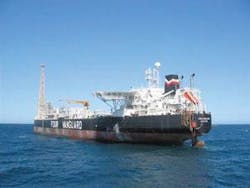
“Our big breakthrough came in 2002,” Barraclough says, “when we provided the FPSO for Agip Australia’s Woollybutt development. This was far and away our biggest project: we had a full scope of engineering, from front-end engineering design to detailed engineering, conversion of the vessel (by Keppel FELS in Singapore) through to operation. Here again we formed a partnership Premuda, and they became the vessel’s primary owner in due course. We subcontracted installation to Subsea 7 in Singapore. It took 18 months from contract award to first oil.”
“A month later,” he says, “we had a problem with one of the turret mooring’s production swivels. We had to take the vessel back to Singapore briefly for fitting of a new swivel, supplied by Framo.”
Woollybutt is located in the Dampier Basin in the North West Shelf, an area right in the path of cyclones.
“We therefore equipped the FPSO with a disconnectable internal turret, designed by Flexible Engineering Solutions in Newcastle, UK. In future, however, as mooring technology evolves, I see more permanent moorings emerging in this region. This would allow floaters to remain on station even when the crew is evacuated.”
Having completed Woollybutt, Barraclough says, “We realized that for Vanguard to progress and build on this type of work, we would need a substantial new financial base behind us. FPSOs are extremely capital-intensive, so we knew we would be obliged to raise more funds to tackle more projects. Being part of a small consultancy was not a good basis for the future, so I and some colleagues left the London Marine Group and went independent.”
The new company, Vanguard Oil & Gas Developments, has regional offices in London, Houston and Perth. As the name implies, it aims to provide full-field solutions (not just FPSOs) and management of fast-track projects involving small oil or gas accumulations. The production system could be a mobile offshore production unit or a barge, as well as an FPSO.
“The other big difference is that we are now in a position to take an equity stake in an oilfield, if that’s a sensible way to move a project forward,” he says. “We are already in discussion with a few companies over some small, undeveloped fields where we would be a partner, taking a share of production as part-reward for developing and managing the project.”
Over the past year, Vanguard has been providing BP with marine expertise for the Greater Plutonio FPSO in Angolan Block 18, such as design input for the export system. “Over time, we hope to give BP additional support for other projects offshore Angola,” Barraclough says.
Currently, Vanguard is among the bidders for two planned FPSO projects off New Zealand, one in Australian waters, and one in the UK North Sea. Applications for OMV’s Maari development closed in July (here the competitors are Prosafe and Tanker Pacific). Transworld’s Tui field floater is still out to tender.
“Conditions off New Zealand aren’t dissimilar from those encountered in the North Sea,” he points out.
In the UK sector, ENI invited Vanguard and others to submit solutions for Fyne/Dandy, two stranded heavy oil structures close together, with combined potential thought to be around 25 MM bbl. After a quiet few years for floaters in the UK, the sector has been revitalized, with at least three other new projects in the frame (Kerr-McGee’s Dumbarton, Venture’s Chestnut and Focus’ Skipper).
“Small companies entering the North Sea are looking for ways to proceed in a partnering environment,” Barraclough says. “We’re keen to offer solutions on that basis. This is partly due to innovations such as the Department of Trade & Industry’s Promote license, which is encouraging development of small fields.
“But we’re also seeing a similar trend in Nigeria. We have been talking to one indigenous company about acting as their partner in a field development. The government there is bringing in new rules that will require front-end engineering design for small fields to be performed in Nigeria. So, we need to develop further relationships with local contractors.”
Under an alliance arrangement, Focus Oil & Gas Group in The Netherlands will provide Vanguard with equipment procurement and topsides engineering supervision. In the Far East, Vanguard still has a good ongoing relationship with Promuda, identifying potential new fields for its tanker fleet. And it has also forged links with a Malysian engineering contractor, which is keen to develop small oilfields in Malaysian waters.
“We are already pursuing two projects which would employ jackups offloading to moored storage tankers,” Barraclough says. “Our business plan involves buying the rig, converting it and chartering the tanker. The capex in these particular cases looks to be a lot lower than for an FPSO.”•
