Vessel market improves as industry seeks new prospects
More boats back to work
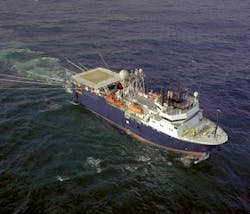
The seismic vessel market is bustling again after years of difficulty and consolidation. The expanded exploration budgets of oil companies as they begin rebuilding their prospect inventories are encouraging the optimism and energy that began last autumn at AAPG Prospect and Property Expo. This enthusiasm carried over at NAPE, formerly North American Prospect Expo. Attendees made comments like: “I have to wait to get my survey done”; “It’s hard to find a vessel”; “Everyone is busy”; “We’re doing more proprietary work.”
The seismic acquisition contractors have reduced their fleet over the past three years and are now well placed to profit from increased demand for their services. Ordinarily, this improved environment would send the ship builders to work laying keels for new vessels, but the vessel owners are discouraging a fleet expansion. The larger seismic companies are talking down the need for new vessels.
“Despite industry talk about new vessel construction being required to meet the increased demand, PGS has no plans to build new vessels,” says Andrew Long, vice president of technical marketing for PGS Marine Geophysical.
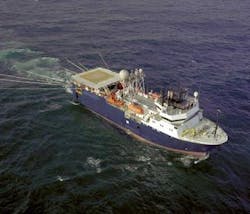
“We still believe that there is excess vessel capacity in the market,” Penny Ratcliffe, marine marketing manager for WesternGeco, says. The offshore sector is certainly in a period of growth,” Ratcliffe says, “however, as an industry, we need to be realistic and not go after short-term gains only to destroy the longer-term health of the business. The lessons learned from the rapid expansion in the 1990s, and the subsequent contraction over the past 2-3 years, must be heeded as we go forward,” she says. “It is a cyclical industry, and anyone who has been in the business over the years should understand the need for discipline regarding adding vessels.”
Instead of building new vessels, equipment upgrades are the norm. The acquisition companies continue to seek improvement through incremental change rather than the technology leap that was required to create the 3D vessel fleet during the 1990s.
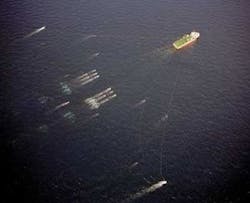
In this year’s survey, Veritas added solid streamer technology to several of its vessels, replacing industry-standard oil-filled streamers. The company notes that solid streamers are becoming the new standard for 3D vessels because of their reduced noise, environmental friendliness, and stable ballasting characteristics.
“PGS started to introduce solid streamers in the streamer fleet last year to enhance its operations in marginal conditions,” Long says, “and will continue to gradually replace its old streamers with new solid streamers in the coming years.”
WesternGeco introduced solid streamers to the market on its 3D vessels a few years ago.
The renewed financial fortunes is creating its own set of tensions. Within the seismic companies, the contractors shifted away from multi-client surveys as the demand for proprietary surveys rose. While they have not stopped gathering new datasets for their libraries, this increased demand limits vessel availability to meet the in-house multi-client survey schedules.
“Like most service companies, PGS has decreased the multi-client activity from up to 70% of its total capacity in the late 1990s to a current level of about 5-10% of total annual capacity,” Long says. “Opportunities for more multi-client activity in future are evident, but PGS approaches these opportunities with careful risk analysis and a focus on delivering return to its shareholders.”
Such is the tension between short-term and long-term money. Proprietary surveys feed the current need for cash to maintain operations, but have no value beyond their higher contracted charge. Multi-client surveys have a shelf life that can help the contractors financially bridge the slack time when demand for proprietary surveys softens.
“We recognize that multi-client products are an important part of the seismic market and we continue to invest in the creation of these products, either through acquisition or the application of new processing techniques,” Ratcliffe says. “With the proprietary market currently stronger than it has been in years, the multi-client surveys that are currently being acquired are based on very strong business justifications. We are seeing that the industry is generally becoming wiser about how and what it acquires.”
The oil companies see dwindling prospect inventories and continuing high crude prices. With exploration money flowing again, they want their project areas shot quickly and evaluated, so that prospects can be identified and wells can be scheduled.
This desire has filled most vessels’ shooting time through the summer, but is forcing many projects to wait for a gap to develop in a competitor’s program or to accept an autumn shooting slot. Oil companies’ increased demand is generating a rise in the price of proprietary shooting, and in some cases, a premium for competitive shooting slots. A Veritas spokesman noted that cash flow is significantly better so far this year than in 2004.
In a January report, Poe Fratt of A.G. Edwards Oilfield Service Research noted, “WesternGeco revenue jumped 10% to $331 million from $300 million in 3Q 2004 due to higher multi-client sales and the lingering impact of a long-term multi-client agreement. During the quarter, multi-client sales improved 53% to $132 million, onshore activity improved 15%, and data processing was up 10%, which more than offset a slow winter seismic season in the North Sea, poor weather in Latin America, and operating costs associated with the repositioning of several vessels during the quarter.” Other public seismic companies report similar improved financials.
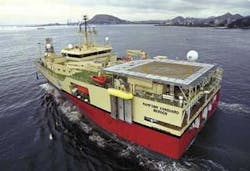
Oil companies complain, but lack of support for marine exploration over the past few years forced the seismic companies to retire vessels and reduce the costs for crew and equipment.
Equipment changes
Seismic companies continue to develop new technologies, even as traditional streamer acquisition carries the routine business. Acquisition companies are taking a new approach to seismic data collection at the mudline and in the wellbore, and they are branching into other types of remote sensing.
“As a prime example, we have launched Q-Seabed, which finally offers the operational efficiency, flexibility, and data quality that have, until now, been missing in multi-component acquisition and processing,” Ratcliffe says. “We see very exciting developments in the integration of seismic with other oilfield measurements, made either at surface or in downhole sensors. For example, the integration of seismic with electro-magnetic measurements holds great promise for the imaging and management of reservoir fluids.”
In the past year or so, PGS has significantly upgraded its deepwater OBS equipment handling systems, introducing a new generation of seafloor hardware, autonomous recording buoys, and recording technology, Long says. New 3D processing technologies, such as 3D SRME for the removal of complex multiples and anisotropic wave equation pre-stack depth migration to provide correct high-quality reservoir images, even in the most structurally complex areas imaginable, are all companions to the HD3D acquisition platform and will be high-profile focus areas in the next couple of years.
“PGS has successfully tested the world’s first working all-optical seafloor seismic system, capable of operating in water depths to 3,000 m, providing safer, stronger, and better technology for instrumented installations and very deepwater OBS surveys,” Long says.
New entrants
The market for seismic surveys has expanded in other ways as well. The customer base is growing again. According to John Adamick, vice president business development for TGS-Nopec, national oil companies, particularly India’s ONGC and Mexico’s Pemex, are seeking more deals to shoot large multi-client surveys over their offshore economic zones. This is adding pressure to the traditional oil company market for proprietary surveys.
Adamick also sees a rise in survey demand for the traditional areas: Gulf of Mexico, North Sea, and West Africa, plus increasing demand off Russia’s eastern coast.
Independent oil companies are gaining experience in international operations and are becoming new players in more mature areas of the GoM and North Sea and stepping out into deeper waters. While they begin with existing data sets, more subtle traps and non-traditional plays often require specialized or more closely shot surveys to image prospects. Multi-client surveys are still their preferred seismic buy.
“It is clear that the global demand for marine 3D acquisition is starting to balance supply, and even exceeding it in parts of the world,” Long says. “However, bidding competition amongst the service companies remains strong. Emphasis will remain upon proprietary work, with a transition from large, regional exploration surveys to a mix of exploration surveys, reservoir-specific surveys, and sophisticated projects such as multi-azimuth, multi-vessel, and 4D time-lapse shooting in overlap mode.”
Click here to view the Worldwide Seismic Vessel Survey.
The new year will likely be a winner for the seismic industry, with high demand, strong vessel utilization, new technology permutations, and plenty of interesting new earth images to locate the oil resources needed by the world’s growing demand for energy.