Simultaneous baseline subsea survey/3D scanning cuts cost of Sangomar inspections
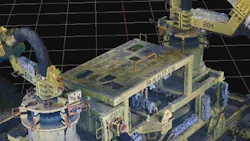
DeepOcean has performed simultaneous inspection and 3D scanning of subsea infrastructure for Woodside Energy at the deepwater Sangomar field offshore Senegal.
The company conducted a full-field baseline subsea survey and a full 3D scan – said to be the first simultaneous operation at scale of its type, without having to bring in additional offshore personnel.
Altogether, the dual-scope program took in 69 subsea structures.
“Completing an inspection routine and 3D scanning of subsea infrastructure have historically been performed in two separate ROV operations,” said DeepOcean CEO Øyvind Mikaelsen.
“However, we have developed a remotely supported holistic system that allows us to conduct both operations simultaneously – enabling us to cut vessel days and costs for the operator.”
Woodside had contracted DeepOcean in mid-2024 to provide subsea IMR services at Sangomar, 100 km south of Dakar. The scope of the contract includes project management, engineering, inspection, survey, intervention, and maintenance, underwater inspections of FPSO (UWILD,) and ROV operations.
The company deployed the offshore subsea construction vessel, Island Ocean, which has been is operating in the region.
Woodside asked DeepOcean to deliver A scanning-for-planning campaign covering 69 subsea structures, including 17 subsea trees. The aim was to acquire high-resolution data to support detailed planning and execution of future inspection and maintenance programs.
“We completed the simultaneous operation at slightly above half the time it would traditionally take to perform two separate operations, while doubling the data output for Woodside,” said Robin Mawhinney, EVP for DeepOcean’s EMEA region.
“We believe performing the simultaneous operation at scale without deployment of additional personnel on board was an industry first, but the most important thing is that we have successfully proven that there are substantial time and cost savings associated with this approach.”
The full “package,” the company explained, comprises inspection engineers, ROV pilots, and ROVs with specialised scanning equipment; data processing software that allows use of computer-aided drawings (CAD), ROV footage and sonar, and a digital twin; and proprietary subsea 3D Imaging software which converts 2D photos and other data into precise spatial data or full 3D reconstructions.
Mikaelsen said: “By applying 3D reconstructions in our operations, we improve our capacity to detect structural anomalies like cracks or deformities and understand their proximity to critical components within our clients’ subsea assets, enabling timely maintenance and preventing failures.”
About the Author

Jeremy Beckman
Editor, Europe
Jeremy Beckman has been Editor Europe, Offshore since 1992. Prior to joining Offshore he was a freelance journalist for eight years, working for a variety of electronics, computing and scientific journals in the UK. He regularly writes news columns on trends and events both in the NW Europe offshore region and globally. He also writes features on developments and technology in exploration and production.