JIP aims to cut subsea flow assurance costs in deepwater environments
Key highlights:
- FlowHeat reduces subsea tieback installation costs and emissions by simplifying cable deployment and enabling post-installation heating cable installation.
- The technology achieves 85-90% thermal efficiency and can handle complex pipeline bends.
- By utilizing telecommunications industry methods, the system minimizes damage risk, lowers power consumption and reduces the need for additional infrastructure.

By Andries Ferla, DeepOcean
A new joint industry project (JIP) aims to commercialize a subsea flowline heating technology that is designed to reduce manufacturing and installation costs by up to 35% through the separation of pipeline and heating installation.
TotalEnergies, Equinor, Aker BP, DeepOcean, Tenaris and LS Cable & System have teamed up to develop FlowHeat, a new method for subsea pipeline heating.
Tieback flow assurance pickle
Subsea tiebacks are essential to offshore oil and gas production, connecting subsea wells to processing facilities via pipelines. While they reduce infrastructure costs and accelerate development, they face challenges in cold deepwater environments where hydrates and wax can form, blocking flowlines and leading to expensive interventions.
Traditionally, chemical-based solutions (e.g., methanol and MEG) were used, but these proved expensive and space-consuming. This resulted in the introduction of electrical heating systems such as direct electric heating and electric trace heating. While effective in some cases, these systems have issues with efficiency, redundancy and high installation costs, especially as more subsea tiebacks are developed in deeper waters, where hydrate formation from long tiebacks is a serious risk.
The market potential for more cost-efficient flow assurance solutions is substantial as operators pursue new tiebacks. There is already a strong demand on the Norwegian Continental Shelf, where subsea tiebacks have become the rule rather than the exception. Other deepwater regions, such as Brazil, the US and Africa, face similar challenges, with more than 300 potential electric heating projects identified by 2030.
Consequently, the industry has been challenged to develop new methods that lower capital expenditure (capex) associated with both the heating and pipeline installation method, cut operating expenditure (opex) through lower energy consumption, and reduce CO2 emissions.
How the technology works
FlowHeat aims to overcome these challenges by using an insulation coating with internal conduits for post installation of heating cables, which reduces tieback installation costs and emissions.
The technology simplifies cable installation, and its hydraulic and water pressures system allows efficient deployment of these heating cables even after pipeline installation, making it more flexible and easier to repair and maintain. The cables can be monitored real time via optical fiber.
Offshore trials and onshore demonstration
TotalEnergies, DeepOcean, Tenaris and LS Cable & System have already invested years in the project and have achieved results of 85-90% thermal efficiency in trials as well as the successful completion of a 3-km onshore installation that demonstrated the system’s ability to handle bends and bumps.
However, there are still critical issues that need to be addressed to finalize the development of the system, such as extrusion of the coating with embedded conduits. Scaling up the technology will require improvements in the method of manufacturing pipelines with hollow channels within the wet insulation layers of the coating, which will have to withstand direct contact with the seawater and subsea hydrostatic pressure.
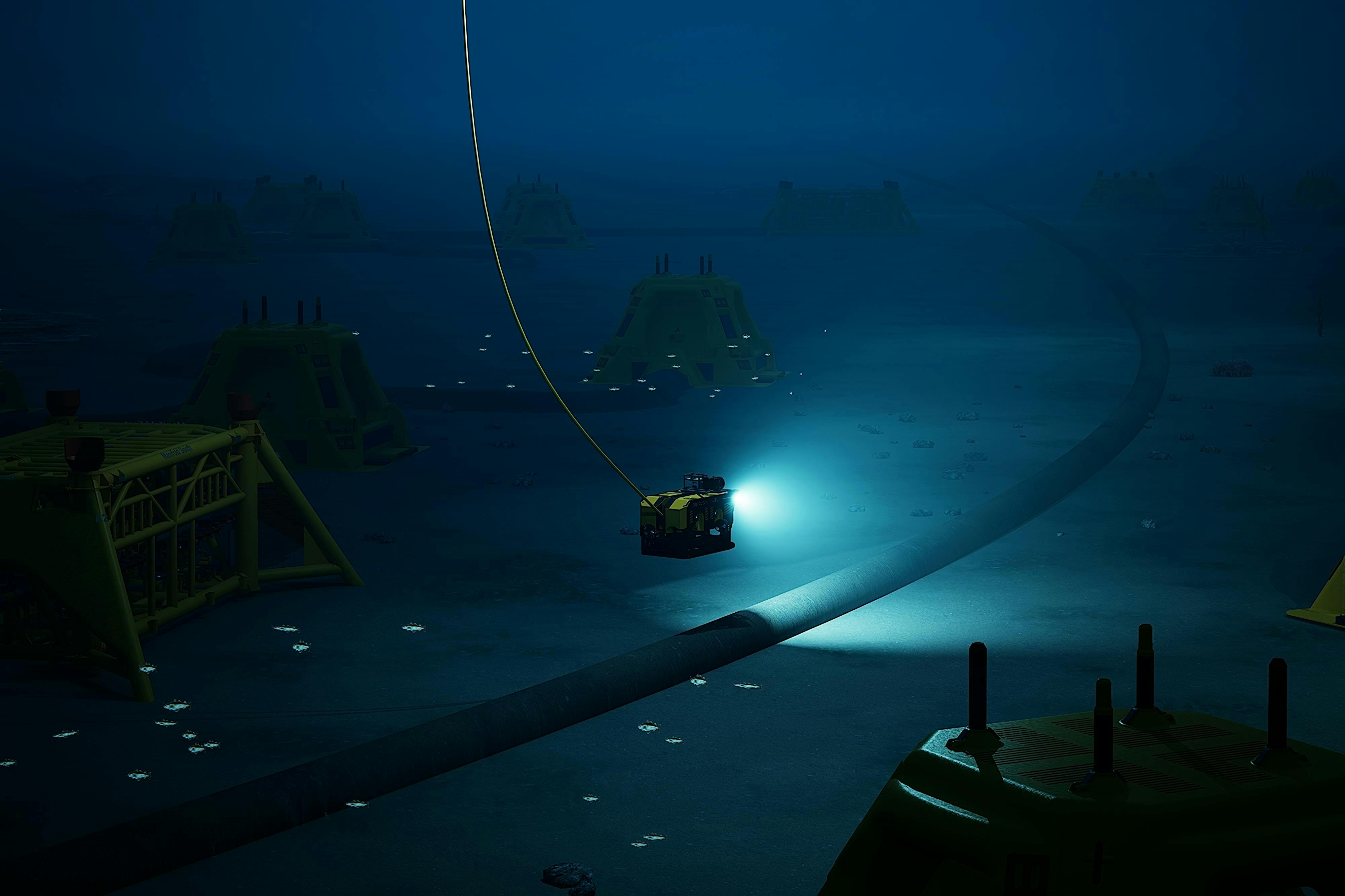
While small scale extrusion trials have already been validated, the FlowHeat demonstration will focus on scaling up the process to a 10-inch pipeline, addressing the complex balance between extrusion and cooling to enable longer cable installation lengths.
The technology also offers reduced topside weight, lower power consumption and less complex installation. The system is capable of contributing to a 30% reduction in carbon emissions by minimizing the need to install additional power infrastructure and hydrate mitigation measures and by reducing the amount of installation days required and enabling the use of smaller vessels (e.g., ROVs).
In total, these improvements can realize an opex cost reduction of up to 30% compared to traditional methods for subsea flow assurance.
System deployed after pipe laid on seabed
FlowHeat applies methods derived from the telecommunications industry, specifically the floating method used to install fiber-optic cables in pipes. This method allows power cables to be installed safely and efficiently in pipes using water as a medium. This is one of the main advantages of the FlowHeat system, where the power cables are installed after the pipe has been laid on the seabed, reducing the risk of damage to the power cable and, as mentioned above, providing significant emissions/cost savings in terms of subsea installation.
The system can be deployed after a pipeline has been laid and is suitable for distances of up to 30 km with a potential to increase to 50 km, in water depths of 3,000 m. This makes it an ideal system for long subsea tiebacks.
About the Author
 Andries Ferla
Andries Ferla
Andries Ferla is the ocean solutions and technology director at DeepOcean, where he has spent the past 15 years in various technology, innovation and engineering roles. He holds a master degree in civil engineering from KULeuven in Belgium.