Mermaid Subsea Services completes rapid recovery of a CAN-ductor system in the North Sea
Key Highlights
- The North Sea's unpredictable weather and aging infrastructure demand quick, precise subsea interventions to minimize operational risks.
- Mermaid’s rapid CAN-ductor recovery involved local seabed excavation, controlled severance and strict waste management.
- The Island Valiant vessel’s versatility has been crucial in maintaining project continuity across various operations, from chemical treatments to mechanical recoveries.
- North Sea operators are shifting toward late-life asset management and decommissioning.
By Scott Cormack, Mermaid Subsea Services (UK)
The North Sea has never been a forgiving workplace. Weather windows narrow without warning and infrastructure ages unevenly, meaning routine operations can soon become complex with little notice.
Against this backdrop, subsea teams often find themselves working not only underwater, but under the pressure of time, conditions and expectations.
Subsea campaign built around quick mobilization
Earlier this year, a major UK operator engaged Mermaid Subsea Services (UK) to deliver the rapid recovery of a CAN-ductor and associated equipment from the Central North Sea.
Developed to lower the cost of well construction, a CAN (Conductor Anchor Node) system allows the top-hole section to be installed using light vessels, so the subsea well foundation is ready before the drilling rig arrives.
All CAN systems start with the CAN-basic, which is a suction anchor with a guide pipe running through it. The CAN-ductor builds on this by adding one joint of conductor into the anchor. When it is installed, the suction anchor pushes the conductor into the seabed, giving the well immediate structural support.
The recovery project called for the internal and external severance of casing, conductor, guide pipe and cement lines, which is work that must be highly controlled to protect both personnel and assets. To support this activity, Mermaid carried out local seabed excavation before lifting and recovering the CAN-basic structure.
Once the hardware was safely brought to deck, the team assumed responsibility for waste and materials management, ensuring all recovered items were handled and disposed of in accordance with environmental and regulatory requirements.
Final operations included backfilling the excavation site so an overtrawl survey could confirm a clear seabed.
The fast-track CAN-ductor recovery campaign resulted in a complex job executed precisely, safely and on schedule.
Other regional subsea programs
That recovery campaign followed a series of technically demanding subsea programs that occupied the Mermaid team throughout 2025.
Earlier in the year, the company carried out a scale inhibitor treatment on the Teal P2 well in the Anasuria Cluster of the Central North Sea, a task central to maintaining the well’s long-term integrity. The operation required precise chemical handling and deployment from the vessel, delivered during a narrow opportunity in the offshore schedule.
Around the same time, Mermaid executed a complex wellhead severance program in the Southern North Sea. The scope brought together multiple specialist vendors, from tooling providers to vessel support teams, creating a program that depended as much on coordination as on technical capability. Despite the logistical demands, the operation was completed seamlessly.
Conclusion
For Mermaid, the approach in the last year has been shaped in partnership with clients and reflects the increasingly dynamic nature of regional subsea work. The company is seeing a wider range of operational challenges as operators address both late-life assets and targeted optimization projects.
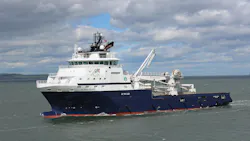
A consistent enabler of these deliveries has been the Island Valiant, the multi-role offshore vessel from which Mermaid has conducted several of its most recent North Sea projects. Now in its second year under charter, the vessel has taken on a variety of scopes, from chemical treatments to mechanical cutting and recovery operations. Its versatility has allowed Mermaid to maintain project continuity and retain familiar vessel teams, an advantage when working in tight operational windows.
As the North Sea transitions into a new era, defined by late-life asset stewardship, decommissioning commitments and selective field reinvestment, the need for safe, efficient subsea intervention will take on a whole new level of importance.
About the Author
 Scott Cormack
Scott Cormack
Scott Cormack joined Mermaid Subsea Services (UK) in 2021, following 30 years of experience in the global energy industry, including the oil, gas, nuclear and clean energy sectors. He currently serves as regional director.
He has been instrumental in the development of MSSUK, consolidating the company's global track record by entering the North Sea energy marketplace just as it undergoes its biggest evolution to date.
During his career, Cormack has built a diverse portfolio of global offshore energy experience, with a technical and commercial focus on subsea activity, including construction, diving, IRM, LWIV, decommissioning and well P&A.