Responding to market needs
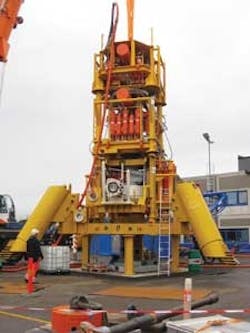
Contractors and suppliers ready to serve Norwegian Sea development
Aker Solutions
Aker Solutions is one of the world’s top four providers of subsea production systems and related services, and has the broadest subsea portfolio in the market place.
The company aims to be a lifecycle partner throughout the value chain of subsea and sub-surface technologies, solutions and services for the oil and gas industry. Aker Solutions’ offerings cover all phases of the life of field, from concept screening and design through manufacturing, fabrication, installation and commissioning to operational support, maintenance and services such as well intervention. The company’s capabilities are available either as individual products and services or as complete EPCI deliveries
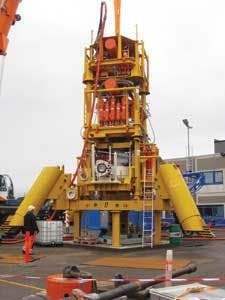
Aker Solutions is also an active member of NCE Subsea, where it is represented by the recently expanded subsea service base at Aagotnes outside Bergen. The base recently underwent a NKr 50-million ($7.87-million) expansion, including the construction of a new workshop for the maintenance of subsea equipment and a new office block, which includes state-of-the-art support systems. These buildings cover 2,400 sq m (25,833 sq ft); in addition, a 600-sq m (6,458-sq ft) storage tent has been set up.
“Our customer base and installed base of subsea equipment has been steadily increasing since we set the base up in 1994,” says Arne Riple, vice president for Subsea Lifecycle Services, Aker Solutions, and chairman of NCE Subsea. “We know the North Sea subsea market will remain solid over the coming decade, and this investment enables us to offer even better support to our customers.”
The Aagotnes base provides life-of-field support for subsea equipment, including offshore installation and intervention support; onshore maintenance, refurbishment and upgrades of subsea trees, control systems and intervention work-over systems; and maintenance, repairs and recertification of tools. It also provides storage facilities, engineering services and technical support.
Manpower-wise the base, with around 420 employees, is Aker Solutions’ biggest subsea service base worldwide. Although its main area of operations is the North Sea, the 110-strong offshore crew provides installation and maintenance support for Aker Solutions’ subsea projects worldwide.
“We have a highly experienced team at Aagotnes. They play an important role in enhancing the performance of our customers’ installed subsea equipment as well as supporting emerging subsea regions such as Africa and Asia with onshore and offshore support. This latest investment is part of our long-term growth strategy for our presence on the Norwegian continental shelf – a part of the world which will see an increased focus on life-of-field service support in the years ahead,” concludes Riple.
Bennex
Bennex supplies products and tailor-made solutions in the fields of subsea distribution, seismic equipment, ROVs and oceanology. The company has supplied sealing and termination technology for over 30 years.
Subsea distribution
Bennex has unique competence in the production of electrical, fiber-optic and hydraulic jumpers that are extremely reliable. Since its first Anguila jumper was developed for Snorre B in 1993, it has become the industry standard for subsea operations.
The company’s products range from high-voltage switches to pressure-compensated electrical and fiber-optic systems. It recently supplied three Anguila high-power changeover switches to Talisman’s Yme project in the Norwegian sector.

It also signed an agreement with FMC Technologies for deliveries of subsea distribution systems.
Bennex primarily supplies tailored solutions that are compatible with existing equipment and satisfy the requirements of the subsea environment.
Seismic components
Bennex is a leading supplier of components and systems to the seismic industry, as well as for marine research, environmental monitoring and military purposes. The company has a 50% market share of the world’s seismic ocean bottom cables, of which it has delivered more than 20,000 units to the seismic industry worldwide.
It has developed its own air gun umbilical termination, a state-of-the-art product which it supplies to the major operators of towed seismic systems.
Bennex is also in the forefront of controlled source electromagnetic (EM) seismic acquisition, a new and up-and-coming niche in the market, and has supplied a wide range of products developed in-house to leading players in this market segment.
Service
The company offers service agreements on all its products, either by sending out a service team or by means of the customer sending the relevant components to its service centers. The Bennex service team can provide prompt, high-quality service. Bennex has specialist competence in the production of additional equipment, modifications and upgrading of equipment. Its aim is to develop itself into a one-stop-shop for subsea and seismic services related to signal and cable systems.
ROVs and oceanology
Bennex manufactures, supplies, leases and services a range of parts, tools, and work packages for ROVs. In addition to its own specially designed connectors and penetrators which are adapted to the needs of customers’ systems, it also supplies a wide range of cables and connectors produced by different manufacturers, normally delivered as “cable assemblies.”
ClampOn
This year ClampOn celebrates the fact that the first meters it supplied to the petroleum industry have been in continuous operation for 15 years – which represents considerable progress since the company was launched in 1994. At that time it had little money and no products, but highly specific ideas and a lot of creativity, according to market coordinator Tonje Dahl.
The company’s founders already had wide experience of instrumentation for the offshore industry, and were used to operating in an international market. The first instrument to be developed by Clampon was a passive acoustic measurement device that could be configured to perform various tasks such as sand monitoring, pig detection, and later, corrosion, leak and vibration measurement.
Since the very beginning it has been ClampOn’s stated aim to develop and produce the best equipment of the highest possible quality. To do this it developed a technological platform with intelligent processing, in which the software determined the area of application of the instrument.
Subsea corrosion-erosion monitor
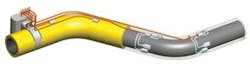
The latest development from ClampOn includes a subsea version of the company’s Corrosion-Erosion Monitor (CEM). ClampOn, BP, and Innovation Norway have established a joint industry project (JIP) to develop and field-trial an ROV-installable, low-profile, newbuild version of the CEM system for subsea templates, flow jumpers, manifolds, and flowlines. The CEM will measure changes in pipe wall thickness on a continuous basis, and is designed for non-intrusive subsea wall thickness corrosion rate monitoring. It is designed to allow flexible installation on bends, flowlines, and straight pipes. Field testing is due to take place later this year and the subsea CEM should become available to the market in 2011.
The project is based on ClampOn’s topside CEM system which has been developed to measure changes in pipe-wall thickness over a pre-determined pipe area using only a limited number of sensors. This technology has been installed and used topside and is now being developed for subsea installation. Key to this program is BP’s recent experience in developing and deploying corrosion measurement probes across its facilities, as well as extensive experience in the development and deployment of subsea technologies.
The CEM is an online, real-time, path-based thickness assessment tool that deploys a set of transducers over a given pipe area and uses a dispersion-based principle to assess wall thickness loss. It was the industry’s need for reliable monitoring of changes in wall thickness in subsea pipelines which encouraged ClampOn to develop the instrument for subsea applications, says Dahl.
Framo
Framo Engineering, a total system supplier for the oil and gas industry, is expanding its range of subsea multiphase boosting technology. The company is halfway through a two-year contract with Statoil to develop a subsea wet gas compressor.
When qualification of the technology is complete, Statoil and its partners on the Gullfaks field will evaluate it for deployment on the Gullfaks field in 2013. The WGC 4000 unit, which has the capacity to pump 4,000 actual cu m/hour with gas-liquid ratios from zero to infinity, is technology that can help Statoil reach its goals for increased recovery and accelerated production from subsea fields.
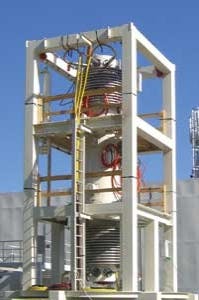
The subsea wet gas compressor which Framo is developing for deployment on Statoil’s Gullfaks field.
Framo’s multiphase compressor technology features a very robust and compact compressor that provides a simplified subsea wet gas boosting system. The fundamental mechanical design of the compressor, with contra-rotating impellers, enables the system designers to eliminate complicated upstream processing equipment and employ a standard and well-proven control system and low-frequency electrical power supply system.
Enhanced recovery systems, including pumps and wet gas compressors, constitute one of Framo’s three main areas of activity. For more than two decades, it has been closely involved in the development and commercialization of multiphase booster pumps incorporating the helico-axial pump principle. Including both topside and subsea installations, it currently has some 30 pumps in continuous operation.
In partnership with others, the company has participated in the development of subsea separation, boosting and injection systems. This technology comes in two forms: removal of produced water from the wellstream for re-injection in the reservoir, and boosting of the hydrocarbons; and separation of the gas and boosting of the liquid phase.
Multiphase metering systems for subsea and topside application is another main area. The Framo PhaseWatcher Vx multiphase meter is acknowledged as a robust, simple, and versatile product, and is the only meter which uses a fully physical metering principle and inherent set-up method. The same hardware is employed for both multiphase and wet gas metering, with two different software packages.
The third main area is swivels and marine systems for FPSOs. The Framo swivel stack is a compact product which provides a good solution for handling the interface between the subsea wells and the FPSO process plant. The swivel design and seal technology have been qualified for an increased number of risers, increased flow capacity and increased pressure rating. The result is a stand-alone swivel system which can cater for almost any type of FPSO application. To date, more than 25 FPSOs worldwide have Framo swivel stacks installed.
Mikromekanikk
Mikromekanikk is a one-stop shop for machined components. Since its establishment in 1982, the company has manufactured thousands of tailor-made components for customers in the offshore and seismic industries, and in other sectors, such as diesel engines, instruments, and the medical business. Deliveries to the seismic sector include streamer components and connectors.
The company can also deliver tooling and machines, again on a one-stop-shop basis, says managing director Gunter Remøy – given the customer’s specifications, Mikromekanikk designs and manufactures a range of devices. The reference list includes pipe inspection tools and cable testing machines.
As a small concern with 32 staff, Mikromekanikk deals mostly in small batches, but can undertake long runs when required. With three trained tool-makers in its ranks, it can also manufacture tools when these are not available.
The company prides itself on its ability to provide a flexible service to clients, including turning round urgent orders at express speed. “We like to have reasonable time, but we often receive an order in the morning and deliver the component by the afternoon,” says Remøy. “This is part of our daily life in the offshore business.”
Mikromekanikk works in a wide range of materials and have experience with almost all kinds of steel, cast iron, carbon steel, stainless steel, alloys, high-grade alloys and plastics such as POM, PEEK, and nylon.
The company operates 20 CNC machines and machining centers as well as manual lathing and milling machines. The latter include a Matec 30HV, which performs vertical milling with five-axis capability, and a Deckel Maho DMC 60H, which provides horizontal milling around four axes.
Equipment in the lathing department includes an Okuma Multus B400-W machine, a Mori Seiki NZ2000 and an EMCO Turn 420MC.
Mikromekanikk also offers a range of welding services for smaller modules. Its welders are certified according to TIG NS-EN287 141 T-BW55.
Mikromekanikk have developed expertise in the mechatronics and automation industries. Working with specialized suppliers the company has developed and designed automation solutions, including manufacturing the machines.
The company attaches great importance to HSE and quality assurance, and is currently upgrading to the OHSAS 18001 and ISO 9001:2008 standards. Its internal training program ensures that operators are fully competent for the tasks in hand. Its vision is to be the preferred one-stop-shop for high-tech industrial products which go beyond the customer’s expectations.
TTS
TTS Energy Bergen, which supplies a range of products for the offshore industry, has delivered active heave compensated cranes to two newbuild vessels.
The company offers a complete range of active heave compensated offshore cranes, ranging in size from 12.5-400 metric ton (13.8-441 tons) and capable of operating in water depths up to 3,000 m (9,842 ft). It also has a range of active heave compensated winches, especially developed for anchor-handling vessels.

“All our cranes and winches are custom-made to meet the requirements of our customers, and can be developed in several configurations,” says technical director Jarle Sørstrønen.
A 70-ton TTS active heave compensated crane is installed on Volstad Shipping’sGSP Prince, a specialized vessel for subsea operations which was delivered last year. The vessel is now under charter to the Romanian subsea contractor GSP, performing inspection, repair, and maintenance of subsea installations in the Black Sea.
GSP Prince will also participate in laying oil and gas pipelines. These operations will take place in water depths of between 300 and 1,700 m (984-5,577 ft), which requires great accuracy and precision. It is vital, therefore, that the motion of the vessel on the surface does not interfere with the lifting work being performed on the seabed, according to Volstad’s technical manager Jan Rogne. It is also important for the vessel’s crane to have active heave compensation, he adds.
The other recent delivery went toAtlantis Dweller, a multipurpose supply vessel jointly owned by Riise Underwater Engineering (RUE) and Simon Møkster Shipping, which is equipped with a 60-ton crane. The vessel is on charter to MR Subsea, performing diving and ROV operations for ExxonMobil off Nigeria. TTS Energy also supplied a 10-ton auxiliary winch which has active heave compensation.
All the drive units and hydraulics have been placed below deck. “We requested this with the purpose of bringing the weight and center of gravity as low as possible, but also to give the equipment the best possible protection,” says RUE’s operations manager, Arvid Bertelsen. “In the waters where the vessel is presently operating, both sand and salt constitute a threat to operability. It is therefore essential to keep sensitive parts of the equipment away from the deck area.”
As well as offshore cranes and winches, TTS Energy’s range of products includes high-performance drilling equipment, multifunctional rigs, and world-class control systems.
Offshore Articles Archives
View Oil and Gas Articles on PennEnergy.com