Rosa sensors to monitor riser temperature and pressure
Alain Fidani
Jean-Jacques Quesnel
Cybernetix
In 2001, Marseille-based Cybernetix and 01DB Metravib contributed to the design, procurement, and installation of the Girassol field instrumentation and monitoring system. At the time this project, operated by Total, represented many technical firsts, due mainly to the water depth (1,250-1,450 m), the scale of the project, and the innovative architecture of the field, located in block 17, 200 km off west Angola.
Development was based on subsea wells tied back to a moored FPSO. Three riser towers, each around 1,300 m high, housed all the production, injection, and gas lift risers. The bottoms of the risers were connected to the subsea production system using flowline bundles. Flexible jumpers connected the top of the riser towers to the FPSO. Offloading to shuttle tanker took place through a CALM buoy, connected to the FPSO by two submerged, free-floating export lines 2,400 to 2,600 m long.
Physical parameters (load & motion) of the mechanical structures, as well as parameters linked to the fluid (i.e. temperature) had to be monitored for the following reasons:
• to confirm they were remaining within the range of design calculated values;
•to allow post-calibration of CAD models;
• to verify integrity of the umbilicals and flowlines after installation; and
• to measure the temperature for flow assurance purposes.
Four years on, these sensors continue to deliver the data for which they were installed. Under the framework of the long-term maintenance contract, Cybernetix periodically retrieves, analyses, and supplies formatted data sets to Total.
Building on this experience, Cybernetix and 01DB Metravib have since pursued development of new sensing technologies to better measure and characterize structural and physico-chemical phenomena pertaining to subsea umbilicals, risers, and flowlines of deepwater offshore oil & gas fields. In cooperation with major operators and technology partners, they have devised various solutions, including non-intrusive, modular, and fiber optic-based sensor packages dedicated to the instrumentation and monitoring of subsea facilities.
Depending on the specific characteristics of a field, Cybernetix can now provide tailored systems of networked field-proven sensors to cope with the harsh conditions of such environments, designed to perform reliably over the typically requested 20-year life span. Solutions rely both on state-of-the-art and non-intrusive sensing technologies as well as modular and redundant mechanical and electrical architecture compatible with ROV operations.
This spring, Saipem contracted Cybernetix to design, manufacture and install an instrumentation and monitoring system for Total’s Rosa field, also in Angolan block 17. The field development scenario proposed by Saipem consists of flowlines tied back to the Girassol FPSO using freestanding risers. Pressure and temperature monitoring will be performed at the bottom part of the riser tower (BHOR) of Rosa D. The proposed system will comprise the following main sub-systems:
•Non-intrusive pressure & temperature sensor packages for each production riser (rated 225 bar / 20-year life time).
•A subsea module housing all the acquisition, conditioning and transmission electronic equipment. All data measured by the sensor network (32 sensors) will be gathered and pretreated at this point. For the sake of reliability, all equipment will be duplicated to ensure full redundancy, as the measuring points and module are designed to be retrievable by ROV. Data transmission is achieved through two cables connected to the FPSO.
• BHOR top and bottom assembly connection system.
• The FPSO topside integrated monitoring units.
This new contract is the result of our continuous involvement in this area of R&D, but more specifically it is linked to Total’s instigation a few years back of a research program to provide capability for detecting and managing flow instabilities in deep and ultra-deep waters. The threefold aim of this development program was: to predict the phenomenon in real time; detect the emergence of flow instability; and prevent severe slugging formation.
During these studies, measurement of production pressure at the riser base was identified as a robust method for detecting these instabilities, and also for measuring the height of the liquid column (severe slugging phenomenon) in the riser, even in the event of shutdown.
In parallel, Cybernetix and 01DB Metravib had conducted in-house development work on non-intrusive solutions, since intrusive pressure sensor installation cannot be considered reliable at a riser base, due to the risk both of plugging the tapping, and creation of a stressed area. This work, supported at the time by Total and Bouygues Offshore, led to development and commissioning of a patented deepwater non-intrusive pressure clamp called DIPE.
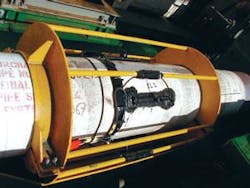
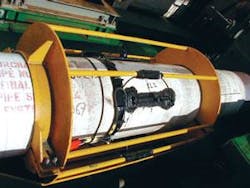
The DIPE modular multi-sensor clamp is designed to measure internal pressure and temperature in pipelines and risers in order to detect instabilities in the flow. The internal pipe pressure is measured through the deformation of the pipe circumference using tension-compression load cells. The pressure clamp also includes a temperature probe, in order to correct the measure of the elongation from the pipe dilatation caused by temperature variations.
The combination of a pressure sensor and a temperature sensor allows the detection of effects such as terrain or severe slugging before they can cause damage to a production installation. An additional sensor such as an accelerometer can be added to the clamp. The whole system is rated for applications up to 3,000 m deep. The main advantage of the DIPE system, besides being non-intrusive, is its modularity: different types of sensors can easily be installed around the clamp, allowing monitoring of almost any behavior of the subsea installations. The size of the clamp can also be adapted to any pipe dimension from 4 in to 16 in.
The DIPE clamp is installed below the thermal insulation foam. Its data acquisition and recording system, which is fixed near the DIPE clamp, transmits data either by umbilical or acoustic modem to the surface unit. The sensor architecture’s reliability and performance has already been proven on onshore oil pipelines.
Cybernetix’s proposed technical solution for the Rosa subsea P&T sensor package is based on this new technology. For the temperature monitoring, a network will be applied similar to that already installed under the thermal insulation foam of the Girassol & Jasmin spool pieces. The system was due to be delivered to Saipem by the end of September, followed by installation at a yard in Angola some time in 2006.
Execution of the Rosa P&T monitoring system is in progress, and Cybernetix is proceeding with further projects aimed at developing and qualifying new types of sensors for future deepwater projects. These include a new measuring system based on optical technology, allowing load, pressure measurement and temperature acquisition at a single point, with modular network potential. Other developments are a leak detection system based on acoustic principles, and a wax detection system employing a thermal current.•